Brigid O’Malley ‘29
News Editor
A developer’s use of Optiline Enterprises as a contractor on a 364-unit housing project on Franklin Street has caused labor union concerns and questions about the company’s work on projects with tax-exempt status.
The project’s developers participate in the city’s Economic Development Incentive Program, which provides tax exemptions to qualifying development projects. Projects receiving tax increment financing or tax increment exemption assistance are subject to Worcester’s Responsible Development Ordinance (RDO), which states among its stipulations that projects receiving this assistance are expected to provide “economic benefits to the Worcester community” during development and after completion.
Optiline was banned from working on Worcester projects receiving tax relief in 2025 following repeated violations of the RDO. Specifically, a Superior Court judge found that the company threatened and intimidated workers who sought unpaid overtime wages. The workers’ immigration status was referenced during the dispute, with the company allegedly implying that employees could face deportation if they did not drop their lawsuit. Despite that ban, the company was selected as a contractor for the Franklin Street development.
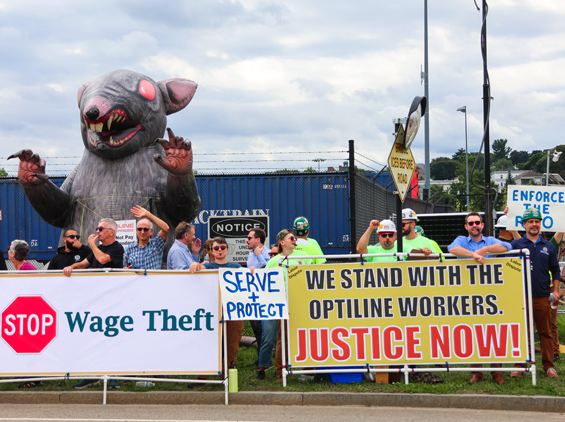
The dispute prompted Carpenters Local 336 to hold a rally calling for “justice for immigrant workers who were victims of wage theft and retaliation while working for Optiline,” according to the North Atlantic States Regional Council of Carpenters. Other groups, including the Worcester Community-Labor Coalition, released statements and promoted the rally, calling for the city to reinstate the ban on Optiline operating on taxpayer-funded projects in Worcester.
The situation also drew attention from Worcester’s faith communities. The Chaplains’ Office at the College of the Holy Cross became aware of the rally through Worcester Interfaith, a coalition of faith communities in the city.
“As members of Worcester Interfaith, the Chaplains’ Office at Holy Cross stands with other faith communities in the city to use our collective voice in calling for just solutions that serve the common good,” Marty Kelly, a Holy Cross chaplain, told the Spire.
Kelly said the treatment of the workers stands in contrast to Catholic teachings on “the dignity of work and the rights of workers.” For students looking to further their awareness of social justice issues and the treatment of immigrants, specifically within Jesuit teaching, Kelly recommends engaging in Pax Christi, a student group that meets Thursdays at 7 p.m. in Campion House.
The dispute connects a local labor issue to broader questions about workers’ rights, immigration, and the use of public tax incentives in Worcester. For Holy Cross students, it also provides an opportunity to consider how those issues intersect with the College’s emphasis on service, solidarity, and engagement with the Worcester community.
Optiline has not issued a public statement regarding the lawsuit or the current dispute. On Sept. 22, the City of Worcester released a statement reaffirming that Optiline remains ineligible to work on projects receiving tax relief from the city. The restriction does not prevent Optiline from operating in Worcester outside of projects subject to the city’s tax-relief requirements.
While the City’s statement on Optiline affirms that companies mistreating their workers will not receive benefits from the city, the dispute raises questions about how the city enforces its labor and development requirements when companies that are ineligible for certain city-supported projects are involved in those projects through contractors or developers.
Copy Edited by Josh Rosenburg ’29
Featured image courtesy of North Atlantic States Regional Council of Carpenters

Leave a Reply