Todd Rado ‘26
Opinions Editor
Earlier this year, a collective of the Holy Cross faculty passed a resolution calling on the college to disclose any potential holdings and divest from investments that could potentially contribute to military bloodshed in service of genocide — with not just a majority, but a supermajority of ~66%. Earlier this semester, students and faculty alike received the news that the Board of Trustees unilaterally rejected this resolution. Irrespective of your opinions on the accusations against the Israeli state, this should matter to you. The conclusion of this, not as a political body but as students, forces us to draw an extremely alarming, alienating, and opposed to the mission we are meant to embody.
To understand where this leaves us, it is first necessary to break down the Board’s “reasoning” for this rejection and the outstanding crises therein, which they made even clearer on November 7th during a virtual panel. For one, they state that investments and the endowment are, quote, “subject only to the control and direction of the board of trustees.” Further, the board goes on to say that they “possess no direct holdings to disclose.” Put simply, Alumni donations and the various monetary sources that go into the endowment are entrusted to the College, for them to invest that money into wherever they feel will turn a profit — irrespective of personal or moral concerns about where that money is going. How does this not conflict with investment policy rule IX? And if the College has no direct holdings, how does it profit from investments? To quote Rougeau in a previous address, “We address this challenge by working closely with Strategic Investment Group (SIG) to select fund managers who act as responsible stewards of our capital and engage in constructive dialogue with companies on matters related to a variety of environmental, social, and governance concerns.” It seems fair enough, until later in the address in which it is specifically mentioned that, “we cannot specify investment exclusions for fund managers, nor do we have the market influence to dictate specific holdings within commingled funds.” So, putting all of this in context, a rough model of what the college’s investment strategy looks like is: the college stays afloat by investing its endowment through SIG, which selects fund managers who invest money God knows where, and the college can’t ask, have any knowledge into this, or control what they invest in. Our only hope that fund managers “invest ethically” is, in essence, the college’s and SIG’s word.
Further, a quick look into SIG’s 2023 sustainability report reveals no on-the-ground information about holdings and investments beyond hollow promises of a commitment to ESG, of which only a third of asset managers remain “fully committed” — which are in themselves standards solely decided by SIG, with no disclosure when asked, on what those standards are. To directly quote the SIG spokesperson who addressed the college: “It’s a journey.” Picture, then, for a moment, the most repugnant group of people you can think of. Whether it be weapons manufacturers, or something else of the sort. The only guarantee the college isn’t directly funneling money into that industry amounts to a pinky promise from an institution that has absolutely no idea where its money is going, stacked on top of the hope that the completely invisible ethical standards set by SIG prevent that transfer, stacked on top of the hope that their asset managers care enough for that ruling to matter. If they invested money into that corporation, you would have no control over stopping it from occurring. To them, the movement away from that bloodthirsty industry amounts to a Lord of the Rings friendship narrative, if they even care enough to move away from that industry, which has not been demonstrated in word or in practice. The first conclusion, then, we are to take from this is that Rule IX of the college’s investment policy — should it continue in this direction — is that its investment ethics is held up by flimsy promises and mission statements Holy Cross has no genuine intention of upholding, of which you, reader, are a victim. And the college wants you to know this.
This, unfortunately, is far from the worst thing to come from the college’s statement. Within the same paragraph, they justify their decision by saying, “From a fiduciary standpoint, inviting members of our community to debate or negotiate particular investment decisions is inconsistent with the committee’s pledge to steward the endowment in a principled, fiscally responsible manner.” Really consider that for a moment. Per their direct admission, the college refuses to negotiate on any investment decision made, no matter how unethical, morally repugnant, or shady and secretive, because it conflicts with their principle of fiscal responsibility. Let’s return to that morally repugnant corporation you envisioned earlier. Say you wanted to speak out. The college would, in that case, truly like to emphasize to you just how little power you have. You have no platform on which to object, no power in which to debate, and not even do the faculty — the people who support Holy Cross on their backs — have any say. Your morals, even if they present not just a majority but a supermajority, come second to the college’s profit — if they even rank at all. You may not personally agree with the faculty’s stance on Israel, but what happens when an issue comes forth, and you do find yourself in the majority, and the college could very well be financially backing your opposition regardless of this? In that scenario, you will find yourself voiceless and unwittingly complicit in the thing you hope so desperately to oppose. In fact, there is a very real chance you are currently in that scenario right now, and just don’t know it yet, nor are you even allowed to know.
Asking an American educational institution not to run itself like a business and gamble with lives using our tuition money will not happen. That being said, I hope it is as broad as day that the college has precisely no genuine intention to uphold any ethical obligations and is flagrantly rejecting its own motto for the pursuit of profit. If it weren’t, it would care enough to know what its partners are investing in and have the decency to share that with the community that gives it that money, or better yet, remove itself from a scenario in which the college has no say on specific holdings, and invite the community to discuss what investment choices to avoid. Is that efficient? Probably not as much, compared to what the college is doing now. But it is the human choice. And if the Board is open and ready to admit they put profits over people, that’s fine. I’m sure they could find a way to use God’s tears to develop some free hydroelectric energy for us. It’d power the college for years.
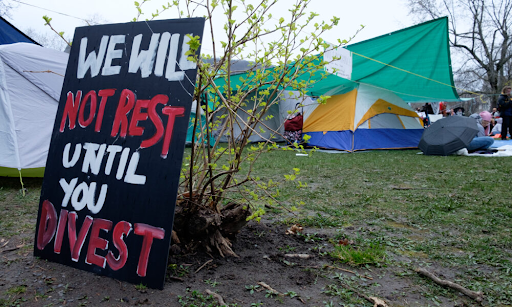
Jokes aside, however, this is where we, as students, come in. Not one of us can take this powerlessness sitting down, or else it will creep up on us, threaten us, and serve as an affront to our principles in ways we didn’t know possible, especially not from an institution that supposes itself a shining beacon of morality. “Men and women for and with others” will never come from the board. It has to come from us. Part of upholding the College’s mission means pressuring them into putting themselves in a situation where they can increase transparency about their holdings and, for once, make all of our principles their problem. We cannot stop, and we cannot rest.
Featured image courtesy of Google Images


Leave a Reply to AnonymousCancel reply