Lizzie Swanson ‘28
News Editor
It’s October 17 and France is burning. Nationwide demonstrations have been growing in size and extremity for the past month, resulting in the culmination of some of the worst violence France has seen in decades. According to Interior Minister Laurent Nunez, roughly 550,000 people protested, while the French General Confederation of Labor (CGT) estimates the number to be much higher at 800,000. With the French population hovering over 69 million, these numbers indicate that roughly 1percent of the population took to the streets, demanding a change in France’s political, education, and welfare systems. Several notable demonstrating groups include the General Confederation of Labour (CGT) and additional labor unions, the Yellow Vests (a populist grassroots movement), and collections of high school and university students. The unions are calling for higher wages while the Yellow Vests are advocating for the removal of President Emmanuel Macron, and students are demanding an increase to the education budget and improvement of school conditions. A number of other civil and social issues are also entangled in these protests which include, but are not limited to, police brutality, solidarity with Palestinian causes, high cost of living, and lack of infrastructure. Known for its constant and lively protest culture, France’s revolutionary history begins with the early overthrow of the government during the French Revolution in 1789. Since then, the French continue to demonstrate publicly on a massive scale, inspiring other countries in Europe to follow. October 17th, in particular, raised a flag for international news outlets which have highlighted the violence and looting that has occurred, especially in Paris. While most of the protests across the country were peaceful, agitation is beginning to intensify. Arson, looting, and physical violence have been met with police response of tear gas, stun grenades, and water hosing. Just a day before October 17, a 15-year-old boy’s hand was blown off after picking up a police stun grenade in northern France, making global news.
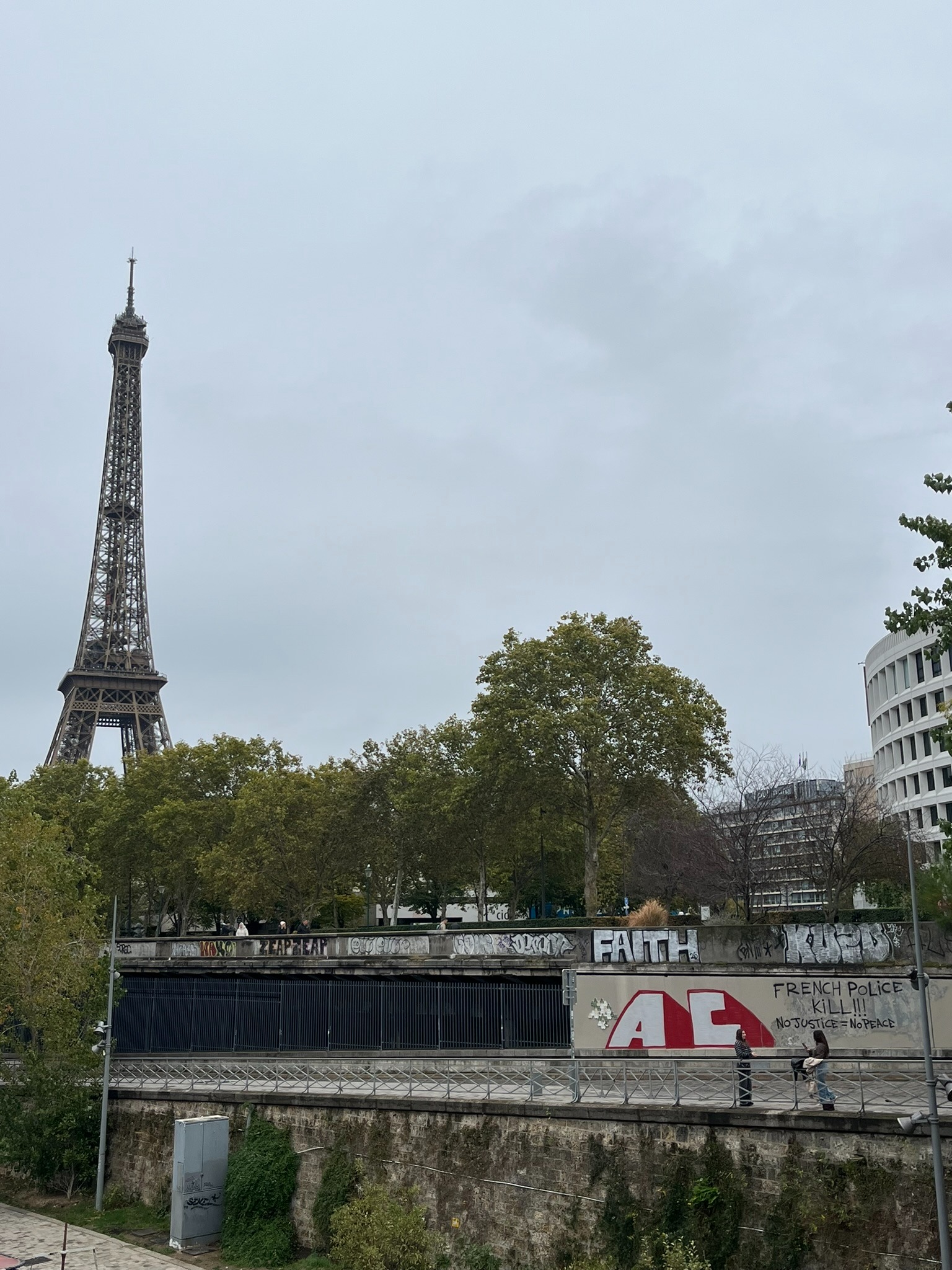
Protest routes, times, and dates are approved by the French government a few days before mass demonstrations take place as a way to acknowledge the protesters and alert the public. In the days leading up to what would be known as “Act II” I spent much of my free time on French forums, tracing the protest route, and reading the terms and conditions of my non-refundable flight to Paris. I had planned to meet Sophia Olbrysh ‘28 who is studying abroad in Strasbourg, France the following Thursday, just two days before Act II. We would be staying four days in Paris and were hoping to stay clear of the protests as much as possible. What I experienced upon arrival was the beauty of the city alongside the very present political action that had taken place. There are 20 arrondissements (or districts) within Paris, each with a unique feel and scenery. We had chosen accommodation in the 10th, which we would soon learn was a mistake. After two nights in the area, we made a switch to the 16th the morning of Act II. Our original accommodation was just a short walk away from the protest route where hundreds of thousands would take to the street and demonstrate.


Shops throughout the city in the days leading up to Saturday had boarded up their windows, preparing for potential looters, afraid of the violence that had ensued the previous week. As we navigated out of the tenth in the early morning of Act II, I was struck by the quiet tranquility tracing along the streets of Paris. Only a few short hours later, these streets would be filled with tear gas and water cannons. Military trucks drove by Sophia and me, passing boarded up stores which were miles away from the protest route; Paris was prepared in all corners of the city. On the day of Act II, we abandoned our original itinerary and laid low, avoiding the metro and checking the news for updates. While significantly less violent than the week before, over 100,000 protesters marched along the Paris route, demanding systemic changes within the French government. Casual encounters with French locals revealed the severity of the protests in comparison with other demonstrations in the last few years. One woman I spoke to said she had been “gassed a lot” although it was unclear if she had been actively demonstrating or simply existing and living in Paris. However, her parting words, relating to being gassed left an impact on me. “I feel like it’s just a part of being French.”


Olbrysh, a yearlong exchange student at Sciences Po Strasbourg, agreed to share her experience living and studying in France amidst the protests. Sciences Po is one of the leading universities in France for political science and as a result of the protests, had to resort to online classes for a month. It was only in the second week of November that the university decided to reopen indefinitely. Discussing the difference between the recent series of protests and past demonstrations, Olbrysh noted the speed at which the protests spread across the nation. She described the wave’s beginnings in education reform and its evolution toward various other causes, most notably anti-government and anti-fascism sentiments. These demonstrations, just a few short months away from France’s presidential election have elicited different kinds of protesting. “I have seen a lot of peaceful protests in Strasbourg of people just marching down the street, gathering in huge squares, chanting, and playing music.” Contrastingly, Olbrysh recalled one instance she had while working at a cafe, noting how suddenly the street outside became white with smoke. “I have seen a lot of tear gas. I’ve seen students throw firecrackers at police and police shooting tear gas down the street. I’ve seen garbage bins on fire. I’ve seen both peace and violence.”


Despite these experiences, Olbrysh emphasizes the importance of fact checking news sources and raises concerns about the media’s influence in fearmongering within France. Students across the country have criticized the media’s portrayal of the protests, noting that focusing too heavily on instances of violence and looting overshadows the originally peaceful demands of French students. While the violence of October 17 has not been repeated on the same scale since, protesters have continued to demonstrate throughout the nation, resulting in continued resistance, arrests, and plans for future protests. My trip to Paris and Strasbourg fell during a revolutionary time in the country’s history. As we traveled throughout the country, I would be lying if I said the political and social tensions did not feel high, especially to an American whose privilege and access to travel made engaging in tourism feel all the more dystopian. The country’s political landscape and beauty run in parallel with one another, making it difficult to ignore either. So while yes, parts of France are ‘burning’, so is the passion and culture of France’s rich history, unable to be extinguished by the risings of political turmoil.

Sources:
France-student-protests-arrests-injuries-school-closures
https://edition.cnn.com/2026/11/05/europe/french-protest-demonstration-latam-intl
https://www.todoalicante.es/english/acto-paris-from-police-20261024081054-nt.html
https://www.afp.com/en/clashes-paris-after-new-french-protests
Copy edited by Joshua Rosenberg ’29
Leave a Reply