Katherine Twombly ‘30
Staff Writer
On Friday, Sept. 18th, President Trump announced via a Truth Social post that he was immediately banning any reporters affiliated with CNN, Politico, or MS NOW from the White House. He cited their intentions to report fake news that gave deliberately negative coverage of him and his administration as justification for this ban. Once the reporters were found to have been denied access to the White House on Monday, Sept. 21st, the three media outlets filed a joint lawsuit against President Trump and other members of his administration for violating their First Amendment right to freedom of speech and a free press. What brought this event even more national attention was the choice by four other major television networks- ABC, CBS, Fox News, and NBC- to also pull coverage of the president until this was resolved.
This was particularly notable given the partisan range of these outlets. Fox News specifically is generally more likely to favor coverage that portrays the current party in power in a more positive manner. Their decision to join this boycott illustrated the true significance of the implication that any voices in conflict with the ideals of the administration should be silenced. It is noteworthy that there was a similar incident during President Trump’s first term in 2018, although on a smaller scale. The President attempted to revoke the credentials of CNN journalist Jim Acosta, but that was also eventually overruled by U.S. District Judge Timothy Kelly.
On the Thursday following the current ban, the same judge ruled in favor of the news outlets and ordered press access to be restored to the journalists. However, directly following the order, the administration still chose to restrict media access to certain events such as the state dinner that was attended by Chinese President Xi Jinping. Even in light of this, it seems as though normal coverage is continuing to resume across networks. Given the relatively brief upset of coverage, this event did not have a huge impact on public access to information; nonetheless, it must be acknowledged that if this were ruled to be constitutional, the entire system of public information would become skewed towards whichever party is currently in power. This was evidenced by the only coverage of the opening of the new White House helipad being livestreamed exclusively on the White House’s Video Feed. During the livestream, the President’s speech was inaudible due to the surrounding noise.
The scale of influence the President believed he had was also notable, as he believed this ban extended beyond the White House. On Tuesday, Sept. 22nd, the United Nations General Assembly commenced in New York City, and journalists from several of the banned news stations were granted access to the event by the United Nations itself. It was later discovered that President Trump was not aware of their invitation, and he told several reporters that they were not supposed to be there. What was particularly striking about this is that it seems to imply some desire by the administration to deny certain networks access to any significant event, which would deprive them of reporting ability, their national relevance, and their First Amendment rights.
Copy Edited by Claire Flynn ’29
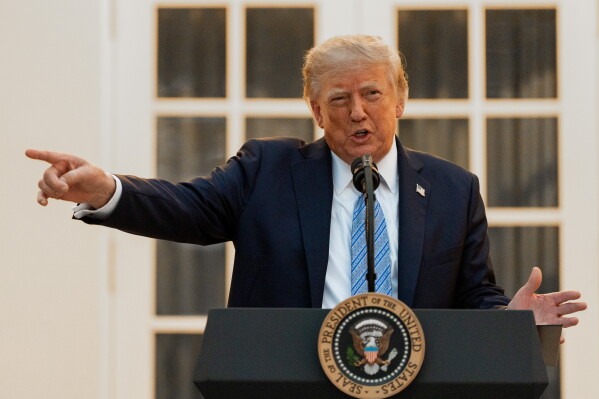
Featured image courtesy of AP News
Leave a Reply