Julia Kane ‘27
Opinions Editor
The United States is packed full of passionate sports fans: Philadelphia Eagles fans lighting the streets on fire and brawls between Knicks and Celtics fans. The country’s sporting scene is also notorious for being less involved in soccer, or football, which is the dominant sport in over 100 countries worldwide. To the surprise of the global sport’s fanbase, in 2018, the US, Canada, and Mexico won the bid at the 68th FIFA Congress in Moscow to host the 2026 World Cup. Despite most Americans having limited knowledge of the world of FIFA, I believe our hosting of the World Cup came at a time when the US needed it most: between hyperpolarization and rising xenophobic sentiment.
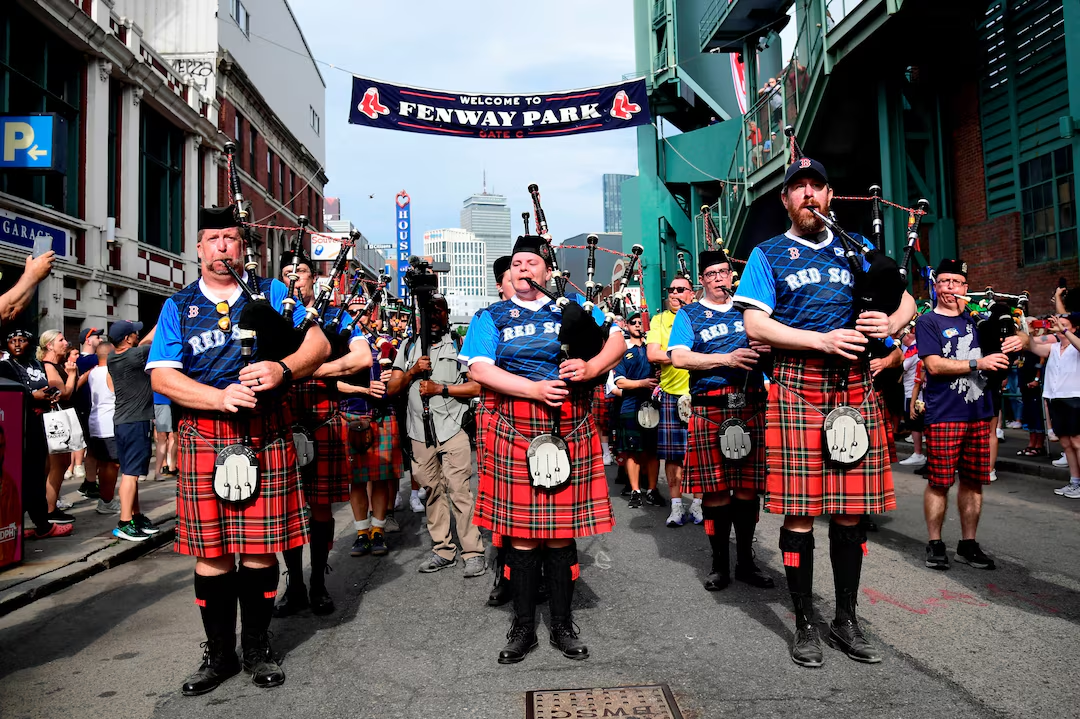
The tournament brought together 48 total teams, including the hosts, with their teams training at various training facilities throughout the country. Fans in Boston rushed to the Four Seasons Hotel, hosting players like Kylian Mbappé and Ousmane Dembélé, hoping to get a glimpse of the French team’s stars. Boston, along with other major cities across the US, also served as a temporary home to thousands of fans from their respective countries. Especially upon the arrival of the Scottish fans, also known as the Tartan army, Boston’s sleepy nightlife transformed into a hub for meeting people and hearing the sound of bagpipes. As I followed the tournament, I too found myself wanting to attend watch parties on outdoor screens on the Boston Common, where thousands of viewers gathered to watch the biggest games. I met people who had traveled from Brazil, Haiti, Scotland, and France, among other countries, which fostered an environment of many languages, cultures, and camaraderie.
This event was, however, inherently political, as President Trump has referred to countries like Haiti as “hellhole countries” that are “filthy and ridden with crime” in the past. As many regard today as an increasingly divisive and politically tense time for the US, having people from all over the world visit the US for the World Cup and bond over soccer was something beautiful. People shared politics, traditions, and opinions, fostered by soccer in a country that has never been very involved in FIFA. As ICE seeks to remove immigrants from the country, I believe this summer’s World Cup was a necessary reminder that the US is a blend of many ethnicities and cultures. From what I witnessed in Boston, the tournament was a moment of respite for the US, becoming a place where visitors from all over the world were celebrated rather than seen as outsiders. It was a time of patriotism while supporting the US Men’s National Team as they competed, but also for Americans to root for other teams and countries while getting to know their stories. After the World Cup ended, its absence was felt. Politically, I hope that people can carry the experiences of making friends and sharing stories during the tournament into the way they view non-Americans and immigration. Most of all, the unity brought to the US during the World Cup was incredible, especially given how fragmented the country can seem in its polarity. I look forward to the 2030 World Cup, and hope that soccer will play a bigger role in the US sporting world in the coming years.
Image courtesy of Reuters
Leave a Reply