Lars-Belvin Larsson ’26
Opinions Editor
At the behest of President Trump’s highly polarizing foreign policy approach, traditional U.S. allies are distancing themselves. Someone well-versed in the matter is the hawkish former National Security Advisor John Bolton, who served a brief tenure during President Trump’s first term. Bolton remains a strong supporter of backing U.S. interests overseas, but questions Trump’s strategy, arguing it is transactional and overlooks the complexities of the world. Arguably, Bolton is correct; nearly every action abroad that the President has taken has run contrary to U.S. interests, and his strategy has encouraged allies to reevaluate their engagements with the United States.
In an article analyzing Politico polls, the majority of respondents from traditionally allied countries preferred relations with China over the Trump administration. While the polls do not imply that China has become a more reliable partner, they suggest that the U.S.’s current predatory and unpredictable behavior has strained relations with our partners. European foreign policy also mirrors the polls, shown in the EU’s pragmatic approach to reducing friction over electric-vehicle disputes.
More than a shift towards China, Europe has also worked on becoming an increasingly central hub for commerce. In early 2026, the EU-Mercosur Partnership Agreement took shape, establishing a free-trade zone covering 90 percent of goods between Europe and South American partners. Contrary to Trump’s concessionary tactics, this agreement aims to achieve mutually beneficial terms by eliminating trade barriers. This trade agreement is no accident; it follows a barrage of threats from President Trump, including invading Greenland, and raising tariffs on EU partners — something SCOTUS ruled against in February. Canada has also responded, with Prime Minister Carney seeking to reduce U.S. reliance by implementing a “Buy Canadian” defense strategy. Evidently, countries are losing the will to collaborate with the U.S., given Trump’s unpredictability, and the future of U.S. dominance remains uncertain if his tactics persist.
The elephant in the room is the convoluted war of choice in Iran, which underscores the President’s shortsighted foreign policy strategy. Although the President announced a two-week ceasefire on April 7, his word has lost credibility, and bombing campaigns will likely persist. Critics of the conflict recognize the brutality of the Iranian regime, but they also acknowledge the incoherent and ill-prepared nature of the U.S.-Israeli onslaught. Secretary of Defense Pete Hegseth alluded to this in a press conference, claiming that the Department of Defense did not anticipate the extent of the Iranian response. The closure of the Strait of Hormuz has disrupted global supply chains for fertilizer and 20 percent of the world’s oil transit, a possibility Trump may have simply neglected. Moreover, Iran continues to target critical water desalination infrastructure among U.S. allies in the Middle East. The President has voiced his dissatisfaction with NATO’s hesitation to join the war and secure the Strait, claiming, “they should be jumping to help us” during a press conference on March 16, but allies feel no inclination to participate. Perhaps representing the global opinion, President Macron called on Trump to be serious, emphasizing that war is not a reality TV show.
In an attempt to alleviate market strains, the U.S. employed the deplorable decision to lift sanctions on Russian oil. Obviously, this carries a plethora of implications for the international community, including the disruption of coordinated pressure on Russia and the undermining of years of Ukrainian support. It also exacerbates efforts to curb Russia’s invasion of Ukraine by funding Russia and its military operations. Although Treasury Secretary Scott Bessent confirmed that the enabling sanction waiver is temporary, damage has already been inflicted on Ukraine and the EU. The President also lifted sanctions on some Iranian oil, another bid to prevent further economic collapse and rising gas prices.
Few signs allude to a fail-safe exit strategy in the Middle East. Some maintain that Trump was encouraged to engage militarily in Iran following the January 2026 operation in Venezuela, assuming that Operation Epic Fury would yield the same quick success. While the underlying motivations are plausible, swift success has become far-fetched, and prolonged entrenchment looms large. First, the Iranian regime structure remains intact, and the late Supreme Leader Ali Khamenei was replaced by his son, Mojtaba Khamenei. Second, pulling out of Iran on a whim will lead to a severely destabilized Middle East with the potential for residual conflicts. Third, as mentioned, allies are hesitant to support the conflict. Many European states are reluctant to enter the war, given uncertain strategic goals and other foreign policy priorities, echoing idioms like “you made your bed, now lie in it.” The U.S. underestimated Iran’s resolve, potentially leading to a quagmire and continued alienation from traditional allies, much to Bolton’s chagrin. The war is hurting our allies, making countries see the U.S. not as an adversary, but more like a toddler throwing a tantrum — something to avoid at all costs.
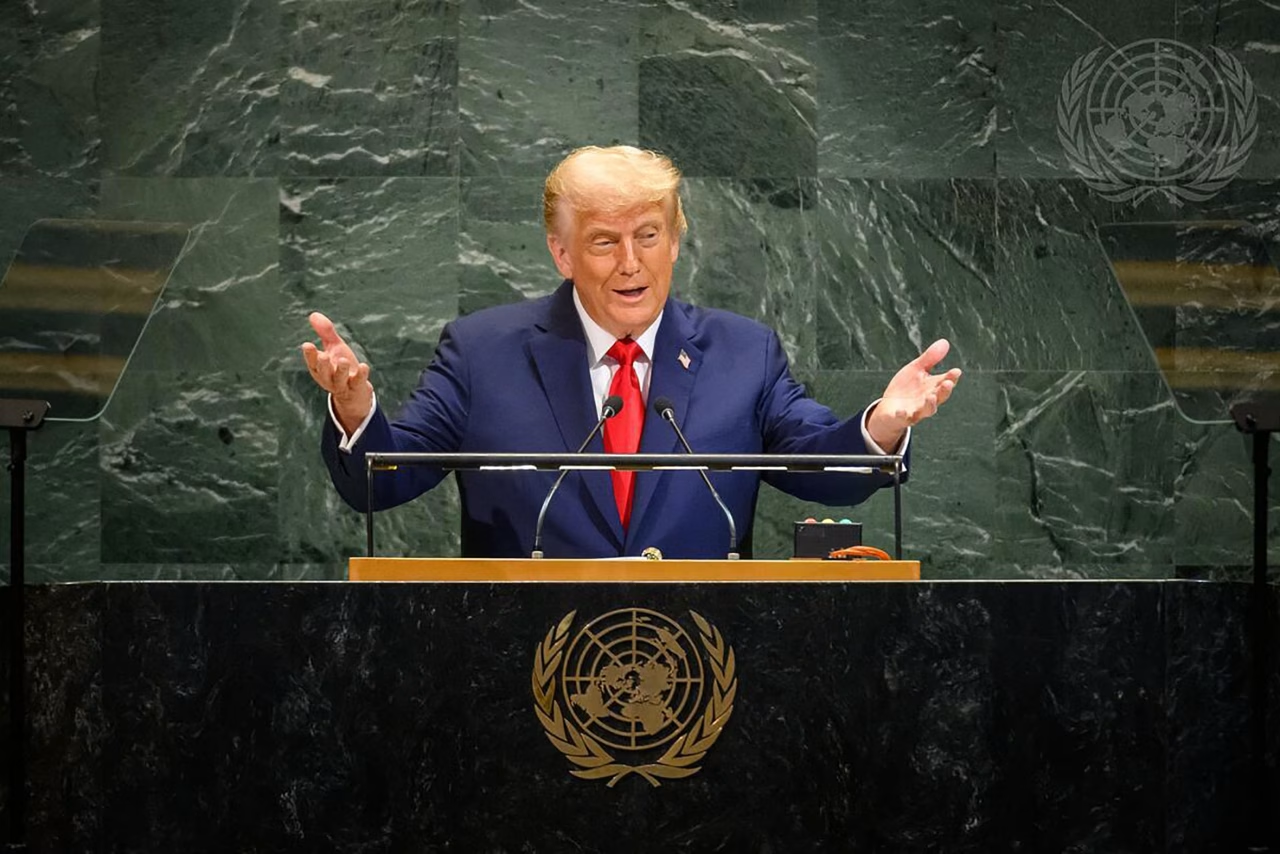
Featured image courtesy of The Wall Street Journal


Leave a Reply