Kate Santini ‘27
News Editor
Provenance analyst specialist at the Worcester Art Museum (WAM), Daniel Healey, gave a lecture titled “Orphaned Antiquities & Cold Case Files – Investigating Provenance in the New Era of Museum Restitution” on Feb. 9 in Rehm Library. Sponsored by the Archaeological Institute of America (AIA) under the Clarence and Anne Dillon Dunwalke Lecture fund, the lecture dove into the legal implications behind art collecting. As North America’s largest archaeological association, the AIA advocates for federal funding and conducts outreach for local art history projects. At the beginning of the talk, all students in attendance were given the opportunity to enter into a raffle to win a free subscription to the AIA magazine.
Healey began by discussing the highlights of his career at the District’s Attorney County of New York where he worked as an antiquities traffic analyst in the New York Antiquities Trafficking Unit (ATU) for ten years. He jokingly referred to himself as an “art detective” which he argued has “ceased to be a metaphor” because antiquities analysts are increasingly required to conduct full throttle investigations and make arrests. At the ATU, Healey was in the business of investigating, seizing, and repatriating stolen antiquities that have been “looted from the ground and/or smuggled.” According to Healey, the ATU has uncovered and reattributed over 6,000 antiquities to 29 different countries.
In the art world, antiquities without records of archaeological origins are often described as being “orphaned.” The term “provenance” refers to “artwork’s history of ownership” which “begins at [the] moment of discovery” or of its excavation. He explained that most antiquities do not have “complete provenance” due to large gaps in documented ownership and unclear understandings of when objects were taken from the ground. While provenance specialists might not be able to fully uncover the journey an antiquity endured up to its present state, they still attempt to “right the wrongs” of the past by sending them back to their paternal countries.
At the outset of the lecture, Healey established that the only cases he is legally allowed to discuss are those featured in New York Times headlines. That being said, he shared some of the most notable and high-profile cases he worked on at the DA’s office. He learned how to identify “red flag” dealers notorious for forging antiquities and orchestrating unethical purchases. At one point, the ATU received “tips on a dealer in mid-Manhattan” who made thousands of dollars selling forged antiquities out of a makeshift workshop. He would buy replicas of ancient objects from souvenir vendors in cities like “Cairo or Istanbul” and repurpose them to con naive buyers. Healey and his team raided the fraudulent dealer’s gallery and arrested him, putting him out of business for good. Healey also played a key role in investigating the infamous Shelby White, lifelong investor and board member at the Metropolitan Museum of Art, who maintained “one of the largest [persona] collections in antiquity.”
He described Shelby as “very glamorous” and “nice enough.”
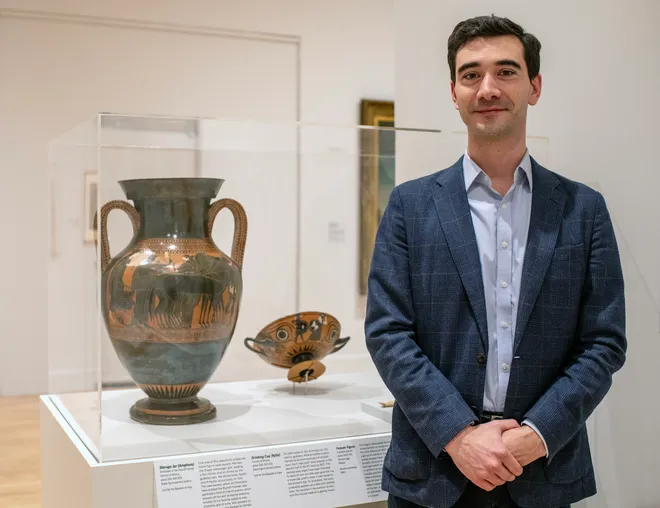
He then shifted to discuss his career at the Worcester Art Museum (WAM) where he is currently employed as a provenance research specialist. Although his research at the WAM is similar to his research at the DA’s office, he now works alongside museums to repatriate stolen art. He explained that museums have begun designing “positions to do provenance research” to be “proactive” and avoid facing art seizures. Just recently, Healey orchestrated the WAM’s return of two ancient vessels to Italy. Because the WAM took the initiative to come forward and negotiate with the country, “Italy was very grateful and cooperative.” Italy expressed gratitude toward the museum by granting it the opportunity to keep the vessels on loan for 8 years and promising to donate other antiquities in the future.
Healey concluded that proactive interactions between museums and countries of provenance reflect “shifting standards of equitable collection.” Most museums abide by UNESCO’s 1970 benchmark for equitably owning antiquities, meaning that any object acquired by the museum after this date is subject to investigation and repatriation. Healey noted that this benchmark is becoming increasingly arbitrary. In reality, ethical acquisition varies depending on a country’s laws. For example, Turkey passed a law in 1906 that declared the government is entitled to all antiquities still in Turkish soil. This means that any Turkish artwork acquired after 1906 by a museum is worthy of investigation.
During the Q&A section of the talk, Healey addressed the misconception that museums are “dens of thieves.” He emphasized the importance of not dwelling on past injustices but instead, “moving forward” and “righting wrongs.” Evan Garcia ‘26, who is currently taking his first art history class at Holy Cross, felt that “the talk opened [his] eyes to the nuances of provenance research” and especially “appreciated the speaker’s many personal anecdotes as an ‘art detective.’” Garcia concluded that, “as someone interested in both international relations and law, I enjoyed seeing how all of these fields intersected around ownership and provenance questions” and that he “will definitely be a more informed visitor the next time [he goes] to an art gallery or museum.”
Featured image courtesy of Telegram
Copy edited by Molly Croft ‘29
Leave a Reply