Aiden Konold ’26
Chief Sports Editor
On the evening of December 14, 2024, nearly 2.5 million football fans sank into their living room couches, crowded around their televisions, and tuned into ESPN to watch college football’s Heisman Trophy presentation. Each year, the Heisman Trophy presentation tends to be one of the most highly anticipated events in all of college football. And each year brings something different. In a time of constant fluctuation, a period in which NIL and the transfer portal has drastically altered how the college athletics landscape operates, the 2024 Heisman Trophy ceremony stood apart.
This night, at the Jazz at Lincoln Center’s Appel Room located on 10 Columbus Circle in New York City, the cameras shone bright in the faces of Boise State running back Ashton Jeanty, Oregon quarterback Dillon Gabriel, Miami quarterback Cam Ward, and Colorado two-way player Travis Hunter. Only one of these four Heisman finalists, Ashton Jeanty, remained at one school for the duration of his collegiate career, a sign of the change being brought about in college football.
As the clock ticked down closer to 9 p.m., when the 2024 Heisman Trophy winner was to be announced, Travis Hunter, college football’s jackknife, a player former All-Pro NFL quarterback Michael Vick nicknamed “Mr. Do It All,” waited for his name to be called. With his coach in attendance, shortly after 9 p.m. Eastern Time (ET), Hunter was called to the stage to accept his award.
With changes taking college football by storm, Hunter had a historic season. Over the course of his three seasons, his first at Jackson State and his next two at Colorado, Hunter excelled on both sides of the ball. In 25 games played, Hunter hauled in 171 catches for over 2,000 yards and 24 touchdowns and another on the ground. Defensively, Hunter recorded 85 tackles, 24 passes defensed, 9 interceptions, and a touchdown.
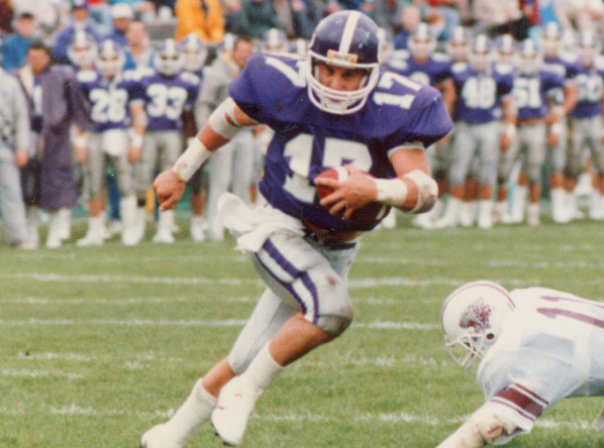
But over 40 years ago, in the small college town of Worcester, Mass., there was another two-way player named Gordie Lockbaum. His face graced the cover of Sports Illustrated, he maintained a 3.0+ GPA, and he became the first non-FBS football player to finish top-five in Heisman Trophy voting. In fact, he finished top-five in back-to-back seasons.
Longtime sports writer Rick Reilly profiled Gordie for Sports Illustrated, but he first had to go through Gregg Burke, the Holy Cross Sports Information Director at the time. When Reilly came to Holy Cross to speak with Gordie, he had to make sure that his interviews did not interfere with Gordie’s rigorous class schedule.
In his four years on the Hill as a student-athlete at Holy Cross, Gordie accomplished feats that even NFL greats could not accomplish. In his junior and senior seasons at Holy Cross, Gordie finished fifth and third, respectively, in Heisman Trophy voting at the Division I-AA level. He finished higher than outstanding FCS players Jerry Rice and Steve McNair, who went on to have highly successful NFL careers.
During his final two seasons at Holy Cross, Gordie’s face filled the pages of magazines such as Sports Illustrated and People, and he was featured in a segment for The Today Show on Holy Cross’s campus. But before all the spotlight shone on Gordie’s face, his story began in the town of Glassboro, NJ. He was one of seven growing up, and large families surrounded his childhood home.
Across the street from the Lockbaums lived four kids. Diagonally behind the Lockbaums was a family with three kids. Children were always running around this Glassboro neighborhood, and Gordie always played up with some of the older kids. Gordie’s early experiences playing with kids several years older than him toughened him up.
Through high school, in contrast to many athletes today, Gordie never specialized in one sport. Though he ultimately decided to pursue football exclusively at the collegiate level, he grew up during a time when it was common for the best athletes to pursue multiple sports.
He joined in on neighborhood games of baseball, basketball, wiffle ball, and even street hockey. With his friends, Gordie pretended he was in the Olympics and raced them down the street. Once he was old enough, Gordie joined local recreational baseball, basketball, football, and wrestling leagues.
Gordie’s appreciation for playing multiple sports was instilled by his parents, who required each of their seven children to play three sports during the calendar year. At eight years old, Gordie could be spotted sparring on the wrestling mat. Gordie loved the sport so much that he later coached it at Worcester Academy.
“I was good at all sports,” Gordie says. “So as I grew up, my parents required that we play three sports. They wanted to keep us busy, keep us active and hopefully tire us out by the end of the day.”
Despite their best efforts, however, Gordie’s parents never seemed to run him down. And it paid off years later when he went on to play against Army, and stayed on the field for an astonishing 153 snaps of a 170 total plays.
The discipline Gordie’s parents instilled in him in athletics translated to the classroom. When Gordie started playing sports, he was reminded by his parents that his success could translate to receiving a college education for a fraction of the cost. But he had to perform well in school, too.
In the Lockbaum household, Gordie’s parents taught him and his siblings to take their academics just as seriously as athletics. It’s in part what led Gordie to later decide to attend Holy Cross when other bigger time programs recruited him. He appreciated the beautiful campus, but even more so, he loved the balance Holy Cross struck between academics and athletics.
“I was very competitive,” Gordie says. “I always wanted to be at the top or near the top of my class, so I worked really hard at school, and sought to get the best grades possible from a very young age. I never wanted to get behind anyone else, and I think that came from my competitiveness on the athletic field.”
As Gordie elaborated over Zoom about how being a good student and his appreciation for academics as well as athletics made for a more well-rounded childhood, he thought about how playing multiple sports growing up boosted his endurance.
“That gives you longevity,” Gordie reflects. “I see a lot of situations where kids are playing a single sport year round, and they get burnt out or they have muscle injuries, or they get hurt because they’re just doing the same thing over and over and over again. And I just don’t think that’s a good idea.”
Gordie was cut from a far different cloth than many of today’s athletes. Today, athletes specialize far earlier, some as early as eight years old, as parents try to push their kids towards earning athletic scholarships at some of the nation’s best athletic colleges. With increasing NIL deals being granted today to “student-athletes” in which college programs are paying athletes as extreme as upwards of $4 million in the case of Carson Beck, parents push their kids in an effort to rake in the cash, Now, money is a primary recruiting tool, and heavily benefits the athletic programs with the largest budgets.
At the time Gordie was recruited, however, a college scholarship was the recruiting tool. It was important for him to go to a program where he would be able to make an impact on the football field, sure, but he also wanted to set himself up for life after football. He had plans of playing football beyond college, but he also knew that no matter when his football career ended, it would end at some point. And he wanted to be ready for that moment. He knew that by attending Holy Cross over some of the better athletics schools but lesser academic ones, he would be ready for that next step.
But first, before taking the next step in his career progression, Gordie focused on the next step in his athletic journey. And he was ready for it, thanks in large part to his parents, but also the community in which he grew up.
Glassboro, NJ, Gordie’s hometown, had a “very strong athletic tradition” during his childhood.
“When I hit high school, I had some very good coaching,” Gordie says.
Glassboro prepared Gordie well for the next step; the high school he attended now boasts NFL players like Corey Clement and Juwan Johnson. Gary Brackett, who won a Super Bowl with the Indianapolis Colts, is also a Glassboro High alum.
Glassboro is a town fixated on sports, which suited Gordie well. He was wired in the same way as the town in which he grew up. It was all sports, all the time. And Gordie loved it, despite being undersized.
“Once I got to high school, things started taking off,” Gordie says. ”I’m one of the guys that was a captain or a leader on the various teams, and we had a lot of success.”
During Gordie’s sophomore and senior years, his Glassboro High School football team won the South Jersey championship. Being the athlete he was, Gordie found success in each of the sports he played.
“I considered wrestling, I considered baseball, but football seemed to be my ticket to a scholarship,” Gordie says. “Again, growing up in a small town and [coming from] a big family, I was second to the oldest. There wasn’t a lot of money that was set aside for my college education.”
Gordie’s father made it very clear to his son that athletics was his path towards a scholarship.
“Here you have a[n] athletic gift,” Gordie’s father would tell him. “I think you need to work hard at it, and have some college pay for your tuition and your room and board.”
As Gordie reflects on his recruitment process, he comments on how different it is from today’s world in college recruitment.
“Back in the day, college coaches would come, look at you, and they got to know you pretty well,” Gordie reflects. “They’d watch you play football, of course, but they’d also come watch you [play] other sports. They’d come [to] visit your house a lot.”
“The recruiting process was a lot longer and a lot more personal [than] nowadays, with all the social media and everything else, and the rankings and the Internet and social media,” Gordie continued. “As I mentioned, there’s just a lot of information out there. Back then, coaches had to kind of get to know you and get to know your family, and whether or not they could trust you, and whether or not they wanted you to be part of their program.”
All the intangibles that today matter far less than a player’s natural abilities or stat lines. Gordie’s combination of both the intangibles and his success on both sides of the ball made him a sought after recruit, but to this day, he refers to himself as a “bubble recruit.”
Though recruited by schools all across the country, including FBS programs Penn State, Rutgers, Temple, the U.S. Naval Academy, the U.S. Military Academy, and Syracuse, Gordie decided to build a 350 mile radius around Glassboro. Several Division 1-AA schools, including William and Mary and the ultimate winner in Holy Cross, also took a look at Gordie.
“I kept all the schools within that range because I wanted to be close enough to home, so my parents could see me, and I could stay connected to my family,” Gordie says.
He didn’t want to go too far outside of that box, if at all. The blend of schools Gordie had the opportunity to choose from made the recruitment process all the more difficult, but his decision ultimately came down to Holy Cross and Syracuse.
When Gordie pulled up the Hill with his parents to take a look at Holy Cross, he was struck by the campus’s beauty, though the training facilities that he first saw were underwhelming. But, despite the poor facilities, Holy Cross remained atop Gordie’s list.
“I thought it was [the] whole package,” Gordie says of his initial reaction to Holy Cross. “They had great academics, [a] wonderful coaching staff, and seemed to be on the way up.”
And he noticed the camaraderie of the football team on his visit. The social aspect just added to all the other qualities Gordie admired about Holy Cross.
When Gordie came to Holy Cross for his visit, he instantly noticed the great bond that the football players had with each other.
“It transcended beyond just the football field to the general student body and people that were walking around campus,” Gordie says. “You could just see the friendships, how deep they were, how genuine they were, and that really spoke to me.”
Featured image courtesy of Holy Cross Magazine

Leave a Reply