Tucker Scott ’26
Opinions Editor
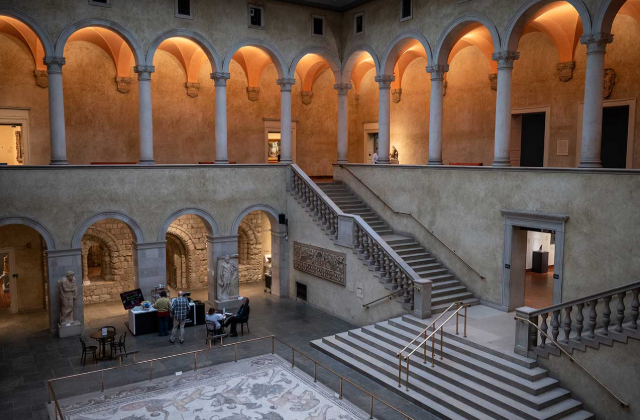
The Worcester Art Museum, otherwise known as the WAM, houses nearly 40,000 works of art across time periods covering all of the world. The museum opened in 1898 and, since 2013 after acquiring the John Woodman Higgins Armory Collection, is now home to the second largest collection of arms and armor in the Americas.
The John Woodman Higgins Armory Collection was open to the public in 1931 and remained open until December 31, 2013. The main reason the Higgins collection had to sell was two fold. First were largely financial concerns, especially following the 2008 financial crash the museum simply did not have the profits to remain open and continue upkeep on the armor. The other reason that Higgins eventually sold was because the buildings they were in did not have temperature control. This led to rust developing on some of the armors and weapons which was an incredibly expensive and technical process to have undone.
However just because the Higgins Armory Collection was transferred to the Worcester Art Museum does not mean that the family-friendly atmosphere has been eradicated or replaced. In fact, it was quite the opposite. Higgins Curator of Arms and Armor and Medieval Art, Jeffrey Forgeng hoped that they were able to recreate the atmosphere that had brought families in for generations. He said, “If we got it right, those who used to go to the Higgins armory (there were generations of people who went as little kids and then with their own kids) will return.”
Forgeng described the process of this curation as intricate and meticulous. “So basically when a collection, a non-profit is dissolved, or integrated in another one you have to define your priorities and hold them… it’s basically a contract, and that contract is with the attorney general of our state [Massachusetts]. It requires board votes and a lot of administrative steps. And we determined there were certain priorities we shared. Number one, we wanted the collection to stay together. Number two we wanted the collection to stay in Worcester, not going to another state, another museum, another city. Number three, and I was also very much behind it, that the spirit of the Higgins comes to the Worcester Art Museum and transforms us. Then we were bound to certain covenants, to fulfill certain conditions. For example, we needed to make sure there was a space of at least 4000 square feet to show the collection.” Forgeng continued to describe the worry and concern that the museum would not showcase the collection. These fears were remedied by creating a 5,000+ gallery instead of the initial 4,000+. “On the basis of that the board voted to dissolve and become part of the museum, the attorney general agreed… January 1st we had the entire collection with us.”
Jeffrey Forgeng went on to describe the process of getting the armor into the exhibit, “Our staff needed to figure out where does this collection even go… our registrar knew about a good system of compact storage, like in libraries. We could put the entire collection in one space but we also wanted to keep the spirit alive. For that reason we set up shows. The first was knights, the second was samurai and we sprinkled the suits of armor across our collection of antiquities.”
In the display you can absolutely see the Higgins inspiration. The exhibit has a section full of books and toys that small children can enjoy. There are also plenty of interactive tablets that describe the tale of each weapon or armor that it is connected to. All the armor and weapons are organized in a way that you can clearly tell the distinct era or geographical location they came from. One could spend hours in this exhibit and never be bored. It is clear that a lot of heart went into this exhibit and that this creation is not merely meant to be looked at in a museum but truly enjoyed and experienced by families.
When asked what he hoped visitors would take away from this exhibit, Forgeng responded, “There’s so many things. But if you want something in a nutshell, what this collection really does, I mean it’s basically the shape of human bodies. It reflects our humanity in all the complexity. The need to boast. The need to dominate. The need to protect ourselves or others. But the fascination that people have with arms and armor is not only because we see ourselves mirrored but it represents community in an interesting way.” Clearly, through this exhibit, the museum is trying to evoke a sense of both commonality and uniqueness in humanity and the human experience. This exhibit will open its doors on Saturday, November 22nd. All are encouraged to attend and experience the wonder of the armory for themselves.
Featured image courtesy of the Worcester Art Museum
Copy Edited by Charlotte Collins ’26

Leave a Reply