Brigid O’Malley ‘29
News Editor
The theater lights dim, and the stage lights up purple. The singer begins her song, not in English, but in Hindi. Guitar follows, cutting through the melody, and as the singer’s line fades, the drums swing in and the bass takes over.
Then the guitarist steps forward:
Peaches in the summertime, apples in the fall.
If I can’t have the one I love, I don’t want none at all.
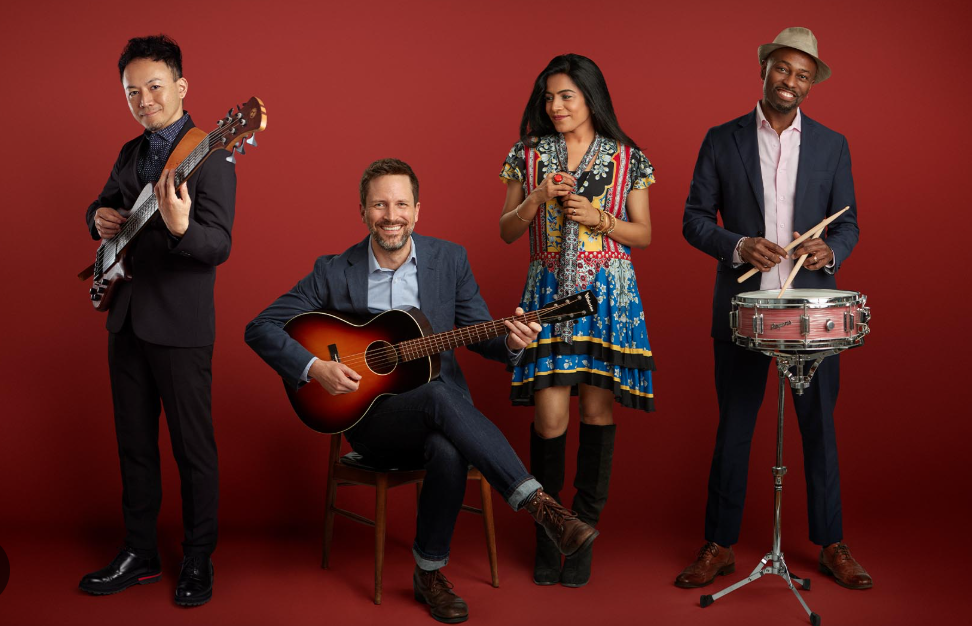
The song is “Shady Grove,” an American folk standard with roots in the early 18th century. Carried to Appalachia by Scottish and Irish immigrants, revived in the bluegrass movement of the 1920s, and sung by Jean Ritchie on Pete Seeger’s show in 1966, it’s a true piece of American folk history. It’s fitting, then, that the American Patchwork Quartet, GRAMMY-nominated for their self-titled record, opened their set with it; a song shaped by the immigrant influences that built American folk. “Folk music,” said Clay Ross, APQ’s founder and guitarist, “is about the American experience, but also the immigrant experience.”
Ross, a South Carolina native who grew up around Gullah Geechee communities, is a two-time GRAMMY winner and lifelong student of folk traditions. He’s fascinated by the genre’s “floating lyrics,” lines that drift from one song to another over generations, resurfacing in new contexts. APQ takes that idea of shared heritage and pushes it forward by blending tradition with the individual backgrounds of each member to create a folk evolution that is unmistakably modern and identifiable.
After a fiery rendition of “Cuckoo Bird,” the lights fade to red and drummer Clarence Penn steps up to tell the story of how he and Ross met on a flight to New York. “A couple weeks later he calls me,” Penn says. “‘I want to put together a band… folk music.’ I said, ‘Clay, I’m from Detroit.’” Penn, a renowned jazz drummer who has taught and performed at Carnegie Hall, Stanford Jazz Workshop, and Jazz at Lincoln Center, brings a dramatic, dynamic musicality through his drumlines.
Bassist Yasushi Nakamura, also a jazz musician, adds more to this complexity. Born in Tokyo and raised in the U.S. from age nine, he picked up bass in his teens before studying at Berklee College of Music. His ability to slide effortlessly through intricate bass lines elevates the group’s arrangements, collaborating with Penn’s drums to create a structural richness beneath these simple ballads. This blend of jazz and folk, once an unlikely and even unwelcome pairing, becomes APQ’s backbone.
Now, the light is blue, and the singer, Falu Shah, begins the song “Eastbound.” The song is made up entirely of Indian solfege, the Indian “do-re-mi-fa-so-la-ti-do” that instead reads “sa-re-ga-ma-pa-dha-ni-sa.” She asks the audience for call and response, calling out melodic syllables, and teaching the crowd to sing in Indian melodic scale. This call-and-response is reminiscent of early folk traditions, arising from African American communities in the South, and again reapplied by the Quartet.
Reinterpretation has always been the heart of folk music, and APQ leans into that legacy. Shah, a GRAMMY-winning, classically trained Indian vocalist, is the group’s most distinctive asset. Singing centuries-old American songs in the Indian vocal tradition, she reshapes the familiar into something refreshingly new. Speaking about bringing raga into the group, she said, “I brought this to APQ. This is my little contribution.” Hearing the Quartet perform, it’s clear that this contribution defines the entire ensemble.
The band sang a variety of folk songs, including “High on the Mountain” by Ola Belle Reed and “Jubilee” by Jean Ritchies, as well as traditional songs “Ninety-nine and ninety,” “Shenandoah,” and “Mr. Rabbit.” Before singing their final song, a rendition of Skip James’s “I’m so Glad,” Clay shared the meaning behind APQ’s project: “It’s our American music, all of our American music. And it’s not about where these songs came from, but it’s about where they can go when we share them like this. Thank you for helping us share this music.”
The American Patchwork Quartet: a group combining bluegrass, jazz, and Hindustani influences to redefine the traditional folk sound. They show that the story of American folk has always been one of diverse communities coming together to redefine a sound.
Featured image courtesy of the Prior Performing Arts Center
Copy Edited by Charlotte Collins ’26

Leave a Reply