Bryce Maloney ‘26
Senior Advisor
I met Dr. Christina An at the Prior Performing Arts Center on a cold drizzly Monday morning. At the top of the building’s impressive stand-alone staircase, I met the gaze of the new Assistant Director of the Cantor Gallery for Education and Engagement. With a distressed yet determined look on her face, she stood among a group of firefighters as they reassured a student who, as I would later find out, had fainted during her class tour. For many, the drama of such a moment might have been a deterrent. For Dr. An, it appeared as though the show had to go on…
Meeting with her no more than fifteen minutes after the fact, you would have hardly believed anything at all had gone wrong. As I walked into her neatly decorated office, with lofty ceilings and sleek white walls, I began to see a pattern. New to the Worcester and Holy Cross community, Dr. An presented herself as eager to learn more and dedicated to building relationships within her new surroundings.
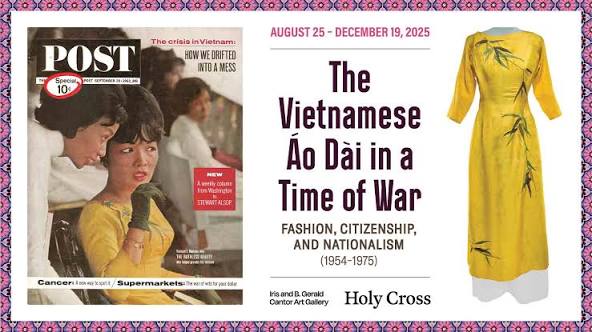
Our meeting had been tentatively on the docket for about a week, in hopes of discussing the recent “Living Threads” event I had attended surrounding the Cantor Gallery’s latest exhibit, entitled ‘The Vietnamese Áo Dài in a Time of War; Fashion, Citizenship, and Nationalism (1954 –1975).’
The exhibit explores the adaptation of Vietnam’s national costume, the Áo Dài, through two of the country’s most influential first ladies. The outfit itself is gender neutral, and consists of a long split tunic, styled alongside a pair of black or white (although traditionally black) silk pants. Upon entering the gallery, viewers are invited to take in the scandalous elegance personified by the late Trần Lệ Xuân, South Vietnam’s de facto First Lady from 1955-1963, known to many in the West as “Madam Nhu.” With the ruthlessness of Imelda Marcos, the glamour of Eva Perón, and a public perception not dissimilar to that of Hillary Clinton, she was a diva with a spirit as unbreakable as the bamboo she so often wore. Dr. An would later tell me this was a telling epitaph of her role: a Confucian symbol of resilience and leadership typically associated with male scholars. Then, you find yourself pulled into the more traditional elegance displayed by Nguyễn Thị Mai Anh, the country’s second first lady, who served during her husband’s tenure from 1967-1975. Her use of imported silk and understated colors point to the precarious nature of South Vietnam’s political situation during her tenure.
In an effort to prove that “Communists care about fashion” too, the exhibit’s curatorial team, led by Professors Ann Marie Leshkowich of the College of the Holy Cross, Martina Thucnhi Nguyen of Baruch College, and Tuong Vu of the University of Oregon had included two images of President Ho Chi Minh, who spearheaded the Communist north to a victory over the anti-Communist south in the war. The images in question, which were displayed as part of a wider section on North Vietnamese fashion, were actually two variations of the same photo: one in which Ho Chi Minh was wearing a Western business suit, and the other in which his image had been altered and made to look as if he was wearing the more synonymously Communist “Mao Suit.” They had hoped that this image would have broadened understanding of this time period, while viewing Ho Chi Minh’s legacy from a critical lens.
The “Living Threads” event itself was aided by a number of students in Professor Leshkowich’s “Fashion, Power, and Identity” Course, in which students may act as tour guides for class credit. Following the tour, guests were invited to participate in the creation of a “Living Áo Dài” by sharing a memory on a piece of fabric and pinning it on one of the elaborate garments.
However, one crucial part of this beautiful woven tapestry was missing: namely, full representation of Worcester’s large Vietnamese community. The Southeast Asian Coalition of Central Massachusetts (SEACMA), which represents many of the thousands of Vietnamese Americans in the area, decided it could no longer in good faith endorse the event. Worcester’s Vietnamese community is largely made up of those who fled Communist oppression at the hands of Ho Chi Minh and their descendants. For many, his image is a symbol of the destruction of the Vietnamese nation rather than a celebration of its culture. For the Vietnamese of Worcester, and members of the diaspora around the world, the rule of Ho Chi Minh is synonymous with the death of thousands of individuals, and the imprisonment, torture, and loss of human rights that bear all the same hallmarks of some of humanity’s worst regimes. When asked about this, the curators were straightforward and candid. “I have no love for the guy,” Professor Nguyen explained. As the daughter of Vietnamese refugees, she pointed to the layered nature of history, explaining that while the images of Ho Chi Minh may have welcomed controversy, his legacy is one which has left an indelible mark on Vietnamese history. In their opinion, that includes the history of Fashion as well, explaining that ultimately, “Fashion is a battleground.”
Thus, when members of the local Vietnamese community came to view the exhibit just before the Living Threads event, there was understandable opposition to its inclusion. A copyright delay had meant that the images had not been included in previous walkthroughs. News of this quickly spread through the community, and SEACMA’s representatives were forced to pull their support of the project altogether.
After careful review of the objections raised, the curatorial team still viewed the inclusion of the image in some way as important to the integrity of the exhibit. After several different suggestions, the team decided to remove the images, and add a QR code in its place, which, upon scanning, would allow patrons to view the photos. The curatorial team also hoped that by keeping the images alive through the QR code, they would be staying truthful to their original product, whilst also “honoring the response” it provoked. Pointing out that it is generally difficult to discuss themes relating to war without opposition, the professors expressed that telling the story from a Communist perspective provided moments of “reflection, listening, understanding, and dialogue.”
This setback did not deter Dr. An, who was determined to keep channels open with SEACMA: inviting its Executive Director, Tuyet Tran, to explain her organization’s decision to remove their sponsorship live at the event. In a passionate address, Tran spent several minutes explaining the pain that images of Ho Chi Minh can provoke, especially among refugee communities like the one in the greater Worcester area. The “Living Áo Dài,” which had been donated by SEACMA for the Living Threads event, will still return to the organization with messages from the Holy Cross community.
This comes at a time where the college administration has made serious efforts to change its perception within Worcester. In light of accusations that the campus community is out of touch with the city’s residents, Holy Cross has become an effective rallying point for channeling the community’s anger, especially during election season. A recent non-binding ballot initiative aimed at taxing private colleges and universities in the city at 0.5% of the value of their total endowment passed on November 4th with a margin of more than fifty-three percentage points. The initiative was spearheaded by community leaders who expressed anger over massive real estate acquisitions made by both WPI and Holy Cross in recent years. A recent report from President Rougeau’s office tried to set the record straight. Citing the school’s strategic investment in the community, large employment opportunities, and role as a center for community service; it attempted to turn the page on the school’s past relationship with the City that lies at its doorstep.
The decision made by the team at the Cantor Gallery to allow room for dissenting voices added a value to the event that can’t quite be quantified by statistics like those in the President’s report. As Dr. An explained, opening the space to initiate broader conversations was always the goal of the exhibit. Having hosted more than 1900 guests since opening, including over sixty classes of students from Holy Cross, as well as groups from the Worcester Public Schools and the UMass Chan Medical School. Dr. An hopes that the broader Worcester community has the opportunity to ask these existential questions as well. From inviting students in a Spanish linguistics class to offer spotlight tours of the gallery en Español, to hosting students from a class entitled “Collapse of Communism” to assess its wider geopolitical ramifications, the Cantor’s team is making sure that there is truly something for everyone in the exhibit. In this way, the event showcased efforts outlined by the President’s report. While opening pluralistic dialogue is sometimes difficult, it is also necessary. The Cantor Exhibit showcased just how valuable turning the page and starting fresh could be… and how those conversations are representative of just how much work this exhibit has done to integrate the community, both on the Hill and in the city.
You can view the exhibit ‘The Vietnamese Áo Dài in a Time of War; Fashion, Citizenship, and Nationalism (1954-1975)’ in the Cantor Gallery of the Prior Performing Arts Center free of charge until Dec. 19.
Featured image courtesy of Prior Performing Arts Center

Leave a Reply