Ian Sykes ’28
Staff Writer
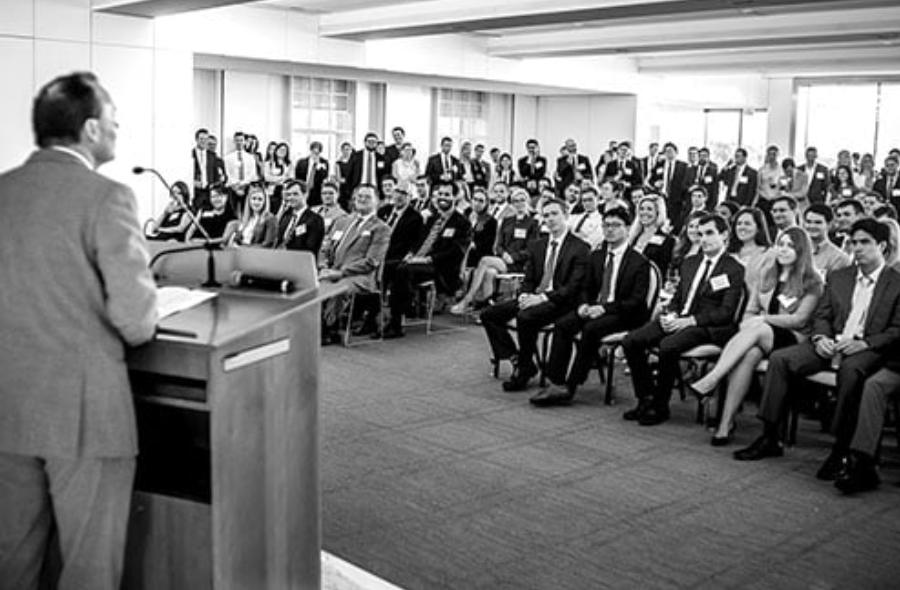
On March 20, the Holy Cross chapter of the Federalist Society was lucky to host Harvard Law School professor Stephen Sachs for a discussion concerning Originalism, a form of constitutional interpretation.
The Federalist Society, a national legal organization that promotes constitutional discussion, is partnered with many lawyers and school chapters. The chapter at Holy Cross is one of few located in liberal arts institutions nationally, as many of the organization’s chapters are at law schools.
Sachs, the Antonin Scalia Professor of Law at Harvard Law School, is an accomplished legal academic, Rhodes scholar, and professor who has taught law ranging from civil procedure to constitutional interpretation. His paper, “Originalism Without Text,” published in the Yale Law Journal, was the topic of discussion for the afternoon.
The mainstream form of Originalism, a way of interpreting the Constitution, focuses on two main ideas cited by Sachs: the “Fixation Thesis” and the “Constraint Principle.” The Fixation Thesis states that the “meaning of the constitutional text is fixed when each provision is framed and ratified,” or that the meaning of the constitution was set in stone when it was made. The Constraint Principle states that the “original meaning of the constitutional text should constrain constitutional practice,” or that people interpreting and adjudicating the Constitution (like judges) should act in accordance with the fixed meaning.
However, Sachs disagrees and argues in his paper that “texts aren’t fundamental to originalism, [and] originalism isn’t fundamentally about texts.” He proposes that a “society can be recognizably originalist without having a written constitution, written law, or any writing at all,” considering his interpretation of originalism entails that laws may “receive their binding power, and [their force,] simply by usage and reception,” or essentially by unwritten rules.
Following the presentation of his paper, the floor was opened to questions. When asked what role other forms of constitutional interpretation play in statutory interpretation, such as the Living Document approach, Sachs vouched for originalist purism, but also noted the merit of more eclectic approaches beyond originalism. Sachs emphasized the importance of evaluating legislative history when considering current legislation by presenting the hypothetical situation of legislators making guns near banks illegal. He suggested that “we might think they mean a financial institution [when they write ‘bank’] but if you go and read the newspapers of the time, and the congressmen are giving speeches about how terrible it is that all of these duels are being fought by the river… they clearly mean a river bank, and that seems relevant.”
When Sachs was asked what he saw in the future of law today, he noted that it was a “little hard to speculate,” citing pertinent political concerns and the rapid growth of AI as being two factors that could impact its future most.
In all, Holy Cross was honored to host Professor Sachs. If you find events like this interesting and would like to attend the next one, you can find the Federalist Society on MyHC and contact its leaders to join the email list.
Featured image courtesy of The Federalist Society
Leave a Reply