Jake Ruderman ’26
Sports Editor
With the 2024 Academy Awards having come and gone, let’s take a look at the major awards wins, memorable moments, and the underlying themes that dictated much of the ceremony.
For those who love the Oscars, it’s not enough to simply understand which movies won which awards, but rather, it’s essential to examine deeper, and find out why, and how, a particular film won a particular award. In order to do so, it’s essential to understand how the voting process for each category works. The entire Academy is around 10,000 members in total, and each member exists within a subset category related to their field of expertise (a writers’ branch, a directors’ branch, an editors’ branch, etc.). In the nomination process, these branches vote solely for their relevant categories (actors nominating the Best Acting awards, directors nominating the Best Director award), and the entire Academy comes together to nominate Best Picture, Best International Feature, Best Animated Feature, and various short film categories. When it comes time to vote for the winners of each category, the entire Academy votes for every award. Rank choice and proportional rank choice voting are used at various stages throughout, but it’s fairly complicated to explain; all you need to know is that the experts in every field decide who gets nominated, and everyone has a say in who wins.
It’s also essential to understand the make-up of the Academy as it currently stands today. For nearly its entire history, the Academy has consisted of an incredibly non-diverse group of people – predominantly older, white, American men with serious sway in Hollywood. After facing blowback over a startling lack of diversity within its key categories, the Academy assured changes would be made; in the years since, the Academy has vowed to double its numbers of women, people of color, and other minorities, and it has followed through on its promises. One of the trends among these new members has been a dramatic increase in international voters, who work predominantly outside of Hollywood. These international voters have brought with them a more diversified pallet of film appreciation, and have increased recognition for international films in a variety of categories; notably, this played a key role in helping lead to the first ever non-English language film to win Best Picture, with Parasite in 2019.
For as long as it’s been around, the Oscars have been understood to be the American film awards, but with its increased international body, the Academy Awards has become a more worldwide expression of film achievements. That’s why it’s possible for international films like Anatomy of a Fall, and The Zone of Interest to be nominated for five Oscars each – and win major awards like Best Original Screenplay and Best Sound. Even Godzilla Minus One, a low-budget (and absolutely incredible) Japanese film, was able to win for Best Visual Effects, beating out major American franchises like Marvel’s Guardians of the Galaxy Vol. 3, and Mission: Impossible – Dead Reckoning.
This background information is able to help contextualize some of the Academy’s choices, providing additional reason as to why Oppenheimer lost in Best Sound and Barbie lost in categories related to set, costumes, makeup, and hairstyling.
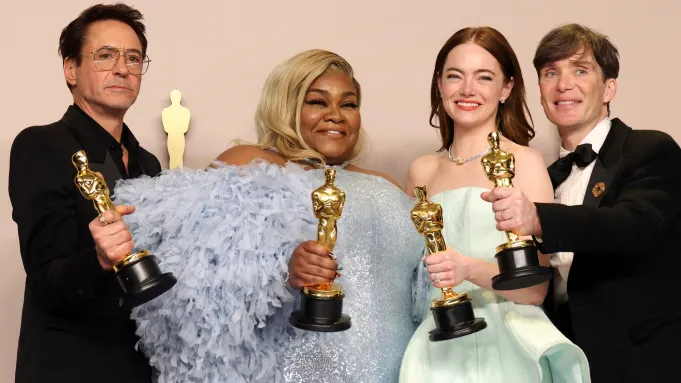
With all that being said, let’s take a brief look through the categories and discuss the winners. As had been prophesized in recent months, the far and away winner of the night was Oppenheimer, which claimed seven Oscars in total. Oppenheimer’s brilliance was recognized not just in its more obvious strengths, like acting and directing, but also in its technical mastery, collecting wins for Best Film Editing, Best Cinematography, and Best Original Score. Other than its behind-the-scenes precision, Oppenheimer’s stars shone bright: Robert Downey Jr., Cillian Murphy, and Christopher Nolan all received long-awaited, first Oscar wins, for Best Actor in a Supporting Role, Best Actor in a Leading Role, and Best Director, respectively. Oppenheimer also took home Best Picture (much to the confusion of Al Pacino), capping off one of the more dominant runs in recent Oscars history.
Da’Vine Joy Randolph continued her run of perfection, collecting her first Oscar for Best Actress in a Supporting Role (and giving the night’s best speech, in my opinion), while Emma Stone, to the surprise of many, took home the Oscar for Best Actress in a Leading Role. Stone had been neck-and-neck with Lily Gladstone throughout awards season, and was the only underdog to win one of the major eight categories (Picture, director, actor, actress, supporting actor, supporting actress, original screenplay, adapted screenplay).
Writer/directors Justine Triet, Cord Jefferson, and Jonathan Glazer each won their first Academy Awards, for Best Original Screenplay, Best Adapted Screenplay, and Best International Feature Film, respectively, while Poor Things dominated the visual awards, taking home the Oscars for Best Costume Design, Best Makeup and Hairstyling, and Best Production Design. Godzilla Minus One scored Best Visual Effects, The Zone of Interest took home Best Sound, and The Boy and the Heron won for Best Animated Feature. Barbie’s lone win came for Best Original Song, with “What Was I Made For”, though Ryan Gosling had the night’s biggest moment with his hilariously extravagant performance of “I’m Just Ken”.
Wes Anderson took home his first Academy Award, winning Best Live Action Short Film for The Wonderful Story of Henry Sugar, and War is Over! Inspired by the Music of John & Yoko won Best Animated Short Film.
Rounding us out, 20 Days in Mariupol earned Best Documentary Feature Film, and The Last Repair Shop won Best Documentary Short Film.
While the public at large may be disappointed by the fairly unsurprising outcomes, there are simply too many precursor awards shows in the leadup to the Oscars to allow for truly out-of-left-field wins anymore. And, while it’s not necessarily a bad thing, it does struggle to compare to the excitement of past years. Overall, I thought the ceremony was quite solid; as always, there were some good bits and some poor ones, but nothing too extreme either way. Jimmy Kimmel was funny enough, and kept things moving along without a hitch, although John Mulaney seemed to submit his application for next year’s host with his hysterical rant about The Field of Dreams. While the Oscars have been surprisingly tumultuous in the past few years, this year’s awards show was somewhat of a return to normalcy, and a step in the right direction for Oscars to come.
Image Courtesy of Deadline
Leave a Reply