Viveca Stucke ’26
Opinions Editor
Over the past month, there has been a surge in tensions between Israel and Palestine, leading to a flurry of news articles, reports, and discussions that have triggered a range of American reactions and perspectives. The media’s coverage of the issue has amplified the sensitivity of the matter, primarily through sensationalism and an emphasis on emotional and empathetic aspects of the crisis.
From a personal standpoint, this is a topic that I have always found challenging to fully comprehend. As a double political science and religious studies major, the Israel-Palestine conflict inherently spans two of my most significant interests. However, this dual perspective does not help me to understand the topic, but rather, deepens my feelings of confusion as I try to grapple with the intricate interplay of religious and political significance in this matter.
As someone who frequently reads the news, I have been yearning for a sense of clarity, relying on a desire to observe public sentiment and understanding of what is happening between Israel and Hamas. Habitually, I always attempt to consume news through varying sources, striving to eliminate bias and partisanship in my pursuit for a credible and objective perspective. However, with Israel and Hamas, achieving this has been an incredibly challenging task.
International conflicts inherently raise concerns over political consequences, inciting uncertainty and fear of the future, something which I can resonate with. Public sentiment with the Israel–Hamas tensions has invoked deeply emotional responses, as both Jewish and Muslim identities have been under threat. The sheer terror unfolding in the region has raised significant humanitarian concerns, notably due to the rising number of civilian casualties, human rights violations, and the potential for population displacements.
In times marked by terror and unpredictability, like right now, there is an inherent desire for a leader, someone who can offer solace and comfort amid distress. In my confusion, I yearned for the Presidential voice, one to strengthen understanding and provide assurance about what is occurring. As the President of the United States assumes the role of “Leader of the Free World”, he serves as a symbol of strength, unity, and leadership, guiding the nation and the world during periods of instability and volatility. Undoubtedly, people look to the President for a sense of security, reinforcing the power that he holds and his authority in decision making and fostering unity.
Critiques of President Joe Biden have consistently revolved around the effectiveness of his communication skills. His ability to engage with the public has been perceived as weak, characterized by his provision of baseline information and updates, and lacking an overarching sense of direction. Given that the President is responsible for key decisions in times of crisis, people naturally look up to him to assume a level of responsibility and act as a representative of the nation’s interests, both domestically and on the global stage. But Joe Biden has simply been unable to effectively do this.
Admittedly, I am in the center politically, and I do lean towards the left. I have always viewed myself as more traditional, valuing the foundation of our country, the Constitution, and our elected officials as the cornerstones that should guide our behavior. The President, especially, is a figure that I have always regarded with high expectations, viewing the role as a strong and symbolic representation for our nation to rally behind. From the start, in my view, President Joe Biden was always the “better of two evils,” a candidate put forth by the DNC to win the 2020 election to appeal to the center of the political spectrum. During his campaign, President Joe Biden pledged to unite our country within times of difficulty, echoing the collective pleas from across the country to fix the cracks in our nation and bridge the gap of partisan division to invoke change.
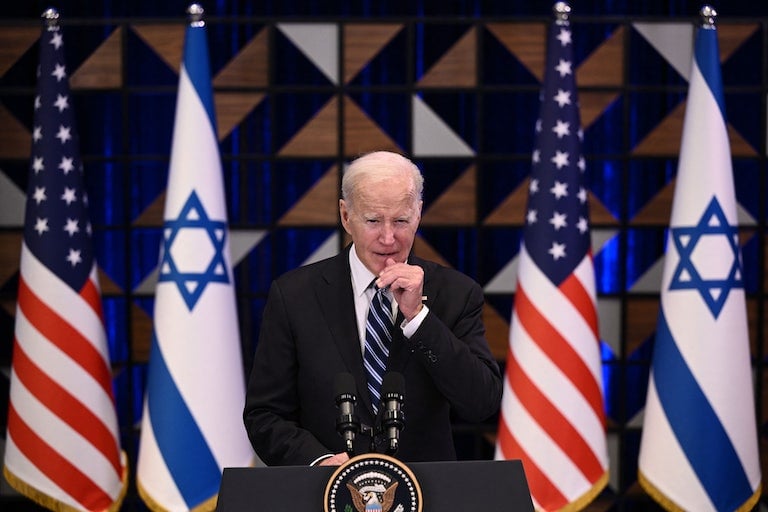
In his address to the nation on October 19th regarding the Israel-Hamas conflict, President Joe Biden left me deeply disappointed. A recurring theme throughout his presidency has been his inability to effectively communicate with the nation, lacking the commanding tone and presence expected from a leader. Listening to his speech, I felt no hope. While the United States is obviously not inherently responsible for the wellbeing of other nations, the President of the United States undoubtedly wields the authority and power to make strategic decisions, influencing the direction of the path of international affairs.
While President Biden’s empathy was evident, he struggled to convey a powerful tone, serving as a weak example of the “Leader of the Free World”, and further failing in his duties to provide hope, foster security, and cultivate stability. His knowledge and information were leaning in a somewhat biased light, which stayed on theme with his consistent strategy to appeal to the masses; not something that is inherently wrong, but not a trait that is ideal in a leader who you are looking for guidance from. Although President Biden was understanding, kind, and somewhat knowledgeable regarding the crisis, there was a notable absence of the “Presidential voice” in his speech that our country, and furthermore, the world is yearning for in this time of concern.
Featured image courtesy of The New Republic
Leave a Reply