Drew Butler ’29
News Editor
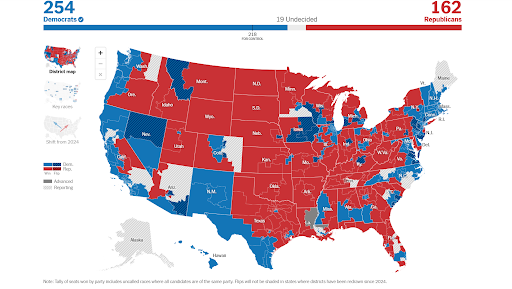
The 2026 Midterm elections resulted in a landslide victory for Democratic candidates across the nation. From America’s coasts to the heartland, voters came out in droves to voice their concerns over the state of the nation’s economy, the war in Iran, and the Trump administration. Entering the election, Democrats enjoyed favorable polling numbers; however, people largely underestimated the extent and scale of their victory. Democrats made significant inroads in states that President Trump won by double digits in the 2024 presidential election and will hold sizable majorities in both chambers of Congress for the final two years of Trump’s second term.
In the House of Representatives, Democrats are projected to win roughly 255 to 265 seats, an estimated 40 to 50-seat net gain. Before the election, according to Real Clear Politics, Democrats polled with roughly an eight-point generic ballot advantage. Per current estimates from The New York Times, Democrats are leading the generic ballot by a 56% to 43% margin over Republicans, the largest House popular vote difference for either party since the 1974 Midterm elections, which were held in the midst of the Watergate Scandal.
As for the Senate, Democrats are projected to win an estimated 54 to 56 seats, a seven- to nine-seat net gain. Democrats were able to score victories in deep-Republican states including South Carolina, Texas, and Kansas. Ballots are still being counted in Mississippi and Alaska, two states where Democrats have the potential to flip Republican-held seats. Democrats even came close to pulling off victories in Florida and Louisiana. The Democratic wave undeniably aided Democratic candidates in putting traditional Republican states in play.
As for gubernatorial races, Democrats performed exceptionally well across the country. Democrats, so far, have flipped five governor’s seats, securing decisive victories in Ohio, Georgia, Iowa, Texas and Nevada. Republican candidates barely won in red states like Florida, Alabama and Tennessee. However, Republicans were able to hold onto races just north of the Massachusetts border. In Vermont, incumbent Republican Phil Scott won a sixth term, defeating Democratic challenger Amanda Janoo by a seven-point margin. In nearby New Hampshire, one-term Republican Kelly Ayotte, a former U.S. Senator, won re-election against Democrat Cinde Warmington by four points.
Among 21st-century midterm elections, the 2026 elections were the most punishing for the incumbent party. Historically, the party in power suffers congressional defeats: in 2006, President George Bush’s Republicans lost 31 House seats and six Senate seats. In 2010, President Barack Obama’s Democrats lost 63 House races and six Senate seats; in 2014, Democrats lost another 13 House seats and nine Senate races. During Trump’s first term in 2018, Republicans lost 41 House seats, while gaining two Senate seats. In 2022, President Joe Biden and Democrats lost nine House races, and net gained one Senate seat.
As a historical reference, this year’s elections are shaping up to be very similar to the 1986 Midterms, which took place during President Ronald Reagan’s second term in office. During that electoral cycle, Democrats in the House won 258 seats and the popular vote by roughly 10 points. In the Senate, Democrats flipped eight seats, garnering a 55-to-45 seat majority. Despite his 49-state landslide sweep two years prior, Reagan and Republicans were still punished in the ballot box.
Republicans faced a challenging Midterm; yet elections are a snapshot in time. Much can change in politics when voters cast their next verdict in two years. In 1986, Republicans experienced an electoral bruising across the nation, yet in 1988, Republican George H.W. Bush went on to win the presidency in a landslide. Can Republicans replicate this trend, or can Democrats build off of their gains made this year in 2028? Time will tell.
Source: https://www.nytimes.com/interactive/2026/11/03/us/elections/results-house.html
Leave a Reply