Olivia Rembert ‘28
Staff Writer
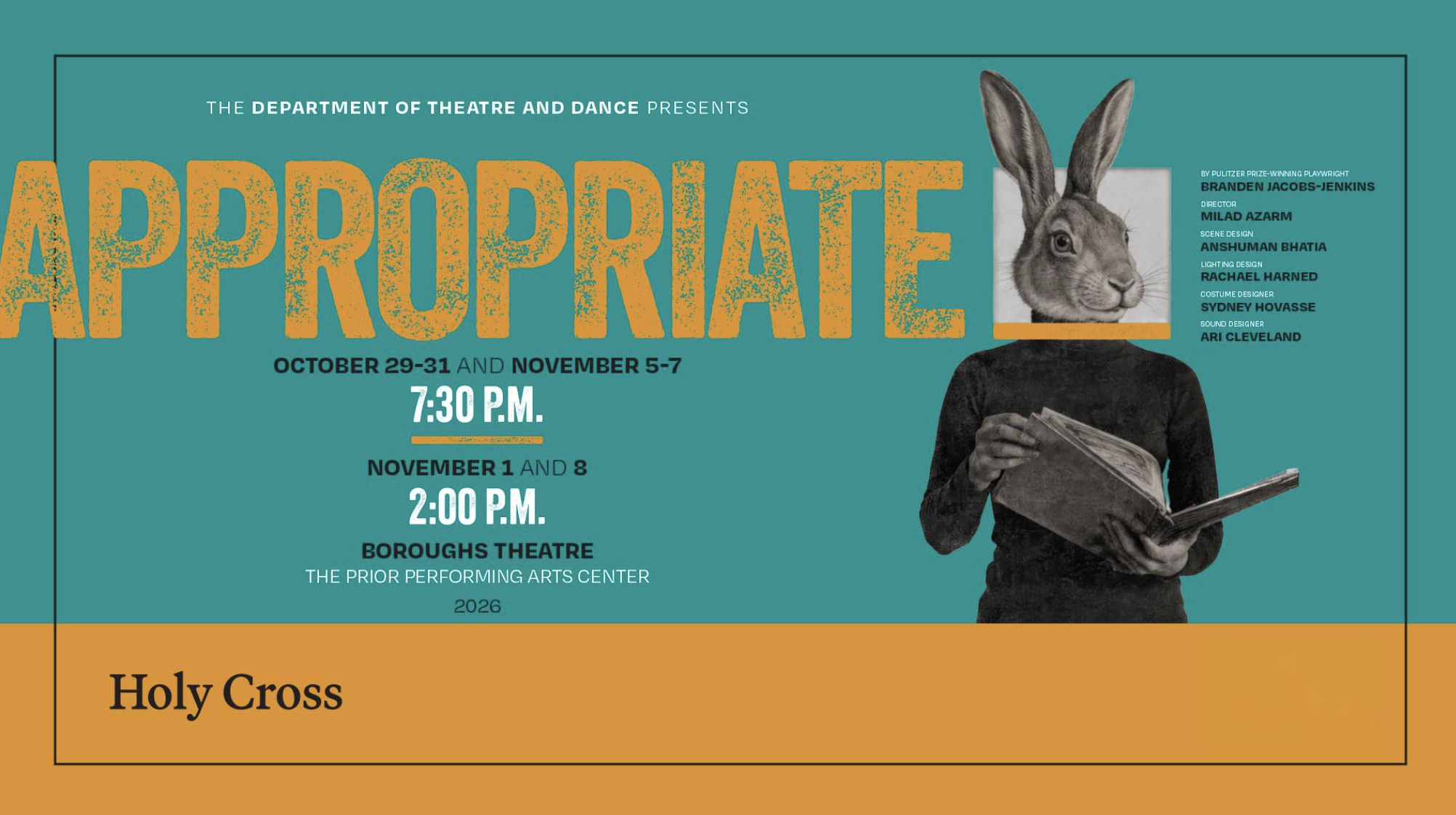
Last Friday, I attended the Holy Cross Theatre Department’s production of “Appropriate,” a play by American playwright Branden Jacobs-Jenkins. The play follows a family cleaning out their late father’s Arkansas home after his death, where they discover an album containing photos of lynching. The discovery forces the family to confront their father’s racism and the possibility that the man they thought they knew was capable of such sinister things. At its core, “Appropriate” exposes the hypocrisy that often emerges when white families encounter evidence of their relatives’ racism, as they have the impulse to make excuses, rewrite history, and protect the image of a loved one because surely the person they knew could not have been so awful.
Before seeing the production, I had low expectations. Given the subject matter and the lack of diversity in our Theatre Department, I questioned whether “Appropriate” was the right play for Holy Cross. I was pleasantly surprised by the production itself and found myself thoroughly engaged throughout the performance.
My reservations did not fully materialize until afterward, when I learned that the character of Br’er Rabbit had been added specifically for the Holy Cross production and was not included in Jacob-Jenkin’s original script.
Br’er Rabbit is a trickster figure in African American folklore that originated as a symbol of resistance against white slave owners. In Holy Cross’s production, Br’er Rabbit appears as a creepy, supernatural figure who looms in the background, illuminated by fluorescent green lights. His presence introduces a supernatural element that is mostly absent from the original play.
After comparing the original script with the production I saw, I have concluded that this addition is unnecessary and ultimately detracted from the play’s central message. I understand that Br’er Rabbit was likely intended to heighten the unsettling situation the play’s characters find themselves in. However, there is little more unsettling than the lynching and commodification of Black bodies. The original script does not need a supernatural figure to make its audience uncomfortable. Although we never see the photographs, knowing that they exist is horrifying enough.
The final image of Br’er Rabbit staring directly at the audience was effective in creating discomfort. But I found myself wondering what, exactly, the audience was being asked to feel. Was it discomfort at the creepy costume and the uncertainty about whether the play was over and to applaud, or was it a deeper discomfort that might prompt someone to reconsider their own prejudices? I worry that the former overshadowed the latter.
In his director’s note, Professor Milad Azaram explains, “I invoke Br’er Rabbit here not as a substitute for the many distinct lives erased from the historical record, but as a figure of counter-storytelling: a reminder that those denied power have long found ways to challenge the narratives imposed upon them.” I appreciate the intention behind his interpretation, but I worry that the message did not fully reach the audience. Rather than functioning as a figure of resistance, Br’er Rabbit becomes another source of horror.
So, is “Appropriate” the right show for Holy Cross? I think it could be, but I would argue that this production missed out on that opportunity. The addition of Br’er Rabbit risks shifting the source of the family’s racism from the family itself to the “haunted” house. If Br’er Rabbit haunts the house, perhaps the family’s behavior can be understood as the product of something beyond their control. That interpretation offers an easy way out for the very people Jacobs-Jenkinds wants his audience to confront. Racism does not need a ghost, a curse, or a haunted house to explain its existence. It is sustained by ordinary people, their choices, and their willingness to excuse the inexcusable.
Jacobs-Jenkin’s “Appropriate” is a brilliant play because it refuses to let its audience look away from that reality. Unfortunately, I am not convinced that Holy Cross’s production trusted that reality to speak for itself.
Copy edited by Emma Bono ’30
Featured image courtesy of the Prior Performing Arts Center
Leave a Reply