Dan Rentel, ‘27
Guest Editor
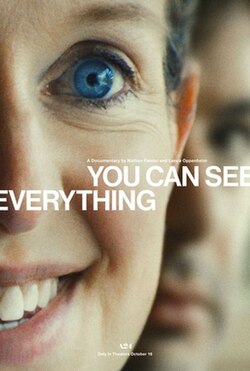
The human face — bathed in soft and hard light, moving in and out of frame, jolting its eyes and its lips, every inch magnified a thousand times by the camera — is of the deepest interest to “You Can See Everything”, the new documentary directed by Nathan Fielder and Lance Oppenheim. And what a peculiar face the camera has as its chief subject: Elizabeth Holmes’, founder and former CEO of Theranos, and the main perpetrator of one of the most infamous business scams of the 21st century. By saying that their company had made one of the greatest diagnostic tests of all time — one that was inexpensive, fast, and could diagnose a myriad of health issues with a single drop of blood — she and her ex-boyfriend, Sunny Balwani, got their company a valuation of nine billion dollars. The problem, though, was that they didn’t have a diagnostic test that did most of what they said it could do. Holmes was found guilty on charges of fraud, and her eleven year prison sentence began on May 30, 2023. Thirty-four days before her prison sentence, however, she invited Fielder, Oppenheim, and a camera crew into her San Diego home to film her last month before her jail time began. The results of that, and years of keeping in touch with her in prison, are “You Can See Everything”.
I don’t want to talk about that, though: about an hour into the movie, I finally landed on the word bulbous to describe her face. Bulbous, like something from inside her face was struggling to burst out. In some extreme close-ups, the proportions almost trigger the uncanny valley. Her boyfriend, Billy Evans, is cold and steely, robotic and harsh, like there’s a demonic entity far behind his eyes and deep in his brain. And Fielder’s face is soft and dark, frequently sporting salt-and-pepper bristles of unshaven facial hair. He has hidden depths. He’s funny here, but this isn’t the guy from “Nathan For You”, it’s not really even the guy from “The Rehearsal”. The lighting contributes to this murky feeling. Fielder, Oppenheim, and director of photography David Bolen have dreamily lit the film to make it all feel borderline surreal. Surreality, though, has the connotation of dreamlike, and this is more nightmarish: this is a descent into the whirling circles of hell, and Nathan Fielder is wielding the camera as his holy sword.
Although perhaps that surreality comes from the personalities involved. Fielder’s endearing charm has always come from his signature brand of awkward comedy. He encounters normal people and is a starkly immovable object in the gentle, predictable tides of normal social interaction. But Holmes and Evans are unstoppable forces. They both have permanently stilted, uncanny speech of phony salesmen or AI chatbots. They also seem hyper-aware that everything they say will be endlessly scrutinized legally, adding another strange layer to this already bizarre situation.
Speaking of bizarre: why on earth is Nathan Fielder here?
Oppenheim makes sense. It’s clear from his recent firecracker “Primetime” that he’s interested in topics of power, deceit, and fame in modern America, tools that would serve well in a documentary about Holmes, who stands in the center of a spinning hurricane of all three. But Fielder is a much stranger choice. I wasn’t quite sure that he could nail and dig into the delicate balance of investigative journalism and entertainment that a movie like this requires. But as the movie heaves on, something strange happens: his unconventional approach to the average social interaction poses him as a non-threat, while also allowing him to slip under the radar and volley dagger-shaped questions. He gets the most out of the two of them that he possibly can, and drills into their psyches as much as anyone could. I saw the movie with a journalist friend of mine, and she praised Fielder’s deftness of toeing the line between outright confrontation and not getting the story at all.
This is, to be frank, an unbelievable movie. I have never seen a movie like this, you have never seen a movie like this, there has never been a movie like this. As of my writing this, this three-hour documentary has demolished box office expectations: this will dominate the cultural conversation for a while. There’s so much in this cinematic tornado that I think a thousand articles, blogs, thinkpieces, video essays, whatever, will be made about this in the coming years, and they’ll all be about different things, and they’ll still only have scratched the surface. The magic trick of the movie is that the more you see, the less you know — by the end of the movie, you’ve seen everything, and you know nothing at all.
Leave a Reply