Kimberly Von Randow ‘28
Opinions Editor
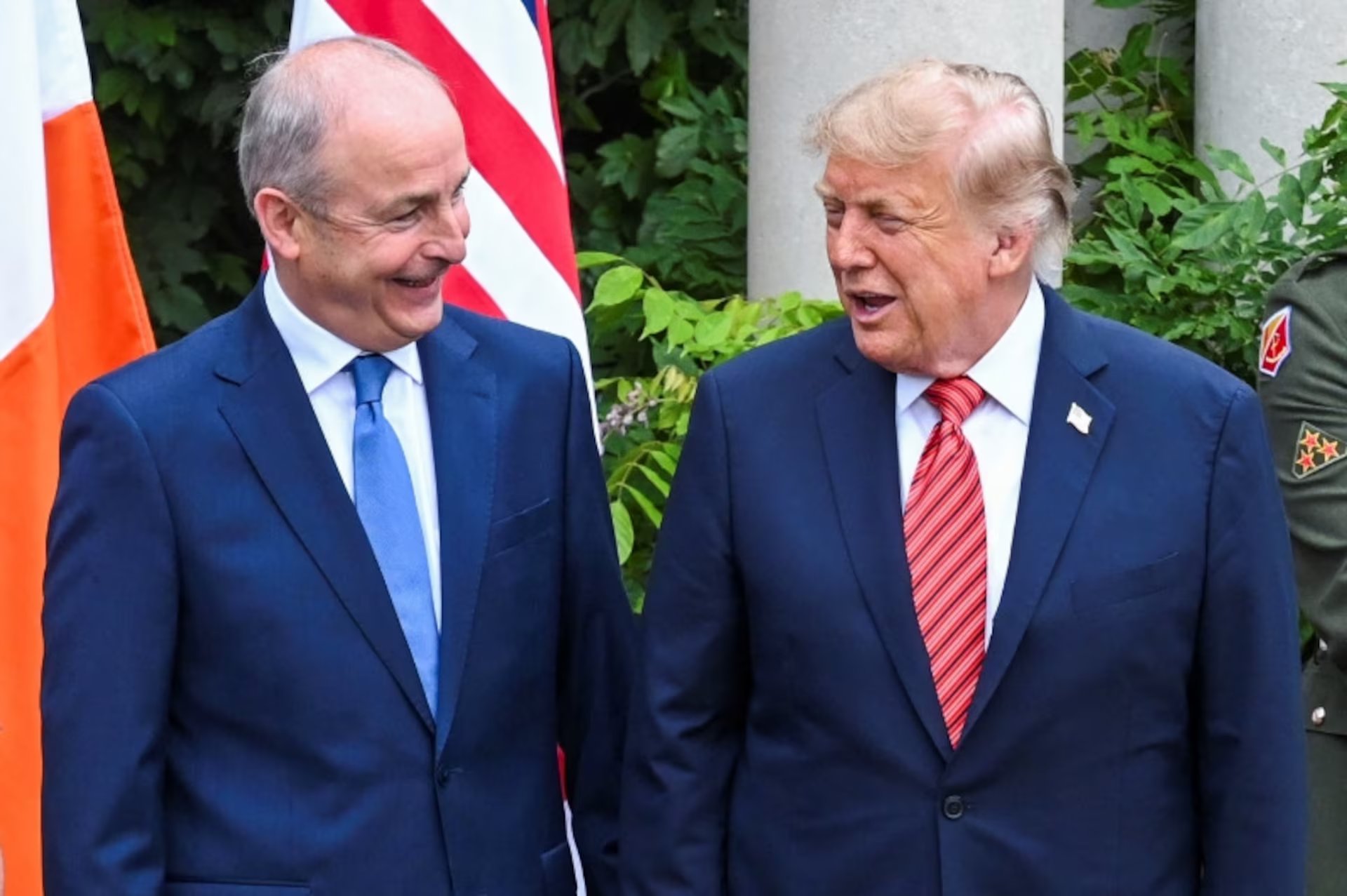
When President Donald Trump visited Ireland this month, he was asked a question that has divided the island for generations: Does he support a united Ireland?
His answer was unusually direct. “I’d love to see it unified,” Trump said alongside Irish Taoiseach Micheál Martin in Dublin. He went further, saying that Irish reunification would happen eventually and “may as well happen now.” The following day, at his golf resort in County Clare, Trump doubled down, calling a united Ireland a “fantastic” thing. Trump is certainly entitled to have an opinion. But his comments raise a bigger question about whether or not the United States should have a say in whether Ireland is united. The answer should be no—at least when “having a say” means influencing the constitutional decision itself.
America has earned a place in the history of Northern Ireland’s peace process. The United States played an important diplomatic role in the negotiations that produced the 1998 Good Friday Agreement, with former U.S. Senator George Mitchell serving as chairman of the multi-party talks. The agreement helped bring an end to decades of conflict known as the Troubles. That history gives the United States a legitimate interest in maintaining peace and stability in Northern Ireland. It does not, however, give an American president the authority to decide what Northern Ireland should become.
The Good Friday Agreement established the principle of consent: Northern Ireland’s constitutional status can change if its people vote for that change. Under the agreement, a border poll can be held when the British government believes a majority would support reunification. Any constitutional change also requires support in both Northern Ireland and the Republic of Ireland. That distinction matters greatly. Supporting the peace process is not the same as supporting one possible outcome of that process.
Trump’s comments have already produced a political backlash. Gavin Robinson, leader of Northern Ireland’s Democratic Unionist Party, argued that the territory’s future should “be decided by its people rather than by politicians in London, Dublin or Washington.” Meanwhile, the British government has maintained that there is currently insufficient public support for a referendum.
What concerns me more, however, is whether Trump’s comments show just how little he appreciates the complexity of what he is talking about.
It is easy, particularly from America, to look at a map of Ireland and see an island divided by a border and assume that removing that border would simply correct a historical wrong. But Irish reunification would mean reconciling two communities with different national identities, political traditions and visions of what their future should look like. It would raise difficult questions about government, healthcare, education, policing, citizenship and the status of Northern Ireland’s institutions. Such questions cannot be solved with a foreign presidential soundbite.
It is incredibly easy for Americans to view Irish politics through an American lens given Ireland’s enormous cultural presence in the U.S. with millions of Americans identifying with Irish ancestry. That connection is meaningful and should be celebrated, but it can create the illusion that Americans understand Irish politics simply because we feel connected to it. I certainly wouldn’t claim that I fully understand all of the political and historical divisions surrounding reunification after reading a few articles. That is precisely why I find Trump’s confidence in his declaration striking. If I am still learning how complicated the issue is, it seems remarkable for an American president to suggest that reunification “may as well happen now.”
America can and should remain involved where its involvement is constructive, such as supporting the peace process, encouraging dialogue and maintaining strong relationships with Ireland and the United Kingdom. But there is a difference between helping Ireland navigate its future and telling Ireland what that future should be.
I can support a united Ireland while still believing that the decision ultimately belongs to the people who live there. Trump can have an opinion, and so can I. But neither of us should get a vote.
Image courtesy of Reuters
Leave a Reply