Lizzie Swanson ‘28
Chief News Editor
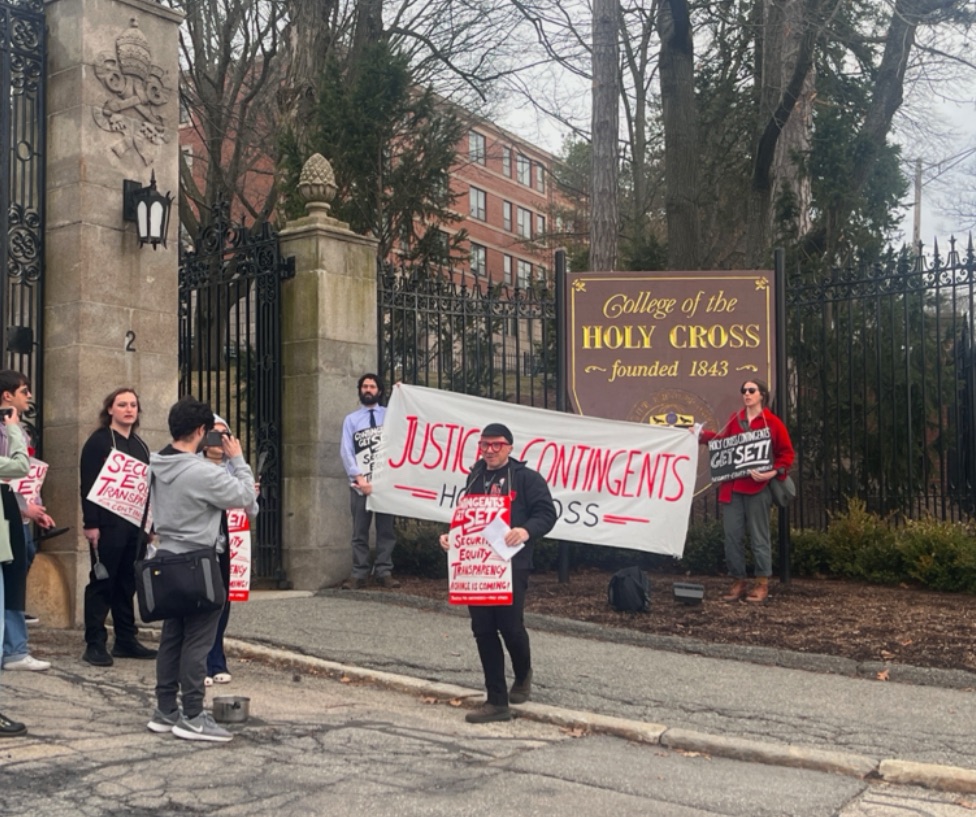
On Tuesday, April 21 at 3:30 p.m., 12 faculty members of the Holy Cross community gathered in Stein 132 in support of the Justice for Contingents campaign. This group met to hopefully voice their concerns towards the administration and gather in support of one another. The Justice for Contingents Movement advocates for security, equity, and transparency as it pertains to contingency. Contingent professors are educators who are not tenured and have to renew their contracts with the college every few years. Contingents professors at Holy Cross make up 30% of the faculty. This group invited representatives from the administration, department chairs, student government officials, and The Spire to their meeting, all of which were in attendance except for the administration who had prior commitments and were unable to make it. The meeting lasted a little over an hour, with contingent professors reading their own testimonies and testimonies of those who were unable to attend. Each excerpt gave a unique but shared perspective on the challenges contingent faculty are currently facing. On March 13 of this year, the Faculty Assembly met to pass a number of bills and resolutions. One of these included a bill from the Justice for Contingents Movement. The campaigns’ demands include a response from the administration regarding their concerns. This passed with 98 percent in favor, and those who voted in favor were excited to hear the response from administration as it relates to contingent security, equity, and transparency.
Anna McNeary, a Visiting Assistant Professor in the Visual Arts Department, read her own testimony and voiced her concerns about the lack of security in contingency roles. She first expressed gratitude toward the policy introduced at the Faculty Assembly. She was glad to know that instead of 3 year term contracts, this policy would increase job security to 5 years. Additionally, contingent faculty will be awarded $1,500 for external conferences and similar expenditures. One faculty member at the meeting proposed that this amount should be evaluated each year to account for inflation. The administration has also made a verbal commitment to addressing the concerns brought on by the campaign. McNeary additionally touched on how unclear the pathways for promotion are in addition to a tenure track conversion program. She also stated that the longer term contracts would give more security to non tenured professors so that they can spend more time thinking about course material and their students. Another professor who wished to remain anonymous echoed this sentiment. “Promotional pathways increase performance” they stated, regarding student wellness, education, and college experience.
Källan Berglund, a Visiting Assistant Professor in the Physics department, agreed. Berglund shared her own testimony with a particular focus on student development and wellbeing. As an advocate for both queer and neurodiverse students, she described the emotional labor involved in the mentorship relationship she develops with students. She additionally voiced her concerns about course evaluations, a crucial bridge between students’ responses and administrative action. Berglund described the weight course evaluations have on a professor’s job security especially as it relates to the contract renewal process. “Our jobs are in their hands in a sense.” Berglund has yet to see her contract for the upcoming academic year and shared that many of her colleagues are in the same position.
One professor stated that students are unable to tell the difference between a tenured professor and a contingent one because both care deeply about their students despite the pay and security differences. This sentiment was particularly emphasized, as many faculty members shared their love and appreciation for Holy Cross students and their love of learning. This group of professors are passionate about Holy Cross’ mission to be “for and with others.” However, they do not feel as if the administration is properly acknowledging these concerns. Andrew Thompson, a Visiting Assistant Professor in the Sociology and Anthropology department, is one of the campaign heads. In a testimony to the room, he stated how unsatisfying the dialogue between the movement and the administration has been. He described issues he faced with housing as an international scholar and a lack of transparency regarding his accommodations. Despite the Faculty Assembly being successful for the campaign, the movement does not feel as though their concerns have been addressed or acknowledged by the administration.
The meeting concluded with members stating they will continue to voice their concerns to the administration. While they have stated that the administration says they want dialogue, the campaign alleges there has been so feasible action taken toward it. The Justice for Contingents Movement is hoping that by the fall, the administration will have not only acknowledged their concerns, but will have engaged in a dialogue that will spark productive solutions towards their goal of security, equity, and transparency.

Leave a Reply