Claire Hunter ’26
Guest Writer
In 1843, Benedict Joseph Fenwick S.J., wanted to establish a Catholic college in New England. He hoped to build it in Boston, but anti-immigrant and anti-Catholic sentiment, especially toward Irish immigrants, made that impossible. Instead, he turned to Worcester, where the College of the Holy Cross was built. Today, Worcester continues to reflect the legacy of being a city for migrants and refugees. Specifically, as of 2022, about 23% of the city’s population is foreign-born, and there are many refugee resettlement and migrant programs, including Catholic Charities Worcester County and the Office of New Americans at Friendly House.
Nearly 200 years after Holy Cross’s founding, anti-immigrant sentiment has not disappeared. Immigration remains one of the most polarizing issues in the United States. Although migration is often framed as a political debate, at Holy Cross, that framing feels insufficient. If our college exists because of exclusion, then what does it mean for the Holy Cross community to respond to migration today?
As a Jesuit liberal arts institution, Holy Cross calls us to engage this question through the lens of Catholic Social Teaching, which emphasizes the inherent dignity of everyone. The U.S. Conference of Catholic Bishops released a statement in November that echoes this teaching:
Catholic teaching exhorts nations to recognize the fundamental dignity of all persons, including immigrants. We bishops advocate for a meaningful reform of our nation’s immigration laws and procedures. Human dignity and national security are not in conflict. Both are possible if people of good will work together.
Within this framework, migration is not a policy issue, it is a moral one. It asks us not only what we believe, but how we encounter others. This perspective came into focus for me after attending the Law, Conscience, and Migration Today conference at Boston College and the on-campus event, Building Sanctuary in the Age of Walls, Bans, and Raids. Together, these experiences reflect both the urgency of the current moment and the power of collective response.
Speakers consistently returned to the idea that we are living in a moral crisis demanding action. Mario Russell, Executive Director of the Center for Migration Studies, noted at the Law, Conscience, and Migration Today conference that justice must accompany compassion. Honest conversations matter, encounters matter, and the willingness to confront our own limitations and biases matter. Marjean Perhot, Vice President of Refugee and Immigrant Services at Catholic Charities Boston, challenged us directly: if our faith calls us to discipleship, then the quality of liturgy should not be confined to church walls, it should be visible in the streets. That challenge feels especially relevant on our campus as it is easy to speak about justice, but it is harder to practice it in daily life. To engage in difficult conversations, to advocate for policy change, or to stand in solidarity with communities that may feel distant from our own. However, that is what our history demands of us. Holy Cross was founded as a response to exclusion. It was built for those who were told they did not belong, and to ignore that legacy would be to misunderstand the very purpose of the institution we are part of.
Responding to modern migration, then, is not about adopting a single political stance or ignoring the complexities of immigration policy. There is a need for borders and immigration laws, but those structures must always be accompanied by a commitment to human dignity. Therefore, in a time often defined by “us versus them,” the call of Jesuit education is something different: to see the humanity in the stranger, and to respond with solidarity.
Now I must ask you to consider: What responsibility do we, as members of a Jesuit institution founded in the wake of anti-immigrant sentiment, have toward migrants and refugees in our community? How can we engage immigration not just as a political issue, but as a human one? In what ways do our daily choices reflect, or fail to reflect, the dignity of others?
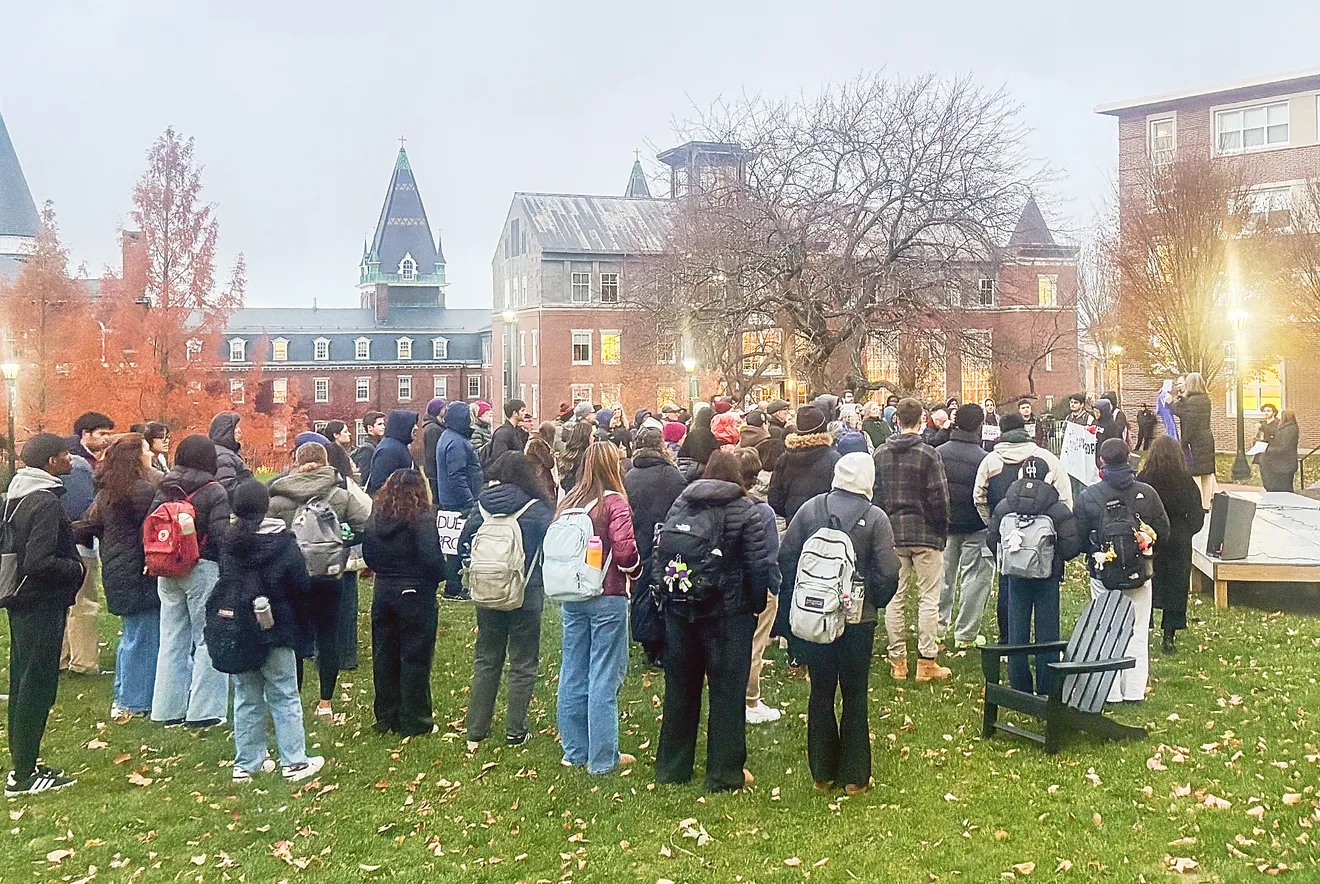
Featured image courtesy of Telegram & Gazette
Leave a Reply