
Ian Sykes ‘28
Opinions Editor
Despite the fact that most people label Trump a conservative, I think that the word “conservative” is useless to describe him. To identify as a conservative has meant differing things over time; normally it has meant a preference for limited government, individual rights, and constitutional adherence, but nowadays it has lost its meaning and suffers from an identity crisis. Trump took advantage of this schism in 2016 of an electorate whose last “conservative” Republican president waged one of the least popular wars in history and oversaw one of the worst economic crises of the 21st century. He gave a new meaning to conservatism by deforming the term from something that indicated at least some semblance of respect for the country to something that only degraded it, its people, its resources, and its respect internationally. Hence, the “legacy definition” of conservatism hardly applies to him; as a matter of fact, Trump is better described as a Democrat.
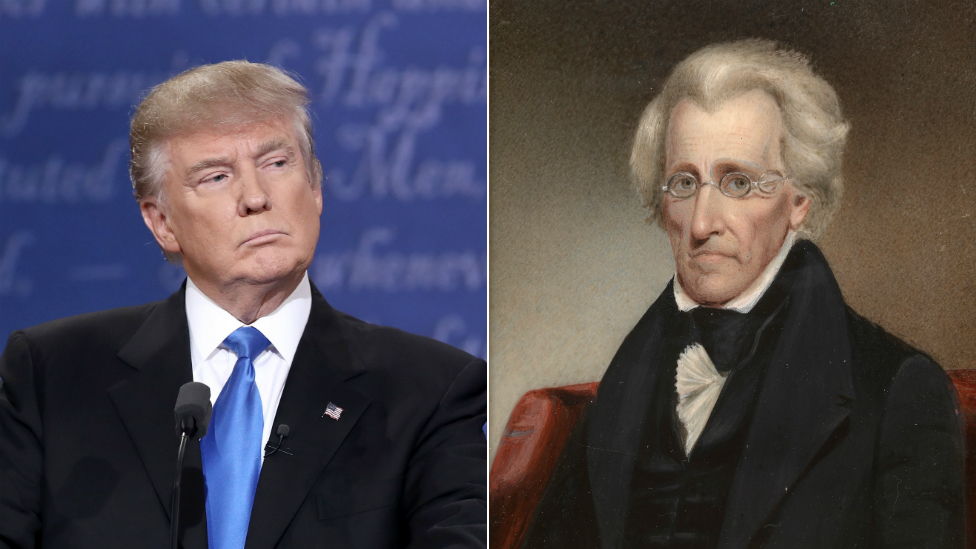
But not just any democrat. Trump is an Andrew Jackson democrat.
In rhythm with how the Trump administration is hellbent on sending America back to the past, his very identity as a “conservative” also pledges to send America back to the reality of the 1830s Democrat, whose time was defined by Jackson. Jackson was, for his time and in history, the first president to be considered as a true representative of “the people” rather than the land-owning political elite which was typically represented by presidents of his time. He was known for his confrontational personality, his propensity to populism, his rallying against the “establishment,” his levying of bureaucratic powers towards his supporters through the spoils system, his hatred for indigenous peoples through atrocities like the Trail of Tears, his unprecedented expansion of executive power, and his rage against his 1824 election loss which he called a “corrupt bargain.” By this account, Jackson sounds like Trump, just in the 1830s; much like him, he’s xenophobic, power-hungry, abrasive, and questioning of institutions, which makes him a Democrat of the antebellum period.
Aside from being culturally conservative (i.e. with Jackson wanting to preserve white dominance and slavery and Trump wanting to preserve white dominance and keeping the marginalized still marginalized), labeling either as “conservative” is inaccurate, especially for Trump. When I think of conservatism, I think of its poster child, Ronald Reagan. He advocated for a free market, for the rule of law, and for limited government, and while he was a president I scornfully disdained, his ability to project humility and respect domestically and abroad gave me the impression that conservatism meant “less is more,” not “Project 2025.” He also welcomed immigrants with open arms, seeing them as indispensable to America, and he gained respect for America abroad by being diplomatic with the USSR and overseeing their fall — all without a war on the ground. When thinking of conservatism, I also think of Teddy Roosevelt, who took great strides to preserve the environment and to preserve capitalism itself by curbing capitalism’s worst impulses in the form of trusts and monopolies. Abraham Lincoln also comes to mind for his dedication to conserving America itself, as does Dwight Eisenhower, who followed the Brown v. Board Supreme Court decision even though he didn’t necessarily support it and who devoted billions to funding American infrastructure through the Interstate Highway System, and Richard Nixon who created the Environmental Protection Agency.
When I think of conservatism, I don’t think of Trump. He has no respect for his country, working people, immigrants, the marginalized, institutions, the environment, the rule of law, a free market (as evinced by his tariff splendor,) and limited government. His whole platform is making America look like a kleptocracy and his demeanor makes America a joke. His administration is one of cronyism and failures like his (and Netanyahu’s) war in Iran demonstrates that America is not only a pushover, but also interested in returning to war rather than avoiding it through strength. And, interestingly enough, his fervor for capitalism has led many Americans to see it as not working for them, thus making it less legitimate. Whatever he is, he isn’t a conservative, and is better described as a Jacksonian than he is a Reaganite.
Maybe I have an optimistic idea of what conservatism should look like. Humility, institutional adherence, peace through strength, and admiring the rule of law may no longer be helpful characteristics to characterize conservatism with. But either way, Trump, when compared to archetypical conservatives looks nothing like them; he looks more like Andrew Jackson per his faux populism, his cronyism, and his reckless expansion of executive authority, and it is for these reasons that he isn’t actually a conservative — he’s just a Democrat from the 1830s.
Featured image courtesy of BBC
Leave a Reply