Shaye Callanan ‘26
News Editor
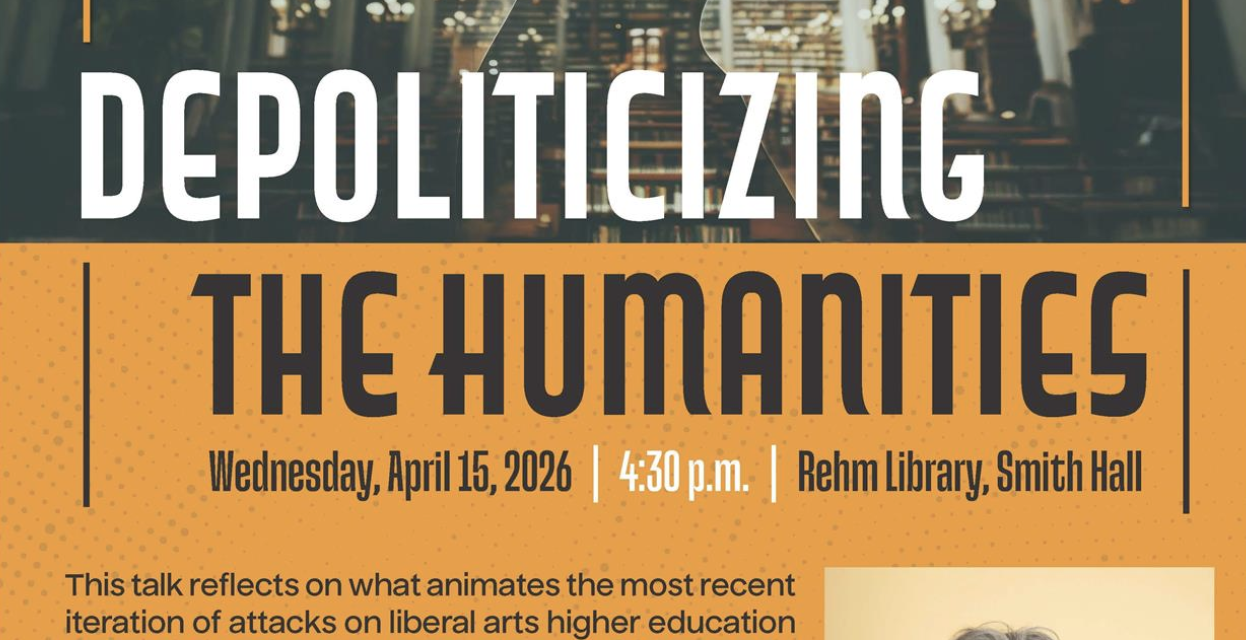
In a fascinating lecture delivered recently at Rehm Library, Professor Wendy Brown of the Institute for Advanced Study at Princeton argued that the ongoing dismantling of liberal arts education, from Washington to the West Bank, is not an accidental byproduct of budget pressures or shifting student demand. She instead contended it is a deliberate political project, and one with profound consequences for democratic life.
Brown opened by setting the issue in our current political state and time, citing Donald Trump’s declaration, “I love the poorly educated,” and JD Vance’s public admiration for Hungarian Prime Minister Viktor Orbán as examples of anti-education rhetoric. Brown suggested these were not to be overlooked, as they were statements of intent. Brown explained how Orbán’s Hungary has become a dangerous example of authoritarian educational policy. Over the past decade, his government has systematically privatized public universities, which prices out lower-income students and strips curricula of gender studies, philosophy, and other disciplines that encourage critical thinking that can separate from national tradition. What remains is an education system consciously reoriented around religion, nation, and political loyalty. “This is fundamental to authoritarian leaders,” Brown argued. When governments attack academic programs, they are not trimming budgets, they are actually reshaping the kind of citizens a society produces.
Brown went on to note that the erosion of liberal arts education in the United States did not begin with the current administration. Most national education policies since the 1980s have accelerated this change due to the rise of neoliberal thought. George W. Bush’s “No Child Left Behind”, with its emphasis on standardized testing and measurable outcomes, was one program in a larger series of neoliberal attacks on education. To demonstrate this further, Brown drew on Nancy MacLean’s Democracy in Chains, which showed how the rise of neoliberalism gradually shifted the purpose of education away from the holistic development of a person toward the production of what she called “individual human capital.” Students began to be encouraged to frame their education purely in terms of return on investment. Brown argued neoliberalism made college increasingly inaccessible to non-elites, brought social mobility to a halt, and devalued any education or research that could not be directly tied to financial gain.
Brown extended her argument beyond the Western context by pointing to Israel’s recent ban on UNRWA, the United Nations agency that has provided education, healthcare, and social services to Palestinian refugees for decades. Brown argued that banning it is therefore not simply a military or diplomatic act. It is an attack on the future of Palestinian education and, by extension, on Palestinian democratic possibility or self-determination.
The final section of the talk addressed what teachers and students can actually do in the face of these pressures against academia. Her first answer was that we must acknowledge that knowledge always has politics. What professors and students must do is engage with material with fully “open arms”, and focus less on the agreeability of the actual material but more on the open and honest engagement with it. Her second answer drew on poet John Keats’s concept of negative capability, which she explained as practicing knowledge from uncertainty rather than from false confidence, which is a form of resistance in an era of authoritarian certainty. She also mentioned Fintan O’Toole’s notion of a healthy democratic culture that undergoes inevitable changes and accepts them as a facet of true democracy. She closed with Aristotle’s distinction between two forms of human fulfillment, or eudaimonia: the political life, worldly and active in the public sphere, and the contemplative life, pursued alone in thought. Brown’s argument, ultimately, was that we cannot fully politicize intellectual life, but we also can’t isolate it from politics. The humanities, she suggested, exist in the interval between the two: neither pure contemplation nor direct activism, but the essential human practice of thinking carefully about the world we share.
Featured image courtesy of The College of the Holy Cross
Copy edited by Sophia Mariani ’26
Leave a Reply