Sean Rego ’26
Chief Opinions Editor
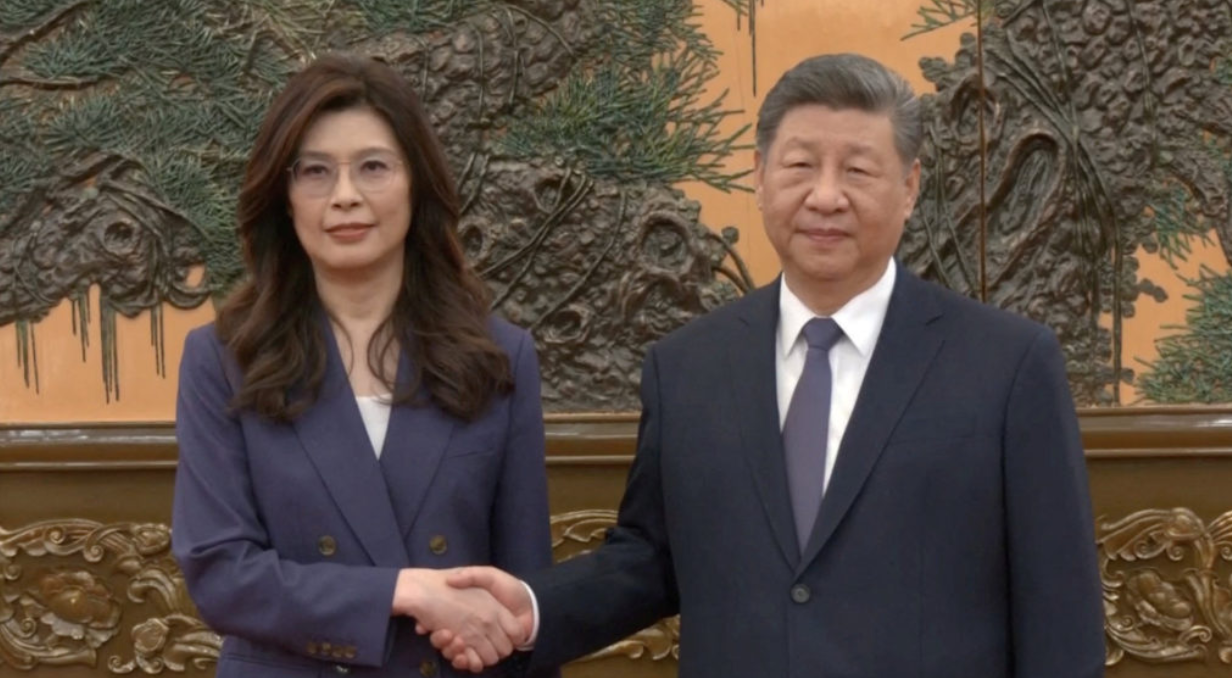
Last week, the chairwoman Cheng Li-wun of the Kuomintang (KMT) visited Beijing on an unprecedented “peace and reconciliation” tour with the Communist Party of China. By no means was this tour an endorsement of Xi Jinping’s China to take over the Republic of China (Taiwan), but it certainly has sent a sobering message across East Asia. The KMT is the second largest party in the Taiwanese legislature, and the historic face of capitalist China. While there is no concrete dialogue, the meeting of Cheng and Xi signifies something massive; China has taken a rare– albeit ambiguous– step towards full reunification.
In an increasingly hostile global environment, China is showcasing a fascinating example of strategic diplomatic silence. Sure, China is still quite active in bodies like the United Nations—it is a permanent member after all— but she is hardly participating in global hotspots like one would expect a great power to do. Look at the Middle East, where the United States is engaged in a nationwide bombardment of Iran. In Ukraine, Russian forces grind away with few allies beyond North Korea willing to help. Even the European states are making noise, defensively and offensively. Across the world, civil conflict and unrest are flaring up, all while China dodges the spotlight.
I can’t pretend to know the true reason behind this very calm mood from China, though perhaps it’s out of necessity. The United States, in its current aggressive foreign policy, is waging conflict against friends and foes in what seems to be an attempt to change the world order it itself helped create. China, which is suffering from long term economic and demographic woes, needs to avoid any possible conflicts. In a moment where China is so conjoined to the global markets, it would be suicidal to engage in a conflict or situation which would threaten their economy. More than America, which is still the undisputed world titan of industry, investment and force; more than Russia, who was never truly coupled to (or fully earned the benefits of) the global markets, China could lose its last 60 years of progress.
Perhaps it is less of necessity and more of strategy. A China at peace is one that is not weakened or fatigued. As America becomes strained, and Russia is distracted on her western front, China can gather her own sphere of influence, and perhaps expand it given the opportunity. Whether it is the South China Sea or the illustrious emptiness of Siberia, there are areas where the People’s Republic can push.
Regardless of the reasons, it is simply fascinating to watch what China’s next move will be, all while the world shifts. In many ways, this tempered and rational behavior may even garner support from the non-aligned countries of the world, which once looked towards China for guidance in the previous century. In 2023, I wrote an article titled China: Awakening Dragon or Paper Tiger? Maybe it’s neither of those things; maybe China is dodging every opportunity to reveal its actual strength all while the world is distracted.
Although the world may tremble when China awakes (whatever that truly may mean in the future), the world is already awry. The recent improvement of relations between Taipei and Beijing already proves that China is using the uncertainty to its own gain. While others tether themselves to conflict and chaos, China is momentarily buoyed to some sort of stability, for which I give them my admiration and attention. Such hidden progress will not go unnoticed forever– not with a nation so big and powerful as China– but it certainly can help the People’s Republic in bidding their time and legitimizing their expanding continental sphere.
Featured image courtesy of PBS News
Leave a Reply