Brigid O’Malley ‘29
News Editor
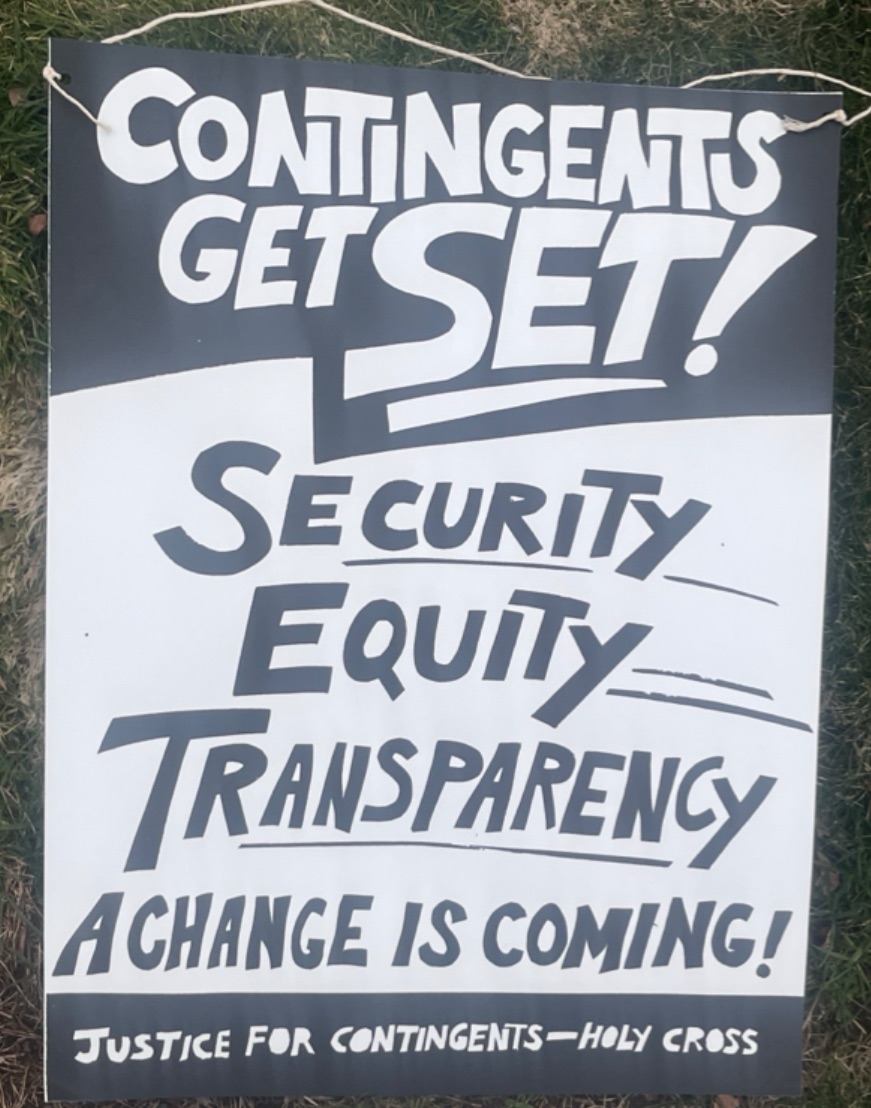
On Thursday, March 26, students, professors, and alumni gathered outside of Kimball Hall to ask one thing of the Holy Cross administration: justice for contingents. Members of the rally stated that contingent faculty teach a substantial portion of courses at the College, but receive substantially lower pay and limited pathways to promotion. By calling on the attention of Provost Visconsi and President Rougeau, these professors are asking for that to change.

The rally began with the clanging of pots and pans. Gathered outside of Kimball after the rally was moved by officers from the Fenwick lawn, Visiting Assistant Professor Jaques Linder came to the front to speak. “This campaign was born out of conversations had in departments, in hallways, in offices on campus… of people in precarious positions.” That precarity stems from the temporality of contingency, where professors are given year-to-year contracts, usually renewed for a maximum of five years, before, as these professors are claiming, being let go with little opportunity for promotion. “What is left behind,” Prof. Linder went on, “are our students, our community.” Many believe shortened stays limit the opportunity for meaningful “scholar-teacher” relationships, hindering student research and professional advancement.
Pay and benefits for contingents are also significantly reduced compared to other institutions. As Associate Professor Carmen Jarrin explained, her experience at another college included multi-year contracts, equal funding, and subsidized housing, benefits not typically offered at Holy Cross. She also noted stagnant wages: “Our raises stagnate year to year… which means that they’re actually making less money in real dollars.”
Leaders handed out red felt square pins, which Prof. Linder described as symbols of labor solidarity. Referencing unionization at peer institutions, he emphasized that change is possible at Holy Cross.
Several contingent faculty testimonies were then read aloud, many anonymously. One speaker noted that anonymity itself reflected fear: some faculty were unwilling to attach their names to criticism of the institution where they work. Others simply could not attend, focused on their teaching loads.
The testimonies painted a picture of instability and strain. One faculty member described a lack of communication around contract renewal, learning indirectly that their position might not continue. The uncertainty, they said, had taken a toll on their mental health. Another explained how, after years of full-time teaching with benefits, they were shifted to adjunct status, losing both income and healthcare while still teaching multiple courses. “A salary of $32,000 a year would not qualify me to rent a studio apartment in Worcester,” the testimony read.

Others focused on the broader implications for the College. A contingent professor of philosophy described how job insecurity limits academic freedom, forcing instructors to weigh professional risk when choosing course material. Another professor from religious studies spoke about the emotional impact of being forced to leave after four years despite deep investment in students: “I have now gotten to watch an entire class… rise from freshmen to seniors… This makes my position… all the more painful.”
Speakers repeatedly tied faculty working conditions to student learning conditions. “Contingent faculty are called on to uphold the school’s mission of justice,” one testimony stated, “while not always experiencing those principles in our own working conditions.”
The rally also included solidarity statements from organizations and unions across the country, including the Massachusetts Teachers Association and faculty unions at other universities. These statements echoed the same themes: job security, equitable pay, and transparency are essential not only for faculty, but for the integrity of higher education.
Former Dean of the Faculty and Interim Provost Ann Marie Leshkowich addressed the crowd, arguing that the administration has the ability to act immediately. She pointed to concrete steps such as multi-year contracts, clearer renewal guidelines, published salary scales, and increased research support as ways to satisfy contingents’ demand. “These are feasible, concrete action items,” she said. “I stand with you in advocating for the administration to respond immediately.”
Prof. Andrew Thompson then outlined the campaign’s trajectory. Beginning with small conversations among contingent faculty, the movement grew into a formal resolution passed overwhelmingly by the Faculty Assembly, 137–3. Despite this mandate, organizers say the administration has yet to provide a substantive response.
“They say they want dialogue,” Thompson said. “What’s missing is a response.”
The crowd processed to the gates of campus, carrying signs, clanging pans, and yelling their central message across campus: “Justice for contingents.”
Featured images courtesy of Brigid O’Malley ‘29

Leave a Reply