Lars-Belvin Larsson
Guest Writer
As the midterm election in November approaches, the country will gain clearer insight into which front-runners stand out. The U.S. Senate primary election in Texas on March 3rd clarified which candidates are still vying for one of the two available U.S. Senate seats, though uncertainty remains. Republican incumbent Senator John Cornyn and the favored Texas Attorney General Ken Paxton are heading to a 12-week runoff, as neither candidate secured more than 50 percent of the vote. Across the aisle, Democratic State Legislator James Talarico narrowly defeated Congresswoman Jasmine Crockett, perhaps to the dismay of Speaker Mike Johnson, who was hoping to score an easy win.
Republicans were plagued by low voter turnout, while Democrats garnered substantially more votes. Compared to the last U.S. Senatorial election in 2018, while Republicans saw a 1.4 percent increase, Democrats increased their turnout by 5.6 percent, coinciding with more votes overall. In a historically red state, this level of Democratic voter enthusiasm may be an indicator of the Senate seat’s volatility. In Texas, this turnout is a monumental shift, and perhaps a sign of things to come. Typically, primary elections are relatively insignificant, but this one was anything but that. The increased Democratic voter turnout during President Trump’s second term has been a consistent trend, most notably in Texas’s 18th congressional district, resulting in a solid red district that flipped blue in a special election. The root cause is debatable, but one can plausibly infer that, given the unpopularity of Trump’s term, Democrats are eager to vote, while Republicans would rather stay home than vote for the opposing party.
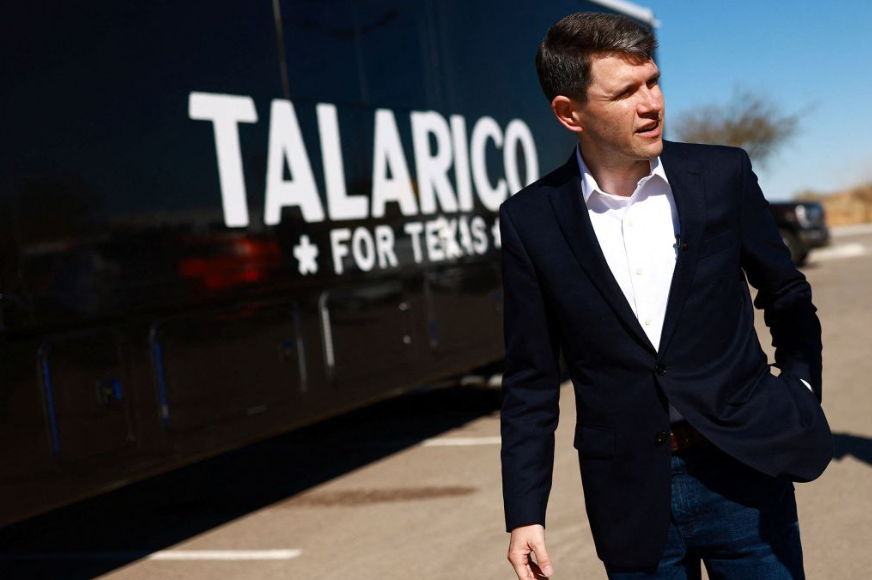
While the Cook Political Report currently lists the race as a “Likely R” since July 17th, it has shifted further left, as its previous rating was “Solid R.” With State Representative Talarico running, there is a possibility of reaching across the aisle to disgruntled Republicans or undecided independents. He already has a record of garnering bipartisan support, most notably by flipping a Trump-stronghold district in 2018. Many Republican politicians see him as a formidable candidate, and were likely astounded and concerned by his victory over the more polarizing Representative Crockett, who led by 18 points just weeks earlier. An August 2025 survey from The Texas Politics Project revealed that most Republicans hold neutral opinions of Talarico, so he does not face staunch opposition, for the time being. To mitigate this uncertainty, Republican strategists are likely to create polarization through attack advertisements, branding Talarico as too progressive, a strategy that has proven effective in previous years. However, their influence on Talarico’s campaign remains uncertain.
More surprisingly, though, was the strength of Senator Cornyn’s performance. A Texas Politics Poll showed Paxton ahead by 2 percentage points in February, yet on election day, Paxton underperformed and trailed Senator Cornyn by 1.2 percentage points. It would be remiss not to mention the advertisement spending frenzy, which totaled $78.5 million for Senator Cornyn’s campaign compared to Paxton’s $4.4 million. This level of spending is unprecedented in a primary, which highlights the incumbent’s uphill battle, which is slated to continue. Clearly, Senator Cornyn’s spending benefited him, given his overperformance in the election.
Both sides of the aisle face challenges in the race, although the hurdles are considerably different. The Republican side is experiencing some infighting, with both candidates attempting to smear each other. Paxton has benefited from Trump’s rocky relationship with Cornyn, as the President labels Cornyn a RINO (Republican in Name Only). Cornyn, in contrast, must not look beyond Paxton’s infamous past, including a 2023 impeachment for bribery and abuse of office (acquitted by the Texas Senate) and a 2024 settlement for securities fraud. President Trump recently weighed in on the race, indicating he will endorse a candidate soon while urging the other to drop out. Signs suggest the President would rather endorse Cornyn despite their spotty relationship, and Paxton has rejected the prospect of dropping out. Arguably, the GOP primary is turning into a large-scale food fight, which the party may suffer from down the road. Democrats would much prefer the controversy-ridden Paxton to win the run-off; however, Cornyn is a potential liability when running against Talarico and remains vulnerable.
Conversely, for Talarico and the Democrats, flipping Texas blue is a utopian and somewhat far-fetched reality. The last time Democrats won a U.S. Senate seat in Texas was 1988. Given Texas’s long-standing Republican history, the DNC might not consider Texas a priority, even with an experienced, well-tailored candidate like Talarico running. He may face challenges with financing, especially in comparison to a seemingly endless wave of GOP liquidity. Talarico undoubtedly faces a tough task in winning the general election, though it is not insurmountable nor implausible.
Neglect could be the biggest obstacle for both sides. Both parties have strong candidates for the state; therefore, underestimating the opponent is a flawed strategy and a serious blunder. Republicans cannot assume they will win easily, and Democrats might consider re-evaluating their priorities—especially given Talarico’s strong reputation and his ability to communicate across party lines. Despite the state’s Republican history, Talarico will likely give Republicans a run for their money.
Featured image courtesy of CNN
Leave a Reply