Kate Santini ‘27
News Editor
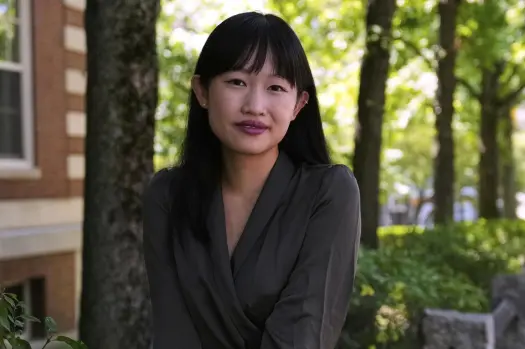
On Thursday, February 27, the Department of English was proud to host renowned author, R.F. Kuang, for a reading of her upcoming novel and a Q&A session with students and faculty. At only twenty-nine years old, Kuang has published six novels including The Poppy War Trilogy, Babel, Yellowface, and most recently, Katabsis. Popular on “Book-Tok,” or the reading community on TikTok, she is known for writing fantasies with historical, racial, and colonial undertones. A graduate of fellow Jesuit institution, Georgetown, she speaks to how her liberal arts played a role in fomenting her passion for history.
Kuang opened the highly awaited talk with a reading from a passage in her unpublished novel, Taipei Story, which deals with grief, familial struggles, and cultural identity. Before reading the passage, she admitted, “I’ve never shared any of this with an audience before.” The scene she read takes place at an airport in Taipei, Taiwan and follows the protagonist and her mother as they prepare to attend a loved one’s funeral in China. Although this scene takes place in roughly the middle of the book, Kuang chose to share it because it offers a “liminal space” where mother and daughter are reunited and forced to navigate their grief together. Loosely based on the loss of her own grandfather, Kuang describes the story as “introspective” and difficult to write because it forced her to “trap [her own grief] into a sentence.”
She then answered a series of questions. After being asked what she believes a writer’s “responsibility to the public” entails, she responded that writers do not have any obligation to espouse certain viewpoints or cover specific topics. Instead, she argued that in the spirit of artistic expression, an author’s only job is to reflect the “variety of ways to be human” in order to “maintain eternal curiosity and compassion” amongst their readers. As a Chinese-American who immigrated to the United States at just four years old, Kuang champions herself on her ability to represent “voices that don’t make it onto the bookshelves” and to “push against dominant voices in the canon.” The Poppy War Trilogy, in particular, takes place in the often overlooked setting of the Asia Pacific during the World War II era.
Asked how she balanced her studies with writing, she candidly responded, “I always wish I could get more sleep” but went on to explain that they often complement each other. Kuang recalls various times sitting in class and “questioning how might I turn this into a narrative.” She added that for her, “historical research is like a magpie” from which she can “create a shining piece of dialogue around.” From there, it’s only a “small leap” to incorporating “magical material” and fantastical elements into a narrative.
As a PhD candidate at Yale, she often teaches creative writing courses where her primary focus is encouraging students “to read” so that they may “imitate and identify craft techniques that appeal to [them].” While she believes creative writing courses are beneficial, she admitted that she began her undergraduate studies as an international economics major and never took a proper writing course herself. Instead, her “teacher was the library.”
Kuang began writing her first novel at only nineteen years old while taking a gap year from college to study in Beijing. At the time, she had little experience with the publishing industry and even admitted to googling how to acquire an agent. After “boldly sen[ding] out queries,” Harper Collins kickstarted her career by agreeing to publish the first volume in The Poppy War.
As a fan of Kuang, this author was eager to attend this talk and learn about the author’s creative processes. As someone pursuing a foreign language degree, this author was curious whether she feels she has a different “voice” writing in English compared to Chinese. Kuang responded that she indeed feels more “polite” writing in Chinese which stems from spending her younger and more impressionable years living in China. Taipei Story, in particular, forced her to translate long dialogues from Chinese to English and vice-versa. It was a valuable writing exercise which forced her to recall the times when she was young learning English vocabulary from “the Great American movies” such as Star Wars.
Kuang concluded her talk discussing how her characters, namely Robin in Babel, reflect her dissonance between being grateful for the opportunities she has had in academia and being cognizant of the fact that most minorities do not get this privilege. Ending on this note, which raises questions about our institution and the privilege associated with it, she signed students’ copies of her books and answered further questions. Taipei Story is set to release in September 2026 and updates can be found @kuangrf on Instagram.
Featured image courtesy of The Hartford Courant
Leave a Reply