Lars-Belvin Larsson
Guest Writer
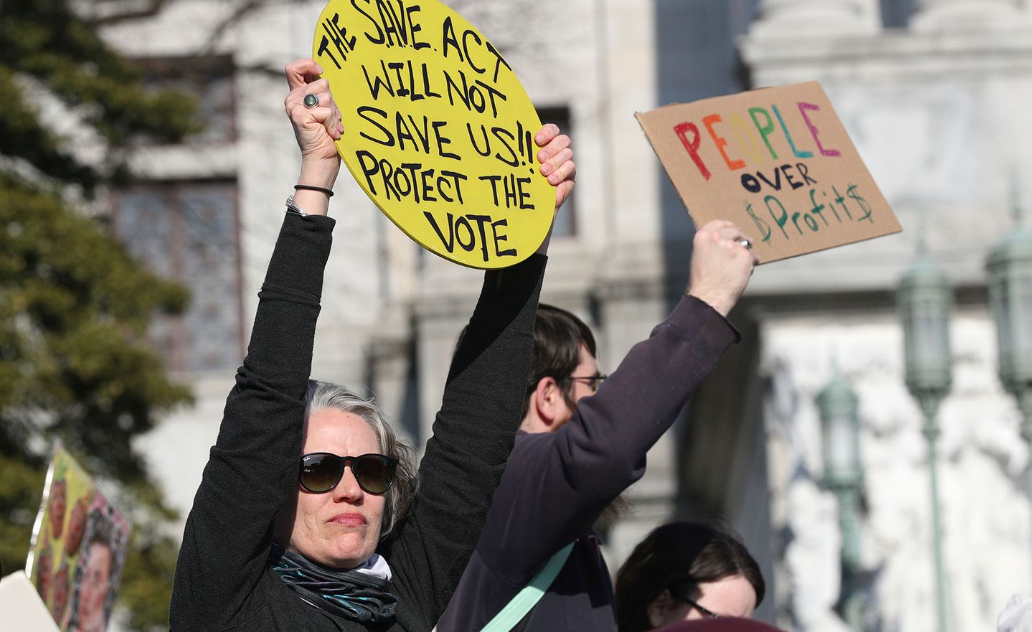
The United States House of Representatives passed one of the GOP’s key legislative agendas on February 11th, the Safeguard American Voter Eligibility (SAVE) America Act, to crack down on fraudulent voting. The SAVE America Act would require voters to provide proof of U.S. Citizenship to register or re-register to vote, rendering common forms of identification, such as driver’s licenses or military IDs, insufficient. Instead, the Act would require citizens to present a valid passport, and, in some cases an original birth certificate to confirm their eligibility.
Now, holding legitimate elections and eliminating fraudulent voting are not partisan issues; both parties are staunch advocates of election integrity. A Pew Research Center study found that 83% of participants supported requiring all voters to show government-issued photo identification. Clearly, the issue of election integrity is uncontroversial, widely recognized, and common around the globe, with many countries requiring voter ID. GOP officials say this legislation is intended to strengthen the security of national elections, coming on the heels of President Trump’s uncorroborated claims that the 2020 election was stolen and ahead of the upcoming midterm elections, where Republicans are likely to face an uphill battle.
To be clear, there are already safeguards in place against fraudulent voting, and the likelihood of someone voting illegally is incredibly rare. By 1924, all states had banned noncitizens from voting in federal elections, and Congress added criminal penalties in 1996. Most states require voters to check a box affirming citizenship when registering to vote, under penalty of perjury. Noncitizens face grave consequences, including time in prison for registering to vote, and possible deportation.
Speaker Mike Johnson has repeatedly reinforced the narrative that noncitizens are voting, stating that: “We all know, intuitively, that a lot of illegals are voting in federal elections,” though he offered no evidence supporting the claim. Clashing with Speaker Johnson’s stance, the Heritage Foundation, which has campaigned hard against voter fraud, found 100 cases of noncitizens voting in federal elections between 1996 and 2025, which is a fairly negligible amount for federal elections, though it may constitute a lot for Speaker Johnson. This is not to say that casting fraudulent ballots should be allowed, but these people have already faced punishment, and their votes are too few to change any prior federal election outcome.
Most notably, the Act would likely disproportionately affect rural voters, a voting bloc that tends to be a Republican stronghold. Democratic-leaning states typically have higher numbers of U.S. citizens with valid passports, while the opposite is true for Republican-leaning states. For instance, a 2023 YouGov survey found that 55% of Republican voters lacked a valid passport. The same survey found that 70% of families with incomes below $50K lacked valid passports, which may suggest that the $165 cost of a passport is unaffordable. States with the most Trump votes in 2024 also have the highest share of citizens without valid U.S passports. West Virginia cast 70% of the votes for President Trump in 2024, and 78% of citizens lack valid U.S. passports. By contrast, Democratic-leaning states tend to have significantly lower rates of citizens without valid U.S. passports; for example, in California (23%), Massachusetts (24%), and New York (25%). All in all, the State Department estimates that 170 million passports are in circulation, representing roughly 45-50% of the population, underscoring that not all voters will remain eligible under the SAVE America Act.
Moreover, married women, a key swing bloc for President Trump in 2024, may face challenges in voting. Given that the bill requires documentary proof of citizenship, roughly 69 million married women who have changed their last names and lack an original birth certificate with a matching name may be disenfranchised.
Should the Act pass the Senate and be signed by President Trump, it could have many unintended consequences for American voters. Democratic Representatives disapprove of the Act, not because they oppose instituting voter ID and support noncitizen voting, but because of the means and consequences the Act may entail. By every available metric, the Act will likely disenfranchise millions of citizens, many of whom may be registered Republicans. The bill currently faces challenges in the Senate, as Majority Leader Thune is skeptical that the Act will overcome the filibuster. The future of this bill is uncertain, but if it becomes law, the voting landscape may change significantly.
Featured image courtesy of Boston University

Leave a Reply