Viveca Stucke ‘26
Chief Features Editor
1. What is the description of your AI Art course?
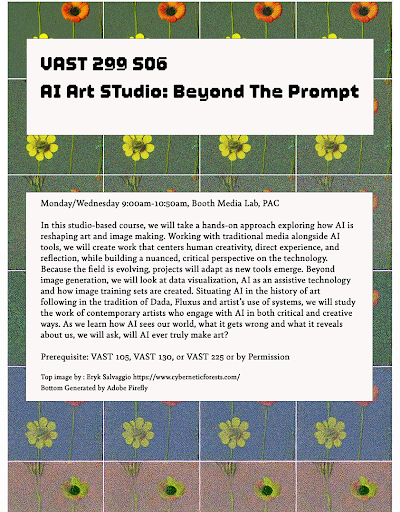
In this studio-based course, we will take a hands-on approach exploring how AI is reshaping art and image making. Working with traditional media alongside AI tools, we will create work that centers human creativity, experience, and reflection, while building a nuanced, critical perspective on the technology. Because the field is evolving, projects will adapt as new tools emerge. Beyond image generation, we will look at data visualization, AI as an assistive technology and how image training sets are created. Situating AI in the history of art following in the tradition of Dada, Fluxus and artist’s use of systems, we will study the work of contemporary artists who engage with AI in both critical and creative ways. As we learn how AI sees our world, what it gets wrong and what it reveals about us, we will ask, will AI ever truly make art?
2. What was the inspiration behind this course?
My field is Digital Art and I have been following the development of AI image technology for some time. I made a jokey holiday card using it way back in 2022. Back then, apps like Dall-E and Midjourney were prone to making strange hands and alarming faces. At the same time, Adobe integrated text-based generation into Photoshop and it really blew me away. It still was flawed in many ways but I recall showing this to my students for the first time and being probably overly excited and a little freaked out about it. They were probably thinking, why is this woman shouting about adding a perfectly blended rainbow to an image. But, what really made it imperative that I take this seriously and dive into it more, was how quickly it improved and the rapid pace of its development.
I have been serving on the Exploring Responsible Academic Uses of AI in the Liberal Arts (Ethics) subcommittee of the Institutional Review of AI Task Force. Working with my colleagues on this issue and having such insightful conversations with them about AI, inspired me to take the leap and teach a course like this, knowing it was going to require that both the students and I be “challenged to be open to new ideas, to be patient with ambiguity and uncertainty” as noted in the college mission.
In my own work I have started to experiment with AI, using it as a tool for coding conceptual projects and to some extent for image generation. Some of the work has explored the way AI can create impossible bodies and emphasizes the impossibility of achieving these looks because the images are not real. So, teaching this course will also be a learning experience for me and will impact my work moving forward.
3. In your opinion, how has AI affected the art world…for better and for worse?
There are many different art worlds but I believe that some fields like illustration, filmmaking and web development will be greatly affected and already are shifting due to AI. In the course, I will show a lot of great contemporary artists like Trevor Paglen, Maya Man, Margaret Murphy and Curry Hackett who are using AI critically in really interesting ways. Artists have always experimented with technology and will always push the boundaries of what it can do, which is exciting. It’s hard to predict how widespread its use will become but I think we will also see a shift toward and renewed interest in the handmade. Something that is imperfect, or that shared space and time with the artist, and shows the artist’s hand will become even more valuable.
4. What are some examples of work that students will do in this course?
Students will do some work with generated images using Adobe Firefly and Adobe programs but we will also dissect the data sets that the images arise from to better understand what biases and stereotypes are baked into them. A large portion of the class will be related to the use of AI as an assistive technology. We will partner with students from the Worcester Public Schools and “vibe code” or use AI to make apps and websites designed to meet a specific goal of the WPS student. Ideally students will train their own model for a project, most likely using a third-party software. The final project will be student driven and open-ended but will build off of the previous work we have done in the class. I’m excited to see how the students interpret the assignments and to learn from them about their day-to-day experiences with generated images and other AI tools.
5. How will this course address ethical concerns regarding the usage of AI with art?
The course will explore ethical issues surrounding the construction of the models, both the older style GAN models and newer diffusion models. We will look at issues related to bias but also to invisible labor. We will discuss ideas about appropriation, ownership and copyright which are still being determined legally but are fascinating to explore. The whole semester we will be wrestling with how we use tools in our work and exploring what constitutes a work of art. On another level, we will be looking at how meaning is constructed in images and what is reflected back to us AI images.
Featured image courtesy of Rachelle Beaudoin
Copy Edited by Lauren Zerella ’29
Web Edited by Emily Costello ’27

Leave a Reply