Jaden Stainforth ‘27
Staff Writer
For many in this country, the automobile serves as their gateway to education and economic opportunities, entertainment, and travel to far flung destinations. The autonomy provided by the car is often characterized as “liberating” and “freeing.” Car-owners can hop onto the vast network of US interstates, highways, and roads and journey from their point of origin to their chosen destination on their own timetable all while listening to their own music or other audio entertainment and snacking on whatever they choose. Personal car transport is not confined by the bounds of schedules or rider rules or seemingly arbitrary routes. All of these points suggest that the car must be the most freeing and liberating form of personal transportation.
The automobile industry certainly pushes this narrative upon us consumers through their incessant advertisement campaigns, which never seem to cease as they continue to concoct more farcical and imaginary holidays. Ads left, right, and center often depict individuals going on vacations and travelling across the country with smiles on their faces and joy in their eyes as they set their own path and visit wherever they desire. For many Americans, the car represents a form of personal freedom.
This narrative, however, is demonstrably erroneous. In the modern era, the car does not give us freedom. In fact, it shackles us to unnecessary economic commitments and it demands us to abide by its rules and ways. It limits urban development and hinders social community. It twists our arms into creating places and cities that hinder other forms of mobility, and it sours the air quality so much that it renders many places barely habitable. Much of North American society has become so dependent upon the automobile that it can no longer exercise its autonomy and personal choice without owning one. Those who cannot afford a car are devoid of a great deal of freedom, restricted in their social, economic, and educational opportunities. In a country that espouses freedom as one of its core tenets, American society certainly has obstructed upon its own freedom through the car.
The exorbitant economic burdens that the car thrusts upon humanity has greatly limited our fiscal freedom on both an individual and societal level. Let’s not sugarcoat it: buying, owning, and using a car is incredibly expensive. From the repair costs to the registration fees and the monthly payments along with the routine maintenance costs, the automobile drains our wallets of our hard earned income left, right, and center. More saliently for all owners is the cost of gas. Depending on the type of vehicle and the make and model, filling up the tank could cost the average driver anywhere between a hundred to two hundred dollars a month, if not more. While EVs might not require gas, free charging is not ubiquitous across the country for owners of all makes and models either. Whether it’s gas, electric, or some other form of propulsion, every mile driven is another hard-earned dollar taken from your wallet. Consequently, the automobile no longer serves as a source of freedom but rather as a substantial fiscal strain, burdening the user rather than liberating them.
Infrastructure required for the car has hindered overall society’s financial freedom as well. State and local governments spend hundreds of billions of dollars on constructing, maintaining, and repairing our vast network of interstate highways, avenues, and roads each year. Figures for 2021 yearly spending on highways and roads estimate an overall figure of $206 billion dollars. However, more importantly, the car’s emissions imparts great environmental costs upon humanity which could potentially be innumerable. From worsening air quality to hotter summers, these emissions have numerous second and third-order consequences that will cost us both our health and our global economy.
The car has also forced society to build stale, soulless suburbs, towns, and cities that dedicate most of their land to either roads or parking. Other forms of mobility are neglected, and spaces are created for cars instead of people. As a result, we forgo not only our freedom to choose other ways of getting around but also our freedom to foster community with others and to build relationships with other people. We lose shared common spaces in which we can converse vis-a-vis in real time and not hidden behind a windshield. Research conducted in 2003 found that those “…living in walkable neighborhoods were more likely to know their neighbors, participate politically, trust others, and be socially engaged” (https://pmc.ncbi.nlm.nih.gov/articles/PMC1448008/). Ultimately, the car strips us of the freedom to meet and know those with whom we live, work, play, and share spaces.
The American perception of this nebulous social concept referred to as “freedom” has remained static over the past few decades, much to the detriment of our society today. Ever since the 1940s, the car has been one of the facets of everyday life that defines this perception. However, it’s clear that it cannot serve as a paragon of freedom any longer. We must shift our attitudes, recognizing that our freedom and liberty is a multifaceted thing. Thereby, we can reduce our reliance on a singular source for our purported “freedom.” We can create a world in which we have the true freedom to determine our destinies instead of being restricted by the confines of a car-centric society.
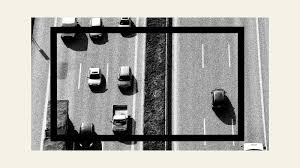
Featured image courtesy of The Atlantic
Copy Edited by Colette Potter ‘26
Leave a Reply