Olivia Zimmerman ’29
Staff Writer
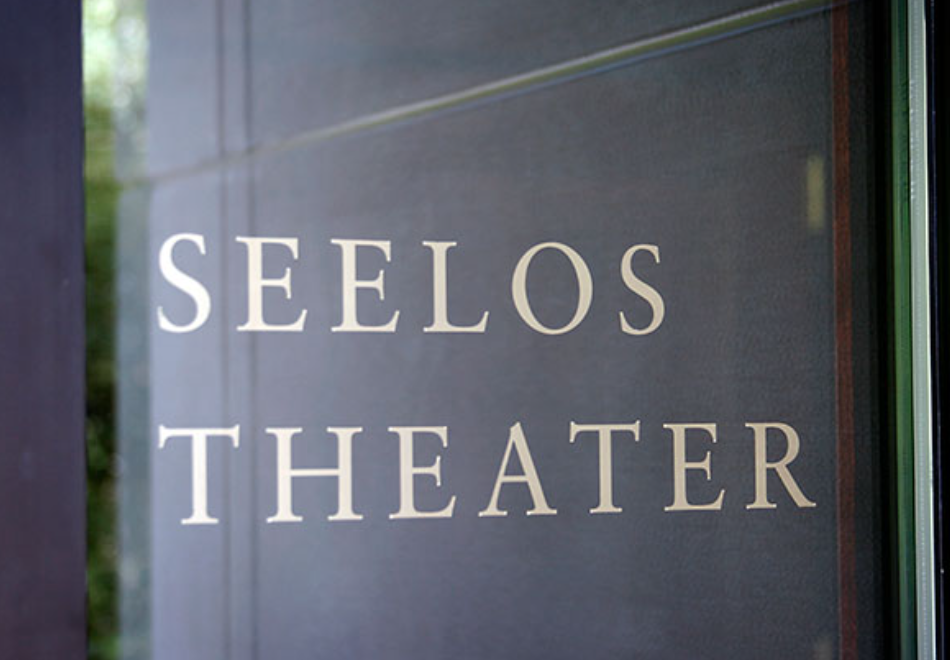
If I were to tell you Holy Cross has its own movie theater, would you believe me? Beneath the well-known terrain of Kimball Dining Hall, auditorium seating, cushioned chairs, dimmed lights, booming audio, and a massive movie screen await you. This pseudo theater contains perhaps one of the most precious traditions of the school, which also happens to be one of the most unknown and unappreciated ones. Not because it is a bad tradition, but simply because students either don’t know about it or aren’t inclined to participate in it.
But why?
The Seelos Film Series is a long-standing Holy Cross tradition where movies, typically new releases, are played at Seelos Theater on Wednesdays, Fridays, and Saturdays. I recently attended several of these showings and was surprised at the sparse number of students in attendance. And by sparse, I mean close to none. My two friends and myself pretty much had the theater to ourselves, and while it was admittedly quite nice, it made me wonder why the events aren’t more popular. After all, who doesn’t like free movies in a theater setting?
I decided to launch my own investigation about the Seelos Film Series. How did it come to be, and was it ever a popular phenomenon? Since the 1920s, cinema has been a cornerstone in the Holy Cross community. Originally, films were shown in the basement of St. Joseph Memorial Chapel. From there, Fr. Frederick A. Gallagher took the torch in maintaining the presence of cinema at the college. In 1946, upon returning to Holy Cross after serving four years and ten months of active duty in the Marine Corps, he introduced the ‘Great Movies’ series. It was a sweeping success, and “so popular did this extracurricular activity become that he was forced to limit the number of tickets”
After Fr. Gallagher’s passing in 1964, the series was renamed the Gallagher’s Critic’s Choice Film Series to honor his legacy. The series was then headed by Charles A. Baker, who chose a variety of films to be screened, from classics to contemporaries. However, its popularity seems to diminish through the years. Vanessa Young, a writer for Crusader, Holy Cross’s newspaper in 1978, explains how “Baker is baffled by the lack of interest displayed in Holy Cross students in on-campus cinema… He termed it a ‘tragedy’ that students fail to take advantage of an opportunity to view close to 400 films during their Holy Cross careers”
(file:///Users/owner/Downloads/Crusader_September_8_1978%20(1).pdf). Between 1946 and 1978, something happened to enthusiasm surrounding these films, and that something continues to hold true today with the Seelos Film Series. Perhaps this has to do with the fading novelty of cinema, or perhaps it is the result of something more in our control.
If I were to guess, I would attribute the lack of interest to two main reasons: 1.) A lack of advertising. I find that these movies are not well advertised among the Holy Cross community. Or, at least, they are not advertised in a way that would reach the greatest number of students. The way I learned about this film series was through an advertisement projected on one of the screens near D’Agostino’s Cafe in the science complex. It was among a rotating set of advertisements, so it showed up on the screen for about a minute and then was replaced by another set of information. While the series is featured in the “Today At Holy Cross” emails, it is always placed towards the bottom, likely eluding the attention of the average Holy Cross student.
2.) The chosen movies. The premise of the Seelos Film Series is to play new movies, simulating a real movie theater. However, this may be part of the reason why the events aren’t more popular. While new movies can be great, they can also be quite flawed (and often are).
I think it would be more enticing to play movies that are fan favorites and critically acclaimed masterpieces; just imagine the thrill of seeing that your favorite movie is being played on the big screen at Holy Cross’s theater.
Flawed or not, popular or not, I believe the Seelos Film Series is an underrated gem at Holy Cross. It is certainly worth checking out, and perhaps we can bring its popularity back, just as it was in Fr. Gallagher’s day.
Featured image courtesy of Holy Cross Magazine
Copy Edited by Sophia Olbrysh ’28

Leave a Reply