Nathaniel La Blanc’28
Staff Writer
On Wednesday April 2, President Donald Trump announced sweeping new “Liberation Day” tariffs. The import taxes are the largest ever tax increase on American citizens, and represent the highest tariff rate since World War II. Economists predict that these tariffs will raise the price of consumer goods, lead to more inflation, and are likely to cause a recession.
Tariffs have long been a goal of the Trump administration as a way to counter the trade deficit that the United States has with other countries in order to stop them from “ripping us off.” However, unlike a budget deficit, a trade deficit is rarely viewed as a bad thing. The United States buys more from Japan than Japan buys from the United States, for example. This is because Japan has less than half the population of the United States, so naturally it buys less. This doesn’t mean that the United States is “subsidizing” Japan, nor does it mean that Japan is “ripping us off.” Most consumers have a trade deficit with their grocery store, yet it would be ridiculous to say that most consumers are ripping their grocery store off just because they buy more from the store than they sell to it.
Many trade wars are also started in hopes of getting better trade deals with other countries. If United States markets are favorable to Canada for example, but Canada is threatened with a tariff that is higher relative to other countries, then Canada is far more likely to offer the US a favorable deal in exchange for access to US markets. However, by tariffing every single country on Earth, no country has a favorable trade deal with the United States now, so no country has any incentive to compete with each other over US consumers.
Tariffs are also not necessarily a bad thing. Economists advise that there are good reasons for small tariffs on specific products. If there is a small tariff on steel imports, like President Biden’s policy in 2024, then construction companies using imported steel can gradually shift to using the domestic supply. Tariffs also only work if there is a domestic alternative to the imported product, like how US steel is an alternative to imported steel.
Trump’s policy, however, is large tariffs on all products which economists strongly oppose. Coffee, one of the goods hit, can’t be produced domestically as the United States doesn’t have the tropical climate for it. Coffee coming in from Vietnam is subject to a 46 percent tariff, and coffee companies like Starbucks and Dunkin’ have no US-produced alternative to buy. With their costs going up astronomically, this policy makes mass layoffs more likely. For companies that do not do layoffs, their higher costs are almost certainly going to be passed on to the consumer, resulting in inflation being exacerbated.
In contrast with the average rate of 2 percent in 2024, Trump announced a 10 percent minimum tariff on the entire world and other country-specific tariffs, some as high as 50 percent. As of April 3rd, there are also tariffs on islands that are only inhabited by penguins. The haphazard way that these tariffs were implemented has led some commentators to speculate that they were calculated using AI. On the Thursday after “Liberation Day,” the S&P 500 fell almost 5 percent and on Friday it fell 6 percent. It was the US stock market’s largest two-day point crash in history. In addition to the risks that the tariffs themselves pose to the American economy, there are also the risks posed by other countries imposing retaliatory tariffs. Many countries including China and Canada have imposed matching tariffs on US goods, making their consumers less likely to purchase American exports. All of this combined has led to firms like JP Morgan putting chances of a recession in 2025 at 60 percent if these tariffs are not taken away.
Trump’s trade policy seems to be taken from the late 1800s when there was virtually no income tax and the government was funded primarily through tariffs. This period is commonly known as the Gilded Age because of the extreme wealth disparity between the rich and the poor. This disparity was only exacerbated by the tariffs because, like today, the cost of those tariffs were overwhelmingly felt by the average consumer. It is also mathematically impossible to replace the income tax with tariffs because today, unlike in the 1800s, we have the largest military on Earth and programs like Medicare, Medicaid, and Social Security, which people rely on. Trump has also claimed repeatedly that the tariffs could raise 6 trillion dollars (a figure widely debunked by economists), and thus pay for his coveted corporate tax cut which is currently making its way through Congress.
Unlike many previous recessions, if this one happens, it will be entirely self-inflicted by the United States government. And while the stock market always eventually goes back to normal, what will never go back to normal is the price of goods. If inflation goes up, it never comes down, the only thing that comes down is the rate at which it increases. While Trump may backpedal on some tariffs like he did previously, Trump’s brand of unpredictability is toxic when markets and countries crave stability.
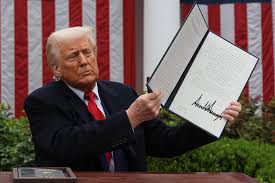
Featured Photo from PBS
Leave a Reply