Ben Lepper ’25
Editor-In-Chief
I’ve been reflecting on Kendrick Lamar’s Super Bowl Halftime show lately. There’s one part that really stood out to me. It wasn’t the breathtaking choreography, nor was it the near-perfect setlist or Samuel L. Jackson’s portrayal of Uncle Sam.
It was the fact that he brought out DJ Mustard. And, while seemingly a simple moment in a complex halftime show, I think that this was a lot more important than people think.
Let me backtrack a bit. For the past ten years of my life, I have been a music producer on the side. I use Logic Pro X and I am entirely self-taught. I’ve produced under a number of stage names and a wide variety of genres, but I’ve lately found success producing chill and melodic house music (think Ben Böhmer, Tinlicker, Christian Löffler, etc.) under the alias Cloudcage. I know how hard it is to make music, and how much harder it is to make music that people actually listen to.
So, what is a music producer, really? In most genres, a producer is someone who works alongside the main artist to ensure every aspect of the artist’s vision is realized. This includes duties such as finding the right studio musicians, scheduling recording sessions, and, often, assisting with mixing, mastering, arrangement, and other essential aspects of the music creation process.
Electronic dance music is a bit different from most every other genre in that it is usually the producer who is the main artist and performer. Often, larger acts will have co-producers in the studio with them, but that main producer is still the main artist. Take John Summit, for example, or Zedd. They are the artist, and it is their vision that they are fulfilling. A lot of other artists in other genres are mostly self-produced, too; Tyler, the Creator, Travis Scott, and (recently) Clairo are three names who come to mind.
But, in many other cases, main artists work closely with producers to fulfill their vision. And, a lot of the time, these producers remain fully unknown. They aren’t listed anywhere on the release except for somewhere deep in the credits.
This, to me, isn’t right. Because, without producers, there is no song.
Now, not every producer remains completely unknown. A lot of pop music fans know that Jack Antonoff is behind recent albums by Taylor Swift, Sabrina Carpenter, Gracie Abrams, Lana Del Rey, and more massive names. In addition, while sometimes hard to spot, hip-hop producers will put their signature “tags” in their productions. You’ve probably heard “Mike Will Made It,” “Daytrip Took It To Ten,” and Pharrell Williams’ signature four-count more times than you know.
But, even then, it still feels like producers are fully underappreciated. Tate McRae fans may not know that Grant Boutin produced her megahits “greedy” and “Sports car,” and 21 Savage fans may not know that “redrum” was produced by London On Da Track. I often find production quality to be a make-or-break aspect of a song, and all three of those aforementioned tracks are extremely high-quality. It’s just a shame that Boutin and London don’t get the public recognition they deserve.
This all came to a head for me when I saw a video on TikTok of Joey Hamhock, a producer who worked on Doechii’s “Alligator Bites Never Heal,” celebrating the album’s Grammy win while delivering for Amazon. To see someone who had a hand in producing such a massive and well-respected album have to turn to delivery driving because they can’t fully support themselves on the hard work they do fulfilling an artist’s vision is simply devastating.
Something’s gotta change. Either artists need to start giving their producers their flowers publicly, or producers need to do something so their work can be appreciated. I’ll give an example of both.
Metro Boomin is an interesting case because, in addition to producing for other artists, he releases his own albums as a main artist and features guest performers, rather than having him take a backseat to those performers. He’s the main feature on “NOT ALL HEROES WEAR CAPES” and “HEROES & VILLAINS,” and it seems like, by doing this, he’s become even more and more of a household name. I think this is great, and more producers should follow in these footsteps. It’s an easy way to gain some recognition.
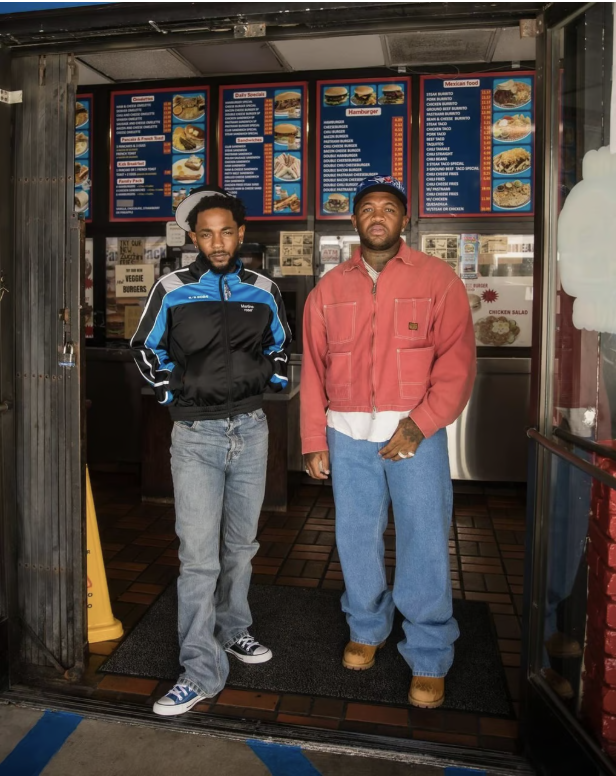
Now, I’d like to go back to Kendrick Lamar. What he has done lately to bring DJ Mustard into the spotlight is simply incredible. Not only did he repeat Mustard’s producer tag as the first line of “Not Like Us,” but he brought him back on for production duties on the now-famous “tv off,” in which Kendrick screaming out Mustard’s name has become one of the most well known moments on his recent album. This is something that I’d like to see a lot more of. To some, the “MUSTARD” shout was just a funny joke. But, to me, it felt like a hip-hop megastar giving his producer some well-deserved recognition. And, that it did: it felt like everyone was yelling “MUSTARD” for a few weeks non-stop.
It is impossible to deny that music producers are among the most important parts of the music industry, and I hope that, as time goes on, all of them will gain the recognition that they deserve. Because, at the end of the day, their work deserves the same respect as the main artist’s, who wouldn’t have anything close to a finished product without them.
Featured image courtesy of Instagram
Leave a Reply