Kate Santini ‘27
Chief News Editor
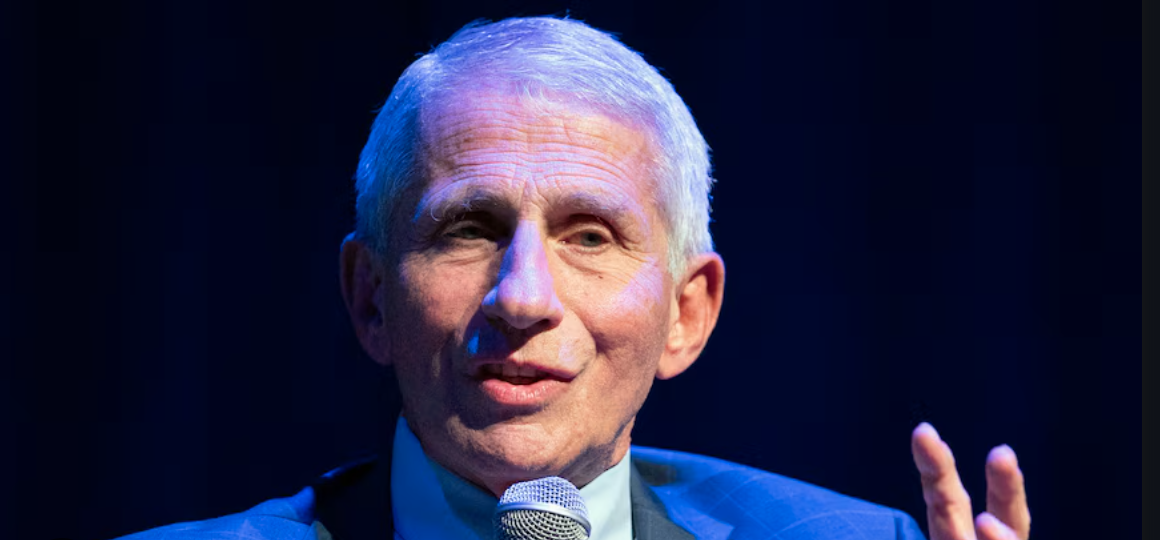
Dr. Anthony Fauci ‘62 ushered in his highly anticipated residency at the College with a talk reflecting on his lifelong career in public service. The lecture, titled “HIV/AIDS: Science, Policy, and a Personal 43-Year Journey,” was centered around his recently published memoir, On Call: A Doctor’s Journey in Public Service. Fauci structured his talk by bracketing the 43 years he dedicated to fighting the HIV/AIDS epidemic into four different categories.
After graduating from the College of the Holy Cross with a Bachelor of the Arts degree and on the pre-med track in 1962, he completed a medical residency at the Cornell Medical Center in New York City. He then went on to pursue a fellowship at the National Institutes of Health, where he was eventually promoted to director of the National Institute of Allergy and Infectious Diseases (NIAID). During his early years at the Institute, he worked closely with its previous director, Sheldon M. Wolff, to publish research findings on viral infections.
From the years of 1981-1984, Fauci grew disconcerted with reports of previously healthy, young men suddenly exhibiting symptoms of “pneumocystis pneumonia.” Exposure to these early reports of HIV/AIDS outbreaks permanently altered the “arc of his career.” During these dark years, an AIDS/HIV diagnosis was virtually a death sentence, with the majority of patients dying within ten to fifteen months of being diagnosed. As the public began to piece together the disease’s association with homosexuality, AIDS patients became highly stigmatized. Fauci explained that prior to being formally known as the AIDS epidemic, it was often colloquially referred to as the “gay plague” or “gay cancer.” Contrary to popular belief, this disease was not limited to homosexual men. In fact, infection appeared in an equal ratio of men to women in sub-Saharan Africa countries, where a total of 67% of the cases were concentrated.
Fauci first entered the public sphere when he was named the NIAID director in 1984. While he confessed that becoming a leading figure in public health was not his initial plan, the federal government’s inaction in the early years of the AIDS epidemic compelled him to assume this position. During his 38 years as director of the NIAID, Fauci advised 7 different U.S. presidents on public health policy and testified before Congress more than anyone else in history. He ultimately succeeded in increasing the visibility of the AIDS crisis and acquiring funding for treatment research. Under the Clinton administration, he secured federal funding to create a vaccine research center at the National Institutes of Health (NIH) which according to Fauci, was built faster than any other building in NIH history.
While working alongside U.S. presidents such as Ronald Reagan, who was infamous for his failure to acknowledge the AIDS crisis, Fauci confronted backlash from AIDS activists. Founder of ACT UP New York, Larry Kramer, published a scathing New York Times article titled “I Call You Murderers” in which he criticized Fauci for being inattentive to the needs of AIDS activists. Fauci took Kramer’s criticisms seriously, eventually meeting up with him and his fellow ACT UP members in 1989. Fauci and Kramer developed a lifelong friendship in spite of policy disagreements. Fauci shared that the ambitious Kramer urged him to take radical measures such as “chaining himself to the White House fence.” After losing his beloved friend to AIDS, which he battled for much of his life, Fauci published a pensive article on how to love “difficult people.” Fauci shared that working closely with Kramer and other LGBT activists broadened his perspective on the AIDS epidemic and revived his commitment to serving others.
After years of research, the medical field issued an FDA-approved 3-drug regimen that would significantly increase the life expectancies of AIDS-afflicted individuals and reduce the infections to below detectable levels. In 2003, after these drugs became widely accessible in the United States, Fauci set out for sub-Saharan Africa as a part of the President’s Emergency Plan for AIDS Relief (PEPFAR). It is estimated that by increasing testing and drug accessibility, this project prevented 7 million new cases from arising and saved 26 million lives. PREPFAR is often referred to as the most impactful public health program of all time. While proud of his successes here and abroad, Fauci still feels that there is work to be done. Racial and geographic disparities still remain barriers to widespread accessibility to these life-saving drugs. Fauci is still working to help the 9.2 million infected people across the globe who lack access to treatment.
At the conclusion of his talk, Fauci was asked to reflect on memorable moments at Holy Cross. The native New-Yorker jokingly recalled a late November football game against Boston College where he claimed to be “the coldest [he’d] ever been in [his] entire life.” On a more serious note, he spoke of the College’s unique sense of “camaraderie” that lies at the heart of Jesuit education. After concluding his talk, Fauci received an honor from Worcester city mayor, Joseph Petty, for guiding the city’s public policy during the COVID-19 pandemic. Students and faculty were then invited to get copies of Fauci’s memoir signed.
The College of the Holy Cross is honored to have Dr. Fauci back on the Hill and looks forward to what the rest of the Fauci-Grady residency has in store.
Featured image courtesy of ABC News

Leave a Reply