Emily Costello ‘27
Staff Writer & Web Editor
Kendrick Lamar’s Halftime performance was both creative and symbolic of both his feud with Drake and our country’s current political disconnect. We open with lights forming the buttons of a video game controller, and numbers rising from zero to one hundred, like a game is loading up. Samuel L. Jackson then enters, introducing himself to us as “Uncle Sam” and wearing a suit identical to that of the famous American figure. He then introduces us to “the great American game.”
The camera pans to Kendrick Lamar standing on a car, that background dancers dressed in either red, white, or blue begin to pile out of, reflecting the foundations of our American ideals in consumerism. Our country’s “game” then ensues, each dancer performing their own individual choreography, representing our society’s disconnect. And then, Kendrick pauses “the game.” His music is interrupted, the lights strobe, and the dancers are stunned, looking up to Kendrick in shock.
Kendrick says “The revolution’s about to be televised, you picked the right time, but the wrong guy.” This statement is inspired by the song “The Revolution Will Not Be Televised,” by Gil Scott-Heron, a satirical piece against consumerism. For me, Kendrick’s statement held two meanings. The first of which is that Kendrick is “the wrong guy,” to have been chosen to perform if a performer who would “play the game” was wanted. The second meaning, is that American voters picked the right time for wanting a change in our country, whether social or economic, however they elected the wrong guy, Donald Trump, to lead us in such change.
The dancers then scatter, frantically flailing their arms, illustrating Kendrick’s disruption. We then hear ominously “someone better squabble up,” warning those who hope to keep “the game” intact, that Kendrick is ready to fight. The dancers are now moving in unison, representing how an acknowledgement of who the real enemy is in America can heal our current polarization.
Uncle Sam returns, telling Kendrick that he is “too loud, too reckless, too ghetto,” and asks him if he “really knows how to play the game,” chastising him to “tighten up.” This encapsulates how the creativity of black artists tends to be stifled in order for them to be deemed better conformists or “players of the game.” This queues Kendrick’s song “Humble,” illustrating the modesty black artists are forced to assume in order to be successful “players.”
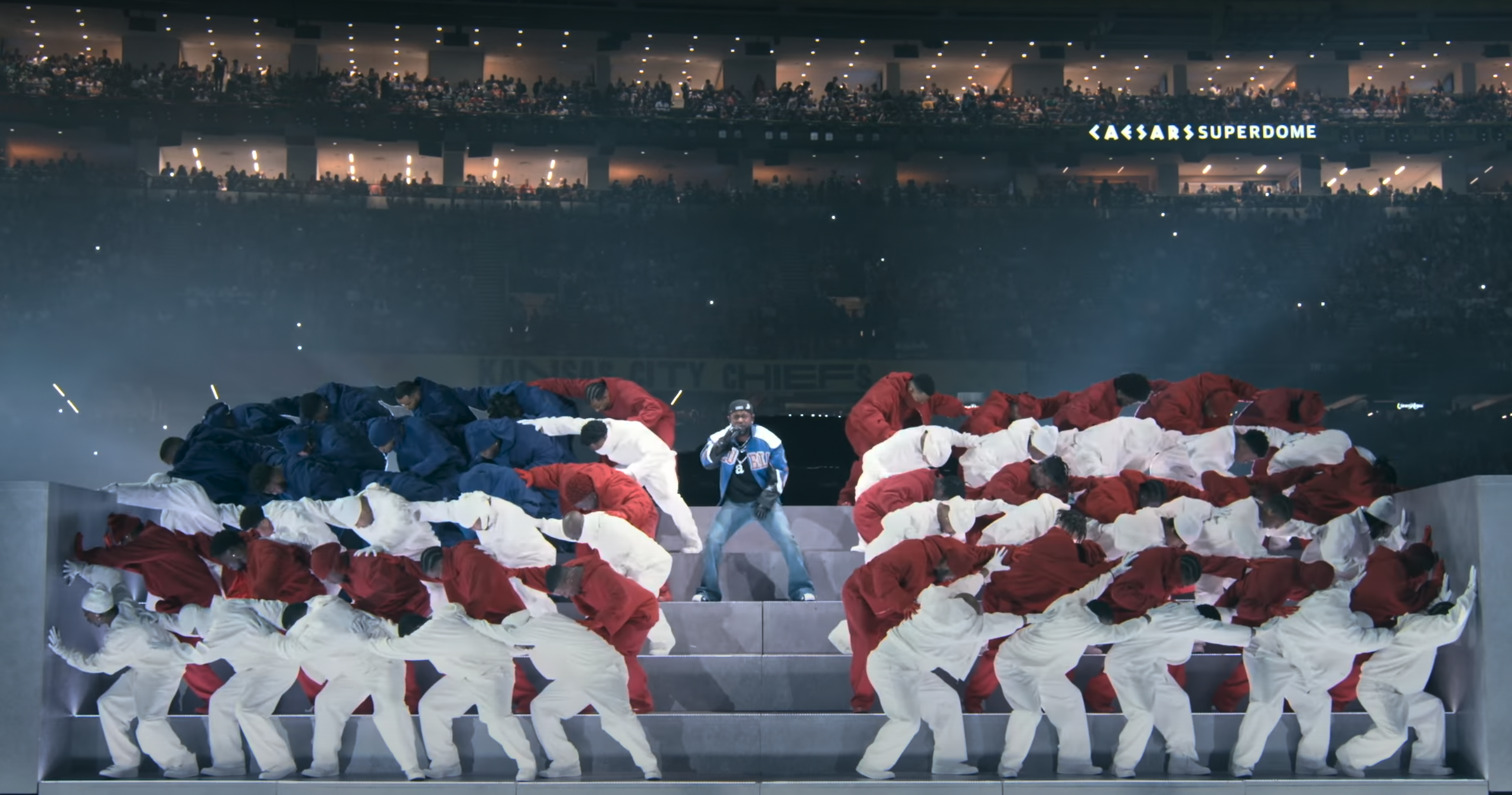
The dancers have now formed an American flag, split in half, with Kendrick in the middle. This illustrates the political divide in America, and how revolutionists such as Kendrick, want to fill the gap and heal our country’s disconnect. The potential for such healing is represented through the dancers performing the same choreography, no matter what side they’re on.
Kendrick then sings his song “DNA.” a celebration of black heritage, to be interrupted by a notification from “the game” that says “Warning: Wrong Way.” However, Kendrick does not change course and persists. Uncle Sam returns, looks into the camera, and tells the scorekeeper to “deduct one life,” on account of Kendrick using the “old culture cheat code,” enforcing the idea of how a celebration of diversity is frowned upon by the “game’s creators.”
Kendrick’s performance slows down and becomes a bit more conventional, to the voiced pleasure of Uncle Sam. However, this peace is quickly upended as we hear the intro of “Not Like Us.” Kendrick claims that it’s a “cultural divide,” and “forty acres and a mule, this is bigger than the music.” Kendrick is saying here that his ability to perform “Not Like Us” signifies not only justice for himself in his feud with Drake, but for all black artists in America who have been silenced.
Kendrick then repeatedly says “Turn this TV off,” for the words “GAME OVER” to appear. This signifies how Kendrick has won the feud between him and Drake. But more importantly, it symbolizes Kendrick’s upheaval of the “great American game,” and the systems that profit off of it at the expense of innocent people.
In summary, Kendrick’s was one of the greatest Halftime Show performances I’ve ever seen. It not only served a tribute to his career, but as a wake-up call to Americans of how we need to fight hatred and forced polarization with progress and unity.
Copy Edited by Charlotte Collins ’26
Featured image courtesy of YouTube

Leave a Reply to AnonymousCancel reply