Emily Costello ’27
Staff Writer and Web Editor
For the first Creative Writing Reading Series event of the spring semester, we heard from Professor Leah Hager Cohen, who read for us excerpts from her seventh and latest novel, entitled To and Fro. Before reading, Cohen presented us with a process portfolio, telling us she believed the process of writing is just as, if not more interesting than, the product. She informed us that To and Fro was actually born from a completely separate project: a narrative nonfiction book about Torah study. However, once Cohen heard that those at Torah study did not want her writing a book about them, she respectfully abandoned the project, caring more about being a member of the community than writing a book. I also enjoyed hearing Cohen talk about the dynamic atmosphere at Torah study, in which nobody is “wrong” or “right,” and everyone is entitled to their own individual interpretations.
In her study of Judaism, Cohen discovered a Franz Kafka parable that catalyzed her novel, in which a man requests his horse so that he can reach his elusive “destination.” Cohen described to us how she basically wrote “fanfiction” about this parable, in which she developed a character who overhears this man’s conversation and sets off on a bicycle with a kitten with provisions for the man who has rode off. This girl, named Ani, would be one of the two main characters of Cohen’s novel.
The most impressive part of Cohen’s novel is its unique structure, where there are two stories in one book. After reading the first half, readers can flip over the book and read the second half which starts from the back, for both narratives to resolve in the middle. This concept for a novel was common in the 17th century for devotional books, and it’s also known to the French as a “Tête-bêche,” (head to tail) or a “Dos-à-dos,” (back-to-back). Ani’s story is the first half, or the “To” section of the book. The “Fro” section of the book is centered around another young girl named Annamae who lives in contemporary Manhattan.
Cohen read us two chapters from the novel: one from Ani’s narrative and another from Annamae’s. From these two chapters we were given a thorough view of these dynamic characters and their motivations. This novel tells two narratives with themes of adventure and navigating young adulthood, embracing simultaneously the struggles, kindness, and humor one is bound to face in adolescence. More importantly, though, this novel is about the idea of reaching, longing, and finding a destination that you can never fully arrive at. Our two main protagonists are yearning for their destinations in their own separate narratives, Ani for the man on the horse and Annamae for a sense of fulfillment in her seemingly trivial life. But, more importantly, these girls are yearning for each other, which becomes all too clear to the reader as we see each girl echo in each other’s narratives and be in subconscious dialogue with one another.

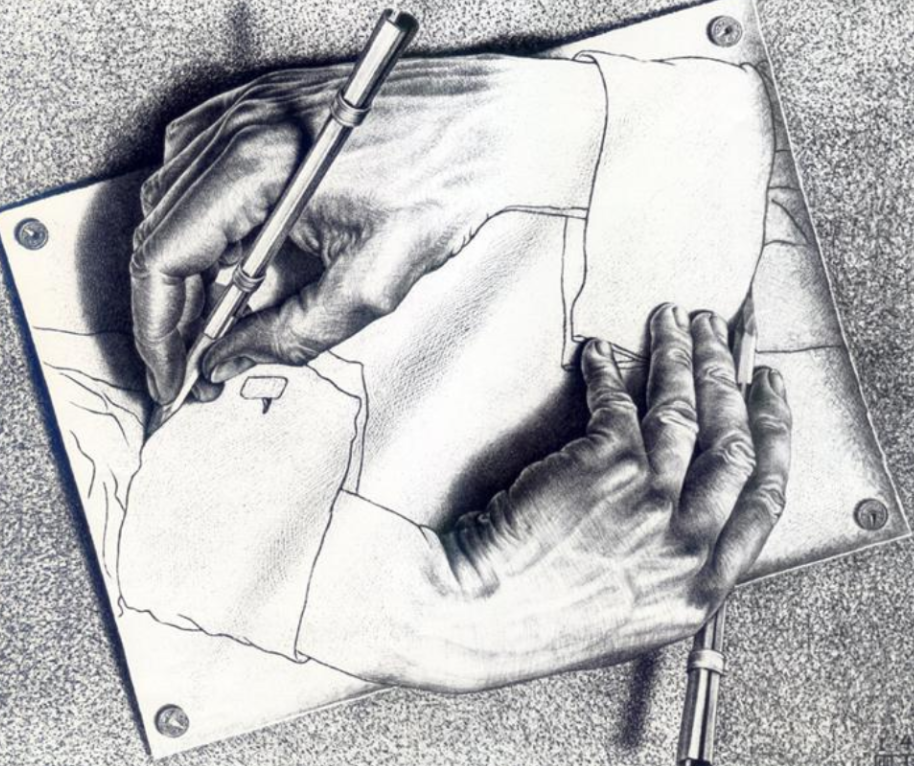
Cohen then displayed to us M.C. Escher’s lithograph entitled Drawing Hands, which depicts two hands drawing one another into existence. Similarly, our protagonists, who initially seem to have nothing in common, are somehow tethered to one another’s existence, transcending time and space. Cohen also cited Hilma af Klint’s painting The Swan, where two swans on opposing sides of the canvas with inverted black and white coloration are trying to touch beaks in the middle. And as Annamae questions the idea of having an “other” or “double,” suspense looms over the reader as the girls get closer to making contact, just like our swans.

To hear Cohen speak so passionately about her process and how connected she felt to her protagonists, combined with the ingenuity of the novel’s concept, has in my opinion created an entirely new standard for the modern novel to be held to. Though I have not yet read To and Fro, I immediately bought a copy after Cohen’s reading. And I am so excited to see these girls’ journeys as they, as Cohen put it, “reach toward the impossible, but the extremely real.”
Featured images courtesy of Wikipedia and Art Gallery of NSW
Copy Edited by Annamaria DeCamp ’27
Leave a Reply