Shaye Callanan ‘26
Staff Writer
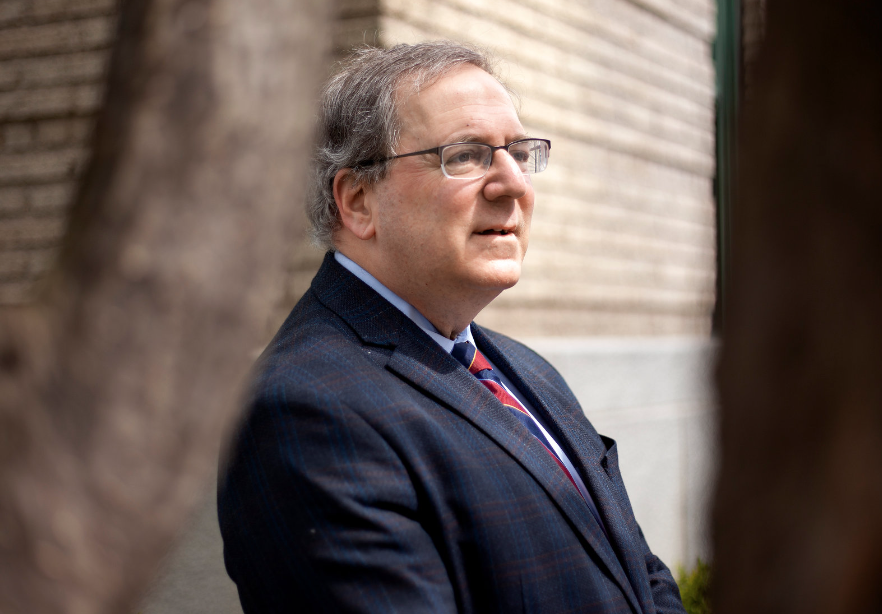
This past Wednesday, David E. Sanger, White House and National Security Correspondent for The New York Times, came to speak at the Prior Performing Arts Center. His talk was entitled “A World on Fire: China, Russia, and the Challenges for the Next President.” Sanger spoke about his new book, entitled “New Cold Wars: China’s Rise, Russia’s Invasion, and America’s Struggle to Defend the West.”
The Editors-in-Chief of The Spire had the chance to interview Sanger directly. They first asked about how he developed his career, and he said that he was a Government major in college with a strong interest in politics and technology, and that everyone around him knew he would be a journalist. The editors then asked what advice Sanger might give to students who are interested in journalism. He responded that journalism is all about collecting many perspectives, always writing, and figuring out what you believe. They also asked how to create a space for effective political discourse on campus, which is especially prevalent during this Presidential election season. He replied that he strongly believes in civil discourse. He also said that being the president of a university is the most dangerous job in today’s America, as they have to protect free speech and open dialogue while denouncing ideas that are offensive to the identities of some students. However, he does not believe this is a defect of our education system, but rather an important feature of it.
Sanger’s address at the Prior Performing Arts Center was impressively engaging and digestible while addressing such dire global political issues. He opened his speech recognizing how he loves coming to Holy Cross and emphasized how it is an amazing institution. He then began the core of his talk, saying that while it is important to focus on this election’s significant impact on domestic politics, we should really be asking ourselves what it will mean for America’s place in the world. He interviewed Trump in 2016 before his election, and claimed he is somewhat responsible for Trump’s use of the phrase “America first.” While speaking with the candidate, Sanger said that Trump’s non-interventionist rhetoric reminded him of President Woodrow Wilson’s use of the term “America first” in reference to America initially remaining neutral in World War I. Trump then began frequently using the term when promoting exclusionist efforts. Sanger jokingly apologized for giving him the idea, but moved onto his thoughts on how internationally, we have returned to a state of political superpower conflict. Russia and China have begun to join Western institutions and firms while somewhat liberalizing their economies to make their way into American markets. Thus, they have overcome their own traditional ideological views, and America is no longer the sole, liberalized superpower. He believes this topic is central to the upcoming election, which is on par with the most significant in American history. Before the Beijing Olympics, which was a time of COVID isolation, China and Russia declared that they had a “partnership without limits;” one that has managed to flourish in the past years. Sanger said this coming together of Russia and China will define the next twenty to thirty years, as while their ideological identities are not aligned, their military and economic goals are similar.
The Q&A section was moderated by Professor Amy Singleton Adams, Department Chair of World Languages, Literatures, and Cultures and Professor of Russian Studies. A few questions stood out, especially one about the likelihood of nuclear war in our current political climate. Sanger’s response was definitive: “A nuclear war cannot be won and therefore must not be fought.” Then a student inquired more about the alliance between China and Russia, to which Sanger referenced his book and a “knowledge gap” he writes about that exists between the West and China and Russia. He was delighted to hear that this student had studied abroad in China, and says that traveling and seeking to know about other cultures and how they think is vital to navigating our multipolar world in the future. He called American universities our “greatest soft power.” He closed with remarks about how technology can certainly aid our diplomacy in the future. Overall, Sanger gave a comprehensible speech on how the upcoming election in November will define America to the rest of the world, and how we can navigate that as students.
Featured image courtesy of The New York Times
Copy Edited by Lily Wasmund ’28
Leave a Reply