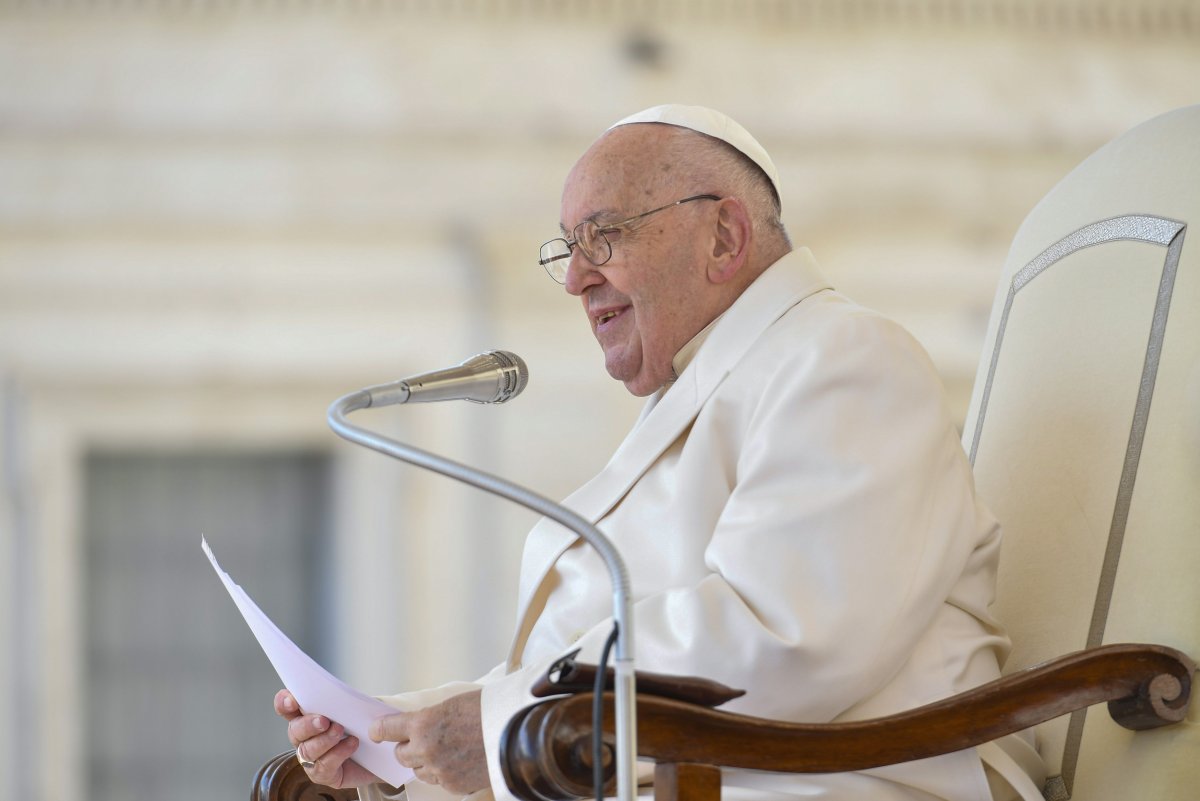
A Message to the People Who Think They Know More than the Pope 

Published by

on

Bryce Maloney ‘26

Opinions Editor

Jorge Mario Bergoglio is an 87 year old single father from Argentina who works multiple jobs. They include, among other things: Bishop of Rome, Vicar of Jesus Chirst, Successor of the Prince of the Apostles, Supreme Pontiff of the Universal Church, Patriarch of the West, Primate of all Italy, Metropolitan Archbishop of the Roman Province, Sovereign of the Vatican City State, and Servant of the Servants of God. In short, if you didn’t already get the message, I’m talking about His Holiness Pope Francis, the 266th leader of the Roman Catholic Church. His children are the 1.3 billion faithful worldwide for whom he serves as God’s representative on earth. However, not unlike an unruly teenager, many Catholics both clergy and laity alike seem less than eager to follow his advice and council, nor to recognize his authority. Many traditional Catholics, especially those in the United States, have actually become vocal critics of the Holy Father in a way which has not been seen within the church since the time of the Reformation. They find themselves unhappy and disillusioned with the Pope’s stance on, among other things, blessings for same-sex couples performed by Catholic clergymen, the acceptance and participation of LGBTQ+ Catholics, the role of women in the church, as well as limits on the ways by which the Latin Mass may be celebrated. Higher-ups in the American Catholic Church have spoken out especially against Papal initiative – seemingly trying to demonstrate the idea that the most Catholic thing someone can do is to publicly chastise the man who has been chosen by the greatest Catholic minds in the world as the leader of our church. The belief that the Pope is God’s representative here on earth plays a defining role in what it means to be Catholic. In short, it’s what separates us from everyone else. As Protestant denominations may change makeup and teachings from parish to parish, the universality of our faith provides that under Papal leadership, all of our followers aim toward one mutual focus. It provides clarity and unity in the variance of a disunified world. 

Last year, the Holy Father ousted one of his harshest critics, the now-ex Bishop of Tyler, Texas, Joseph E. Strickland. Among other criticisms, Strickland was reported to have read a letter aloud during a speech in Rome last October, which claimed that Francis was a “Usurper.” Strickland later called the author of that letter a “dear friend” before showering his work with praise. While many could make the argument that this type of self-serving insubordination showcases the cracks which run deep in the bureaucracy of the Roman church, I think that the problem comes more from the mentality of certain conservative leaning factions of Catholic leadership. While people starve and die in the millions, and as wars rage on in Ukraine and Palestine, conservative leaders of our church find it more important to spend their days arguing about saying the mass in a dead language, revoking the right of pro-choice politicians to take communion, and a push against women taking on a greater role in the church. While I am well aware that the Catholic church and its surrogates are responsible for some of the most wide ranging charitable and humanitarian projects across the globe, I think leaders like Bishop Emeritus Strickland who use their platforms in their community to push their own personal agendas damage the truly great work done by the Catholic church. It gives people the idea that leadership of the Church has disconnected with the lives of real people– and instead spends its time squabbling over issues which only seem to chastise and isolate people from the fullness of God’s love. It’s a huge part of the reason that the church is losing money, and that masses seem entirely devoid of younger people. As a Catholic who took the initiative of receiving my First Communion and Confirmation as an adult, I can testify that my decision came largely as a result of Pope Francis’s openness, not in spite of it. In reality, I think Pope Francis seems to be one of the few leaders in the Catholic church who has accurately understood the need to prove that our Catholic values can match those of the modern world – and that if we should ever hope for our churches to be full once again, we should consider the idea that openness may be a more suitable method of action. 

If recent years in the Catholic Church have taught us nothing else, we should know by now that only complete transparency will restore the faith of Catholics in their leadership. There is an old saying: a church that marries itself to the spirit of one age will be widowed in the next. I worry that leaders in our church who hold us back from making substantial progress on these issues have married themselves to the thinking of the past. Allowing for that opinion to become mainstream within our church is detrimental to its survival. After all, to quote Pope Francis, “We are all children of God, and God loves us as we are and for the strength that each of us has to fight for our dignity.” 

Featured Image Courtesy of Newsweek

Copy Edited by Sabine Hinkaty

11 responses to “A Message to the People Who Think They Know More than the Pope ”

  1. mosckerr Avatar

    Following the splitting of the Sea of Reeds Moshe introduced the song of victory wherein he describes HaShem as a “Man of War”. What does that mean? God is not a Man! Rehashing an old Xtian propaganda with a fundamentalist Xtian.

    Frank Hubeny says:

    July 2, 2025 at 4:52 pm

    I don’t know what that essential question is.

    However, I do agree with you that the way John 1:1 was translated into Greek from Hebrew was confusing.

    If the Van Rensburg’s are correct, then “Word” was originally “Son” in the original Hebrew version: https://www.hebrewgospels.com/john
    ________________________________________________________

    mosckerr says:

    July 2, 2025 at 10:43 pm

    Frank you continue to presume that the Roman forgery NT, originally written in Hebrew. Bunk. Its target audience ALWAYS Goyim and not Jews. This explains why the NT reflects none of the halachic, oath britot, or Constitutional foundations of the Written Torah first revealed at Sinai.

    Dr. Janie van Rensburg and the notion of “Logos” in Xtian theology. This perspective aligns with traditional Xtian beliefs about the nature of the “Crisis” JeZeus – substitution theology. Several early church fathers likewise discussed this substitution theology. Justin Martyr (c. 100-165 CE), in both “First Apology” and “Dialogue with Trypho;” Irenaeus of Lyons (c. 130–202 CE), in “Against Heresies,” where he emphasized the role of “logos” in the creation and redemption of humanity. This falsely presumes that the local/tribal God of Israel lives as a Universal God. A key theme of both Xtian and Islamic substitute theology.

    Dr. Janie van Rensburg’s claim that Logos in John 1:1 was originally “Son”—this is just another layer of Christian revisionism. The entire “Logos” theology was developed by Church fathers like Justin Martyr and Irenaeus to blend Greek metaphysics with Roman theology, ultimately inventing a universalist “Christ” divorced from the פרט, tribal brit at Sinai. This classic substitute theology—replacing Israel’s national oath brit-inheritance-as the chosen Cohen people, with a mythical “son of god” and imagining that Goyim inherit spiritual truths which bypasses Torah altogether. Even Paul’s grafting metaphor does not go this far! It falsely fuses Greek metaphysics with Roman theological imperialism.

    Let’s be clear: the Torah revelation revealed at Sinai, simply not a Hellenistic abstraction or a Neoplatonic emanation. The revelation at Horev (Sinai) – concrete, national, legal, and exclusive—bound by brit to the seed of Avraham, Yitzḥak, and Ya‘aqov. The Oral Torah’s פרדס system—especially as laid out in the opening sugya of Avodah Zarah—explains that the nations of the world rejected HaShem’s authority long before Sinai. Xtianity’s invention of “Logos” does not replace the oath brit sworn to the Avot. The NT false idea: that the tribal, covenantal God of Israel could somehow morph into a universal, metaphysical abstraction. This expresses the core lie of both Christian and Islamic theologies. They both erase the specificity of the brit—the national oath between HaShem and the seed of Avraham, Yitzḥak, and Ya‘aqov—and replace it with theological fiction. NT Greek “Logos” translations, tits on a boar hog – worthless.

    The Talmud, the codification of the Oral Torah פרדס logic system, teaches, as just mentioned, in the opening pages of mesechta Avoda Zarah that the generations of Adam prior to the birth of Noach utterly rejected the בראשית God. Only Israel accepted this בראשית God at Sinai. Your worthless bible Greek translations of “logos”, coupled with their later revised revisionist history/substitute theology, simply never accepted neither the first or second commandments of Sinai. Just that simple. The substitute theology of “logos” does not mean the Name revealed in the 1st Sinai commandment. The perversion of “son of god/messiah” – has no basis in the Oral Torah revelation at Horev. The church rejects the revelation of the Oral Torah 13 middot at Horev. Let’s be clear: the God of Israel revealed at Sinai – not a Hellenistic abstraction or a Neoplatonic emanation. The Divine Name revealed at Sinai is not “Jesus,” “Yeshua,” or “Logos.”

    Origen (c. 185–253 CE), Athanasius of Alexandria (c. 296–373 CE), Cyril of Alexandria (c. 376–444 CE) – all these silly Goyim theologians have likewise promoted this avoda zara. The facts, as clear as the Sun on a cloudless Summer Day, “logos” has nothing to do with the First Commandment of Sinai. Nothing in the Heavens, Earth or Seas compares to the revelation of this Divine Presence Spirit Name which breathes within the Yatzir HaTov of the chosen Cohen people.

    The substitute theology replacement of JeZeus as a mythical messiah for the oath brit sworn to Avraham Yitzak and Yaacov that they would father the chosen Cohen people – absolute narishkeit. Yom Kippur eternally remembers that HaShem made t’shuva and annulled the vow to make of the descendants of Moshe the chosen Cohen people instead of the seed of Avraham, Yitzak and Yaacov. The gospel abomination perverts the anointing of king David dedicated to pursue judicial justice within the borders of the oath sworn lands, as the intent and k’vanna of the mitzva of Moshiach. The specific פרט, of the husband of Bat Sheva, defines the כלל of the anointing of David as king by the prophet Shmuel.

    This revisionist substitute theology represents just a simple continuation of the Golden Calf substitute theology wherein the ערב רב, assimilated and intermarried Israelites, substituted the word אלהים for the revelation of the First Commandment Name. Substitution theology defines the avoda zarah of the Golden Calf for all generations.

    The early church fathers you mentioned engaged with the concept of “Logos” in ways that sought to bridge Greek philosophical thought and Xtian doctrine. The Mishna in Masechet Chagigah (Chapter 2, Mishnah 1). It states that anyone who contemplates the divine matters or the secrets of the universe—specifically what is above, below, or behind—should not have been born. Man simply incapable of comprehending the Divine; no more than an ant can grasp Human culture and civilizations. The Gospel Roman forgery of “logos” – simply a replacement theology revisionist history nonsense. Just that simple. Greek philosophy does not serve as the foundation upon which the Torah stands.

    Frank Hubeny

    Poetry, Short Prose and Walking

    I have no interest in the Oral Torah, Moshe, except as historical documents of the opinions people had over time about what was in the Tanach (Old Testament). It is at the level of the Christian church fathers.

    Now I do take the Old Testament more seriously than you do, because I see it as an historical document. What it says actually happened, but it is going to be difficult to construct a reasonable chronology from the Masoretic text because I believe the Genesis 5 and 11 genealogies were shortened by the rabbis in the 2nd century to discredit Jesus as the Messiah. Those genealogies should extend to about 5550 BC based on Septuagint readings of those genealogies.

    I also see the Daniel 9:24-27 prophecies as having been fulfilled by the ministry of Jesus and the destruction of the Temple in 70 AD.

    What I find interesting about the Van Rensburg’s translation of the Hebrew Gospel of John is that an argument can be made that the original autograph of John 1:1 could well have used the Hebrew word “ben” (son) rather than the Greek word “logos” (word).

    I agree that the use of “logos” was done to bridge Greek philosophy with Christianity. However, I am more interested in the Hebrew Gospel of John than I am in the Greek translation of it.

    I’ve mentioned these things before when you commented on my blog. Since we are on your blog, I am restating them.
    _____________________________________

    mosckerr

    July 3, 2025 at 8:56 am 

    Naturally Frank your a follower of classic Xtian substitute theology. Oral Torah as the definition of prophetic mussar as the k’vanna of mitzvot means nothing to Goyim who reject the revelation of the Torah at Sinai. Hence both the Pope & you pervert mussar and declare prophetic mussar as dogmatic history.

    The T’NaCH has a completely different Order organization than does the Old Testament perversion. The T’NaCH for example does not have Chapters and verses like as does the Old Testament perversion. The T’NaCH organized into sugyot, a concept which the Xtian translators changed into a completely different order of Chapters. Despite the word DOG having the exact same letters as GOD, the two words convey completely different meanings.

    Conservative and Reform Jews like you view the T’NaCH as historical documents. In the late 19th Century German Protestant ‘higher criticism’ actively promoted this Foo/narishkeit. A T’NaCH prophet commands mussar not history. Ya want history – then study it from a professor at a University.

    You believe no different than Muslims who declare that the Jews changed their Bible! LOL Arabs declare, like you, that Avraham did not dedicate Yitzak but rather Yishmael on the altar. And like you the Koran does not bring the Sinai First Commandment Name just like your golden calf bible abomination. So the only people who perverted the T’NaCH – Xtians and Muslims.

    Your pie in the sky slander against the Jewish people, does not fit with the mussar story of the Book Sh’muel which repeatedly states that king David profaned his anointing as Moshiach only in the matter of the death of the husband of Bat Sheva. Ooops Do you also declare that Jewish rabbis changed that Book too? Must have b/c otherwise your pie in the sky 2nd Coming floats like a lead balloon.

    Your worn-out theory compares to a blood libel slander. A textbook example of theological projection disguised as historical analysis. It reflects both ignorance of Jewish tradition and a desperate retrojection of Hellenistic Xtianity onto a text and culture it never understood nor has it any connection there unto.

    The Masoretic Text Is Not a 2nd-Century Rabbinic Invention. The idea that “rabbis in the 2nd century shortened Genesis 5 and 11” is complete historical fiction. The Masoretic tradition predates Xtianity’s revisionist history. Its textual lineage derives from the Second Temple period—Chag Hanukkah pre-dates JeZeus or the rise of the Church.

    The Dead Sea Scrolls (3rd century BCE to 1st century CE)—which predate the “2nd-century rabbis”—show a textual tradition aligned more closely with the Masoretic Text than with the Septuagint. The Tannaim of the 2nd century, such as Rabbi Akiva, engaged in preserving and interpreting inherited Torah, not fabricating new texts to “counter Jesus”, as your blood libel slander promotes. The notion that these sages rewrote Torah to discredit Xtianity reflect the mirror of Xtian super-sessionist fantasy—not history.

    The Septuagint written as a Greek Translation for Hellenized Jews. A Greek translation of parts of the Tanakh (mainly the Torah) done in Alexandria, Egypt, for Jews who no longer spoke Hebrew. Your claim that later Greek versions of Genesis, especially chapters 5 and 11, inflated lifespans and added generations—these deviations do not exist in any known Hebrew manuscript tradition. The Alexandrian scribes were influenced by Hellenistic numerology and cosmology, which sought to align world chronology with Platonic or Egyptian schemes.

    Irony: It is far more likely that the Septuagint’s chronology was lengthened to harmonize with Greek cosmogonies than that the rabbis shortened the Masoretic text to “disprove” Xtianity, which did not yet exist, when the Masoretic tradition the Men of the Great Assembly sealed in the days of Ezra.

    Xtianity has always promoted ‘Historical Revisionist’ propaganda. The accusation that Jews edited Genesis to disprove JeZeus represents classic Xtian ‘blood libel’ projectionism. The Church Fathers (Justin Martyr, Origen, Augustine etc), who reinterpreted or allegorized Tanakh to retroactively “prove” JeZeus as Messiah. The New Testament authors routinely misquote and mistranslate the Tanakh. Example: Matthew 1:23 quotes Isaiah 7:14, mistranslating “alma” (young woman) as “parthenos” (virgin) to manufacture a virgin birth prophecy.

    The NT genealogies of Jesus (Matthew 1, Luke 3), internally contradict one another, and historically utterly implausible. Those corrupt gospels constructed with theological agendas, not historical precision. If anything, Xtianity invented its own substitute genealogies and projected messianic expectations backwards to build a false continuity.

    The Tanakh Does Not Predict a “Crhisis”. The entire premise that Jewish texts should confirm JeZeus relies on the illegitimate Xtian hermeneutic of proof-texting and super-sessionism. Tanakh messianism centers on a national king of Israel—from David’s line, who will establish Torah justice, establish the Torah as the Constitution of the Republic, restore Judicial Review ie משנה תורה Common law courtrooms. State vertical courtrooms imposed by both Rome & Herod, which bribed both Justices and prosecutors through paid salaries, a direct Torah abomination of perverted justice. The idea of a crucified universal savior, as perverse as offering a maimed korban upon the altar. This utterly absurd idea carries the din of כרת.

    The “genealogies” in Genesis 5 and 11 Jewish tradition treats them within the Oral Torah framework which depict the timeline of the chosen Cohen people, not literalist proof schemes.

    Xtianity erased the Oral Torah—Then Accused Jews of Distortion. Based upon the premise that the victors right the history books. Post Shoah with Israeli Independence, and Rome on the dung heaps of ancient history, clearly Jews won our war against the Goyim barbarians of Europe. Xtians rot in exile waiting for the 2nd coming of their God.

    Xtianity rejects the Oral Torah, as the crucial interpretive key to understand the k’vanna the Written Torah prophetic mussar. Xtianity, lacking the Oral tradition, they reconstructed their own readings, often Greek allegorical ones, like agape defines love, and now blame the Jewish tradition for not agreeing with their foreign and utterly alien artificial system. The Samaritans, Tzeddukim and Karaites – like Xtians today – rejected the revelation of rabbi Akiva’s kabbalah of פרדס logic. This too a totally worn out nonsense, forced the church of the Dark Ages to embrace Greek philosophers like Plato and Aristotles 3 part syllogism. Classic super-sessionism: erase the original 4 part Oral Torah פרדס inductive reasoning with Aristotle’s 3 part deductive reasoning, insert your own alien theologies and creed, and then claim the original the Jews corrupted. What you’re doing is projecting the Church’s own revisionist horse-radish onto a Torah tradition that never needed JeZeus—and never recognized him as fulfilling anything. Xtianity defines the sin of the Golden Calf revisionism, not Judaism.”

    Daniel, not counted among the Nevi’im (Prophets) in the Jewish canon, but among the Ketuvim (Writings). This irrefutable classification reflects a common law prioritization and hermeneutic divide that permanently separates Judaism from Xtian avoda zarah. Your entire claim collapses the moment you treat the Book of Daniel as “prophetic” in the same vein as Isaiah or Jeremiah. Xtian revisionism avoda zarah, not Jewish tradition.

    Torah Canonization Matters: the g’lut written Book of Daniel simply Not a Prophet any more than T’NaCH prophets compare to University History Professors. The T’NaKH—the authentic Jewish canon—codified as Torah (Common Law), Nevi’im (Prophets) serve as the basis for the Mishna, and Ketuvim (Writings) serve as the basis for the Gemara. A direct and clear Masoret of T’NaCH/Talmudic common law, Daniel not classified with the prophets because it serves as a Gemara-like commentary to the Books of the Prophets. Therefore the Men of the Great Assembly placed the Book of Daniel alongside Psalms, Job, and Ruth—and not with the Books written pre-galut – Isaiah, Ezekiel, or Amos.

    G’lut Daniel simply not a navi who lived prior to Babylonian king conquering the kingdom of Judah. The visions Daniel, apocalyptic dreams, not prophetic mussar rebukes which defines the very essence of NaCH prophecy. The Talmud (Megillah 3a) even explicitly says: “Many were greater than Daniel, but they did not receive prophecy.” This distinction – not accidental. It represents a rejection of magical, mystical, or Hellenistic eschatology as a basis for the perversion of T’NaCH common law unto Greek statute law.

    Xtian Misuse of Daniel 9: A Manufactured Messianism. Daniel 9 doesn’t mention JeZeus. It doesn’t describe an absurd crucified messiah. It doesn’t authorize the end of Torah or the dissolution of the brit of the Chosen Cohen people replaced by a Roman false messiah Universal God\monotheism. The post NT “scholars” timeline of the Book of Daniel utterly obtuse and obscure; Daniel not legal—because it’s written in Aramaic apocalyptic code, like the mystic work “The Zohar” of the Middle Ages. Neither mystical work qualifies as prophetic nevuah. Xtian use of Daniel 9—just another prooftext grab—an effort to force JeZeus into a text that neither names nor validates him, while ignoring the actual legal terms of the Torah oath brit alliance with HaShem and the chosen Cohen people.

    You treat the destruction of Herod’s Temple\Cathedral abomination in 70 CE as a divine validation of Xtianity. But in Jewish memory, we remember the Roman crushing of our revolt as a tragedy which began our long 2000+ year exile that culminated in the Nazi Shoah. Xtian endorsement of Roman theology, seeks to return the genie back into its bottle. But the national Independence of the Jewish state forever repudiates the Xtian theology which proclaimed Jews and Cain Christ-Killers. The JeZeus gospel “prediction”, (all the books of the gospels, starting with Mark written in Rome, written AFTER the Romans burned Herod’s Cathedral abomination of assimilation to Goyim cultures and customs), of that destruction, neither unique nor accurate—Jeremiah and the Talmudic sages long before denounced the substitute theology which replaced Sanhedrin common law courtrooms as the basis of Legislative Review with the idol of building a House of Prostitution/Temple. Wood and Stone do not rule the oath sworn lands with judicial courtroom common law justice; any more than wood and stone idols compare to the revelation of the Torah at Sinai.

    Judaism a common law Legal Tradition, Not some Pie in the Sky Eschatological Gnosticism. Daniel’s visions—fascinating as they serve as a commentary to NaCH prophetic mussar—never used by the sages to determine messianic timelines or national policy. The mitzva of Moshiach, no different than the mitzva of Shabbat. All generations of Jews have equal opportunities to “fulfill” this Torah commandment. Judaism simply not a religion. Faith defined as צדק צדק תרדוף, not end of days date-setting or speculative metaphysics. Torah a brit-based common law Judicial legal tradition. built on halachah and the oath brit which בראשית continuously creates the chosen Cohen people from nothing. Xtianity stands upon the foundation of Nazi racial theories. Hence it perverted the Book of Daniel into a mystical crystal ball. Precisely because it rejects Torah revelation of both Sinai and Horev, and therefore needed to fabricate its own absurd versions of prophecy – which the Torah defines as Av tuma witchcraft-mystically predicting the future.

    Treating Daniel as a prophet, a perverse taboo distortion on par with declarations of JeZeus as a messiah. Both abominations, products of Rome’s theological imperialism, not Sinai’s revelation. The Jewish classification of Daniel within Ketuvim—not arbitrary—rather it rejects mystical replacement theology, including the false messianism you preach as Av tuma avoda zarah. The abomination which causes Jewish g’lut from ruling our homeland with Torah/Talmud common law judicial justice.

    Frank, your represents a classic example of Xtian wish projection, masquerading as scholarship. Attempting to retroactively “Hebraicize” a document that never has anything Jewish – no connection whatsoever; in order to lend it a legitimacy it never had. You’re attempting to give a Hebrew Av tohor soul to a Roman Av tuma corpse. Isaiah referred to calling day – night and night – day as a direct Torah curse.

    Greek philosophy exists as the soil in which Xtianity spouted therefrom. The gospel counterfeits themselves call it a “wolf dressed in Sheep clothing”. The NT – not Torah, not Talmud, and certainly not the oath alliance brit of Sinai which continuously creates from nothing the Chosen Cohen people. The gospel of John abomination, especially its opening verses, reflects a clear Greek metaphysical construct, directly influenced by perhaps Philo of Alexandria, Hellenistic Jewish allegory, and Neoplatonic emanationism. In no way does Hellenistic Alexandria over-rule the T’NaCH/Talmudic common law legal system. Hellenistic Alexandria assimilated ערב רב Jews had no more understanding of prophetic T’NaCH mussar, and its relationship to how the Aggadah of the Talmud servers to derive the k’vanna of doing halachic ritualisms, than does Xtianity.

    Your fantasy projection: “””An argument can be made that the original autograph of John 1:1 could well have used the Hebrew word ‘ben’ (son).””” What original Hebrew autograph? No such manuscript exists. None. Not a shred. Not a fragment. Not even a whisper from antiquity.

    Zero evidence that supports the Gospel of John ever written in Hebrew or even Aramaic. All existing ancient manuscripts are in Greek—because it was written by and for Hellenized gentiles. The idea of a Hebrew “original” is a theological revisionist history mirage, conjured witchcraft spells, centuries later by Xtians desperate to reconnect Hebraic roots to their post Shoah utterly disgraced reputation of church barbarity.

    The Greek “Logos” = Greek Theology. John 1:1: ἐν ἀρχῇ ἦν ὁ λόγος – “In the beginning was the Logos.” This has nothing to do with the Hebrew בראשית ברא אלהים. The text deliberately rewires Genesis 1 using Hellenistic terms. Logos here is not “word” in the Torah sense (as in “davar” of prophetic command), but a divine intermediary being—a metaphysical emanation that merges Platonic dualism with pseudo-Jewish messianism. That’s Hellenistic Alexandria Philo, not Moshe who commands the Written and Oral Torah revelations of judicial courtroom common law.

    The Hebrew ben (son) in contrast, in Torah usage, never a mystical being co-equal with God. To imagine John 1:1 began with “Bereishit haya haBen” is laughable, and would be theologically alien—absolutely blasphemous—by even the most liberal Torah standards.

    No Hebrew NT = No Jewish Origins. No Hebrew manuscript of John exists. No early Church Father refers to a Hebrew John. Your Apostle Paul opposed mixing T’NaCH with the new Xtian religion. No Jewish or Goyim community ever recognized, preserved, or even referenced such a text. All historical witnesses (Papias, Irenaeus, Origen, Eusebius) cite Greek texts. This modern “Hebrew Gospel of John” you’re referencing—by Janie van Rensburg—is a modern back-translation, no different than translating Shakespeare into Aramaic and then claiming it was written by a prophet.

    Your fascination with a Hebrew Gospel of John is nothing but an attempt to baptize a Roman forgery with a Hebrew fig leaf. The “logos” theology of the Fourth Gospel—Greek at its core and Roman in its mission. It exists to replace the Torah—not to fulfill it. There never existed a “Hebrew John.” There never lived a Torah-true “JeZeus.” And Moshe never commanded a messiah who came to abolish the oath brit which continuously creates the Chosen Cohen People which only the Jewish people accepted this revelation at both Sinai and Horev.

    1.  Avatar
      Anonymous

      it’s the middle of summer and you’re hitting the void with this yapfest dawg get a job😭💔🥀🥀🥀

      1. mosckerr Avatar

        Silly, writing is my job.

      2. mosckerr Avatar

        J-Wire
        http://www.jwire.com.au·

        Israel to send delegation to Qatar for Gaza talks
        Benjamin Netanyahu will meet with Donald Trump at the White House this week, raising hopes of a truce to end the 21 months of bloodshed in Gaza. Israel will send a

        Israel to send delegation to Qatar for Gaza talks. Britain and France, Russia and China not invited. Which highlights the complex geopolitical dynamics surrounding the ongoing conflict. Specifically that Britain and France broke diplomatic relations with Israel after the failed UN Chapter VII dictate to force Israel out of Gaza, vetoed by President Trump 14-1. This veto, along with the subsequent diplomatic fallout, illustrates the divisions among major powers regarding the Israeli-Palestinian conflict. The breakdown of relations between Israel and these European nations reflects broader tensions and differing perspectives on how to address the ongoing violence and humanitarian issues in Gaza.

        The idea of a tripartite alliance between the United States, India, and Israel reflects a strategic partnership that has been developing over recent years, focusing on shared interests in security, technology, and counterterrorism. Such an alliance could potentially reshape geopolitical dynamics, particularly in the context of U.S. foreign policy priorities.

        The notion that the U.S. might withdraw from NATO in favor of strengthening ties with India and Israel is a significant shift in traditional U.S. foreign policy, which has historically emphasized collective defense through NATO. A clear statement from the Trump Administration regarding the Russian-Ukrainian conflict as “not a U.S. problem” would further indicate a pivot towards a more isolationist stance, prioritizing bilateral relationships over multilateral commitments.

        Regarding Russia, the perception of its threat level has evolved since the collapse of the Soviet Union in 1991. While Russia remains a significant global player, its military capabilities and geopolitical influence are viewed differently compared to the Cold War era. The current Russian government, under President Putin, is often seen as more focused on regional ambitions rather than the expansive ideology of the Soviet Union.

        Russia stuck in the Ukraine much like the Johnson Administration stuck itself in Vietnam and the Bush Administration stuck itself in Afghanistan and Iraq. The European idea of a two-State solution a clear failure Foreign Policy of Great Power interventionism. It has Universally always failed from India and Pakistan, to the division of Korea and Vietnam into two hostile countries to the separation of Kuwait from Iraq to the UN SC Resolution 242 and 338 which “advise” the “international Community of Nations” to impose a two-State solution upon the Middle East.

        In the case of the Israeli-Palestinian conflict, the two-state solution has been proposed as a way to address the aspirations of both Israelis and Palestinians for self-determination. An example of foreign great power propaganda. The UN Mandate of Palestine ceased to exist in 1948. All Arab countries Universally rejected British proposed UN 181. Arab countries lost their wars to throw the Jews into the Sea in both 1948 and again in 1967. Jordan attacked Israel and lost Samaria in that short June War. Palestine ceased to exist from 1948 to 1964, when Egyptian born Yasser Arafat opportunistically revived Palestine from the dead by naming his terrorist organization the Palestine Liberation Organization. Confusing foreign states propaganda concerning the non-state of Palestine ignores the simple fact that Mandate Palestine ceased to exist when Israel won its National Independence.

        Equating the independent State of Israel as equal to the 1964 terrorist declaration of Palestine = complete and total propaganda half-truths that would make Joseph Goebbels proud. Stateless Arab refugees the consequence of Nakba defeated wars do not share equality with the Independent State of Israel. Arabs lost their wars and losing wars carries risks and consequences which the nation states which promote the Palestinian cause – completely and totally ignore.

        The portrayal of the conflict as a simple struggle for Palestinian self-determination fails to account for the historical context of statehood, territorial disputes, and the outcomes of military engagements. And therefore it exists as most foul and base revisionist history. Proponents, such as Britain and France, of the two-state solution argue that it remains a viable framework for achieving peace and addressing the aspirations of both Israelis and Palestinians. Utter nonsense – the 2 state solution has always resulted in more wars. Therefore this “peace” noun serves only a great power propaganda – divide and rule – imperialism.

        Peace as a noun does not resemble Shalom as a verb. The latter absolutely requires TRUST. The former has nothing to do with TRUST, and everything to do with propaganda sound bites on par with the anti-war song: “All we are saying is give Peace a chance”.

      3. mosckerr Avatar

        Goyim love to promote their Palestine revisionist history.

        johncoyote·john-coyote.com·

        Dead ends… A You Tube song sung by a beautiful Woman.

        Dead ends A Poem by Coyote Poetry  Time for all of us to think and do the right things. Before it is too late for us and nature.  Please don’t allow Israel/ USA to erase a people ( Palestine.). Murder of cities and people. The greatest sin. Men can do.                  Dead ends.. Brothers told no-one […]

        https://www.youtube.com/embed/IqQvDER-jyk?list=RDIqQvDER-jyk&version=3&rel=1&showsearch=0&showinfo=1&iv_load_policy=1&fs=1&hl=en&autohide=2&wmode=transparent&autoplay=1

        Palestine ceased to exist as a UN protectorate territory when Israel won its National Independence by Nakba defeating 5 Arab Armies invaded the newly declared Jewish state of Israel.

        This pie in the sky song of revisionist history ignores that all Arab countries Universally rejected UN 181. Do you even know what that Resolution was about? Arab rejected the Balfour Declaration by which the League of Nations carved up the defunct and defeated Ottoman Greater Syrian empire and awarded mandates to France in Syria and Lebanon and to Britain in present day Israel, Jordan, Iraq and Kuwait. The latter known as the “Palestine Mandate”. Palestine not an Arab word, Arabs cannot even pronounce the letter P in their language!

        Arabs reject Jewish self determination in the Middle East. Just that simple. No Arab ever would embrace the name Palestinian during the entire period of the British Mandate. Only in 1964 did the Egyptian born Yasser Arafat embrace the name Palestine with the establishment of his PLO terrorist organization. The Palestine Charter of Arafat’s PLO did not condemn the Jordanian rule over Samaria which it rebranded as “West Bank”. Nor did it denounce the Egyptian rule over Gaza! It openly condemned ’48 Israel.

        You want to make the Palestinian issue into a religious belief system, that’s your choice. But this revisionist history compares to the Xtian and Muslim basic theologies of Monotheism. Which God do they worship? Such classic pie in the sky fairy tales of some Universal God… what a load of shit. On par with the lies which Goyim parents spew out to their young children about Santa Claus.

        In similar vein Arab propaganda promotes the travesty of Israeli settlements in Samaria and Gaza today! America formed its original 13 colonies to the vast land from Sea to Shining Sea, built through settlements…American settlements perhaps the greatest success story in the last 250 years!

        1.  Avatar
          Anonymous

          bros employment is schizoposting on a college newspaper online comment section, do something productive with yo LIFE dog donate to charity or sumn😭

          1. mosckerr Avatar

            Exactly – charity case LOL

          2. mosckerr Avatar

            The Vulgate and Lutheran Bible translations so disgusting – eat shit and die – “translations”. What a pathetic joke. Werewolves, Vampires, and Frankenstein … follow with the cowardly lion, down the Yellow Brick Road – Oh my!

            John Calvin and Martin Luther, pivotal figures in the Protestant Reformation, each contributing significantly to the movement in distinct ways. Martin Luther (1483-1546), best known for his “95 Theses,” which he famously nailed to the door of the Wittenberg Castle Church in 1517. This document criticized the Catholic Church’s practices, particularly the sale of indulgences, and called for reform.

            His theology emphasized the doctrine of justification by faith alone, arguing that salvation is a gift from God and cannot be earned through good works or church rituals. Asserting that salvation is a gift from God, this theology day and night different from Torah common law as expressed through T’NaCH prophetic mussar common law and Talmudic halachic judicial common law. This prioritization of faith as the pursuit of judicial justice – fair compensation of damages inflicted by Jews upon other Jews, radically different from the theologies spewed forth by the Protestant Reformation.

            Luther made an utterly sophomoric translation the Bible into German, which utterly failed and even compounded the Vulgate perversion of the T’NaCH. Luther’s translation became “The Word” for the ignorant Lutheran laity. He promoted the idea that individuals could interpret scripture without knowledge of Hebrew or Aramaic and despised the Roman clergy who relied upon Latin and Greek. Luther’s ideas established Lutheranism, and challenged the authority of the Pope and the Catholic Church, leading to the formation of various Protestant denominations.

            John Calvin (1509-1564), Calvin built upon Luther’s ideas but introduced a more systematic theology. His work, “Institutes of the Christian Religion,” laid out his beliefs about predestination, the sovereignty of God, and the nature of the church. He established Geneva as a center of Protestantism, implementing a theocratic government that enforced moral discipline and promoted education and social welfare. Calvin’s teachings led to the development of Reformed theology, influencing various Protestant groups, including the Presbyterians and the Huguenots. He stressed the importance of a disciplined Christian community and the role of the church in guiding believers’ lives.

            The St. Bartholomew’s Day Massacre in 1572; the Huguenots were French Protestants influenced by John Calvin’s teachings. Tensions between the Catholic majority and the Protestant minority led to a series of civil wars known as the French Wars of Religion. The St. Bartholomew’s Day Massacre was a turning point, where thousands of Huguenots were killed in Paris and across France, marking a significant moment of barbaric religious violence. This period was characterized by political intrigue, shifting alliances, and brutal conflicts, ultimately leading to the Edict of Nantes in 1598, which granted limited religious freedoms to the Huguenots. However, this tolerance was revoked in 1685, leading to further persecution and the exodus of many Huguenots from France.

            The immediate trigger for the Thirty Years’ War came in 1618 with the Defenestration of Prague, where Protestant nobles in Bohemia revolted against the Catholic Habsburg rule. This event marked the beginning of the war, but the underlying tensions had been building since the formation of the Catholic League and Protestant Union. The events of 1609, particularly the formation of the Catholic League under Maximilian of Bavaria, were crucial in setting the stage for the Thirty Years’ War. The conflict would evolve into a complex struggle involving various European powers, driven by both religious and political motivations, leading to widespread devastation across the continent.

            The Protestant Union, established in 1608, was indeed led by Frederick IV, the Elector Palatine, and aimed to protect the rights and interests of Protestant states against Catholic encroachments. This was a response to the increasing tensions and conflicts arising from the Reformation and the subsequent political landscape in Europe.

            In reaction to the Protestant Union, the Catholic League was formed in 1609, primarily to counter the influence of Protestant states and to protect Catholic interests. This military alliance included several Catholic states and was a significant factor in the lead-up to the Thirty Years’ War, which began in 1618. These alliances were crucial in shaping the religious and political dynamics of the time, leading to significant conflicts and changes in power within the Holy Roman Empire and beyond.

            The Peace of Westphalia in 1648, which ended the Thirty Years’ War, was primarily focused on resolving the conflicts arising from that war rather than directly addressing the earlier events of the St. Bartholomew’s Day Massacre. The Peace of Westphalia consisted of a series of treaties that concluded the Thirty Years’ War (1618-1648) and the Eighty Years’ War (1568-1648) between Spain and the Dutch Republic. It marked a significant turning point in European history, establishing a new order based on state sovereignty.

            The Peace of Westphalia and the ensuing treaties recognized the coexistence of Catholicism, Lutheranism, and Calvinism within the Holy Roman Empire. This was a crucial step towards religious tolerance, as it aimed to stabilize the region by allowing various Christian denominations to coexist. The treaties recognized the coexistence of Catholicism, Lutheranism, and Calvinism within the Holy Roman Empire. France gained territories in Alsace and parts of Lorraine, while Sweden gained influence in northern Germany.

            While the Peace of Westphalia did not directly address the St. Bartholomew’s Day Massacre, it did contribute to a broader context of religious tolerance and the recognition of Protestant rights in Europe. The massacre had already highlighted the violent tensions between Catholics and Protestants in France, leading to a long period of civil strife. The St. Bartholomew’s Day Massacre (1572) deepened the divide between Catholics and Protestants in France, leading to further civil wars and conflicts. It exemplified the extreme violence and intolerance that characterized the period.

            In the same year as the ‘Peace of Westphalia’ (1648), witnessed the barbaric explosion of the Khmelnytsky Uprising, also known as the Cossack-Polish War. Bohdan Khmelnytsky was the leader (1648-57) of the Zaporozhian Cossacks who organized a rebellion against Polish rule in Ukraine that ultimately led to the transfer of the Ukrainian lands east of the Dnieper River from Polish to Russian control. His barbarian Cossack hordes slaughtered perhaps 1 million Jews living in the Ukraine and Poland.

            Germany annexed Prussia from Poland during the partitions of Poland, which occurred in three stages. (1772) – Prussia gained the region of West Prussia, which included parts of Polish territory. (1793) – Prussia acquired additional territories, including parts of Greater Poland. (1795) – Prussia annexed the remaining parts of Poland, including areas that would later be known as Prussian Poland.

            After World War II, the Allies did not restore Poland to its pre-partition borders; instead, they established new borders based on the outcomes of the war and the decisions made at conferences among the Allied powers. Poland lost significant territory in the east to the Soviet Union, including areas such as Lviv (Lwów) and parts of what is now western Ukraine and Belarus. In compensation, Poland was granted territory in the west, including parts of former German territories such as Silesia, Pomerania, and the southern part of East Prussia. Poland was re-established as a sovereign state after the war, but its borders were significantly different from those before the partitions in the late 18th century.

      4. mosckerr Avatar

        The Vulgate and Lutheran Bible translations so disgusting – eat shit and die – “translations”. What a pathetic joke. Werewolves, Vampires, and Frankenstein … follow with the cowardly lion, down the Yellow Brick Road – Oh my!

        John Calvin and Martin Luther, pivotal figures in the Protestant Reformation, each contributing significantly to the movement in distinct ways. Martin Luther (1483-1546), best known for his “95 Theses,” which he famously nailed to the door of the Wittenberg Castle Church in 1517. This document criticized the Catholic Church’s practices, particularly the sale of indulgences, and called for reform.

        His theology emphasized the doctrine of justification by faith alone, arguing that salvation is a gift from God and cannot be earned through good works or church rituals. Asserting that salvation is a gift from God, this theology day and night different from Torah common law as expressed through T’NaCH prophetic mussar common law and Talmudic halachic judicial common law. This prioritization of faith as the pursuit of judicial justice – fair compensation of damages inflicted by Jews upon other Jews, radically different from the theologies spewed forth by the Protestant Reformation.

        Luther made an utterly sophomoric translation the Bible into German, which utterly failed and even compounded the Vulgate perversion of the T’NaCH. Luther’s translation became “The Word” for the ignorant Lutheran laity. He promoted the idea that individuals could interpret scripture without knowledge of Hebrew or Aramaic and despised the Roman clergy who relied upon Latin and Greek. Luther’s ideas established Lutheranism, and challenged the authority of the Pope and the Catholic Church, leading to the formation of various Protestant denominations.

        John Calvin (1509-1564), Calvin built upon Luther’s ideas but introduced a more systematic theology. His work, “Institutes of the Christian Religion,” laid out his beliefs about predestination, the sovereignty of God, and the nature of the church. He established Geneva as a center of Protestantism, implementing a theocratic government that enforced moral discipline and promoted education and social welfare. Calvin’s teachings led to the development of Reformed theology, influencing various Protestant groups, including the Presbyterians and the Huguenots. He stressed the importance of a disciplined Christian community and the role of the church in guiding believers’ lives.

        The St. Bartholomew’s Day Massacre in 1572; the Huguenots were French Protestants influenced by John Calvin’s teachings. Tensions between the Catholic majority and the Protestant minority led to a series of civil wars known as the French Wars of Religion. The St. Bartholomew’s Day Massacre was a turning point, where thousands of Huguenots were killed in Paris and across France, marking a significant moment of barbaric religious violence. This period was characterized by political intrigue, shifting alliances, and brutal conflicts, ultimately leading to the Edict of Nantes in 1598, which granted limited religious freedoms to the Huguenots. However, this tolerance was revoked in 1685, leading to further persecution and the exodus of many Huguenots from France.

        The immediate trigger for the Thirty Years’ War came in 1618 with the Defenestration of Prague, where Protestant nobles in Bohemia revolted against the Catholic Habsburg rule. This event marked the beginning of the war, but the underlying tensions had been building since the formation of the Catholic League and Protestant Union. The events of 1609, particularly the formation of the Catholic League under Maximilian of Bavaria, were crucial in setting the stage for the Thirty Years’ War. The conflict would evolve into a complex struggle involving various European powers, driven by both religious and political motivations, leading to widespread devastation across the continent.

        The Protestant Union, established in 1608, was indeed led by Frederick IV, the Elector Palatine, and aimed to protect the rights and interests of Protestant states against Catholic encroachments. This was a response to the increasing tensions and conflicts arising from the Reformation and the subsequent political landscape in Europe.

        In reaction to the Protestant Union, the Catholic League was formed in 1609, primarily to counter the influence of Protestant states and to protect Catholic interests. This military alliance included several Catholic states and was a significant factor in the lead-up to the Thirty Years’ War, which began in 1618. These alliances were crucial in shaping the religious and political dynamics of the time, leading to significant conflicts and changes in power within the Holy Roman Empire and beyond.

        The Peace of Westphalia in 1648, which ended the Thirty Years’ War, was primarily focused on resolving the conflicts arising from that war rather than directly addressing the earlier events of the St. Bartholomew’s Day Massacre. The Peace of Westphalia consisted of a series of treaties that concluded the Thirty Years’ War (1618-1648) and the Eighty Years’ War (1568-1648) between Spain and the Dutch Republic. It marked a significant turning point in European history, establishing a new order based on state sovereignty.

        The Peace of Westphalia and the ensuing treaties recognized the coexistence of Catholicism, Lutheranism, and Calvinism within the Holy Roman Empire. This was a crucial step towards religious tolerance, as it aimed to stabilize the region by allowing various Christian denominations to coexist. The treaties recognized the coexistence of Catholicism, Lutheranism, and Calvinism within the Holy Roman Empire. France gained territories in Alsace and parts of Lorraine, while Sweden gained influence in northern Germany.

        While the Peace of Westphalia did not directly address the St. Bartholomew’s Day Massacre, it did contribute to a broader context of religious tolerance and the recognition of Protestant rights in Europe. The massacre had already highlighted the violent tensions between Catholics and Protestants in France, leading to a long period of civil strife. The St. Bartholomew’s Day Massacre (1572) deepened the divide between Catholics and Protestants in France, leading to further civil wars and conflicts. It exemplified the extreme violence and intolerance that characterized the period.

        In the same year as the ‘Peace of Westphalia’ (1648), witnessed the barbaric explosion of the Khmelnytsky Uprising, also known as the Cossack-Polish War. Bohdan Khmelnytsky was the leader (1648-57) of the Zaporozhian Cossacks who organized a rebellion against Polish rule in Ukraine that ultimately led to the transfer of the Ukrainian lands east of the Dnieper River from Polish to Russian control. His barbarian Cossack hordes slaughtered perhaps 1 million Jews living in the Ukraine and Poland.

        Germany annexed Prussia from Poland during the partitions of Poland, which occurred in three stages. (1772) – Prussia gained the region of West Prussia, which included parts of Polish territory. (1793) – Prussia acquired additional territories, including parts of Greater Poland. (1795) – Prussia annexed the remaining parts of Poland, including areas that would later be known as Prussian Poland.

        After World War II, the Allies did not restore Poland to its pre-partition borders; instead, they established new borders based on the outcomes of the war and the decisions made at conferences among the Allied powers. Poland lost significant territory in the east to the Soviet Union, including areas such as Lviv (Lwów) and parts of what is now western Ukraine and Belarus. In compensation, Poland was granted territory in the west, including parts of former German territories such as Silesia, Pomerania, and the southern part of East Prussia. Poland was re-established as a sovereign state after the war, but its borders were significantly different from those before the partitions in the late 18th century.

  2.  Avatar
    Anonymous

    You have misunderstood the quote. Inge said

    “if you marry the Spirit of your own generation you will be a widow in the next.”

    It means the church must uphold its principles.

  3.  Avatar
    Anonymous

    If you want to genuinely reach out across the idle and convince people to have a more favorable opinion of the current Pope, it’ll require more than desperate appeals to papal authority and needless caricaturing. As for the subtle jabs at the Latin Mass, try to develop an actual agreement for why the old Mass needs to go, as opposed to just dismissing those attached to it as people who “spend their days arguing about saying the mass in a dead language” (it’s worth noting that this description by the author demonstrates a lack of familiarity with the subject entirely as the argument isn’t only about language but form and missal). I’d also invite the author to ask himself how to reconcile “a church that marries itself to the spirit of one age will be widowed in the next” with his notion of progress. Is conformity to the modern world not simply marrying ourselves to the current and acceptable zeitgeist?

Leave a Reply to AnonymousCancel reply

Discover more from The Spire

Subscribe now to keep reading and get access to the full archive.

Continue reading