Owen Whaley ‘24
Chief News Editor
The 2023-24 academic year has been the most tumultuous in recent memory, raising fundamental questions about higher education’s place in a world marred by polarization, discontent, and war.
And now, these challenges have been laid bare by the eruption of mass student protests on a scale unseen since perhaps the Vietnam War.
From Berkeley to Columbia, Chapel Hill to Harvard, pro-Palestinian activists have erected sprawling tent encampments, blocked streets, and disrupted campus activities. Schools have responded by canceling classes and graduation ceremonies, issuing suspensions, and initiating police crackdowns. In all, hundreds of students have been arrested on campuses across the nation.
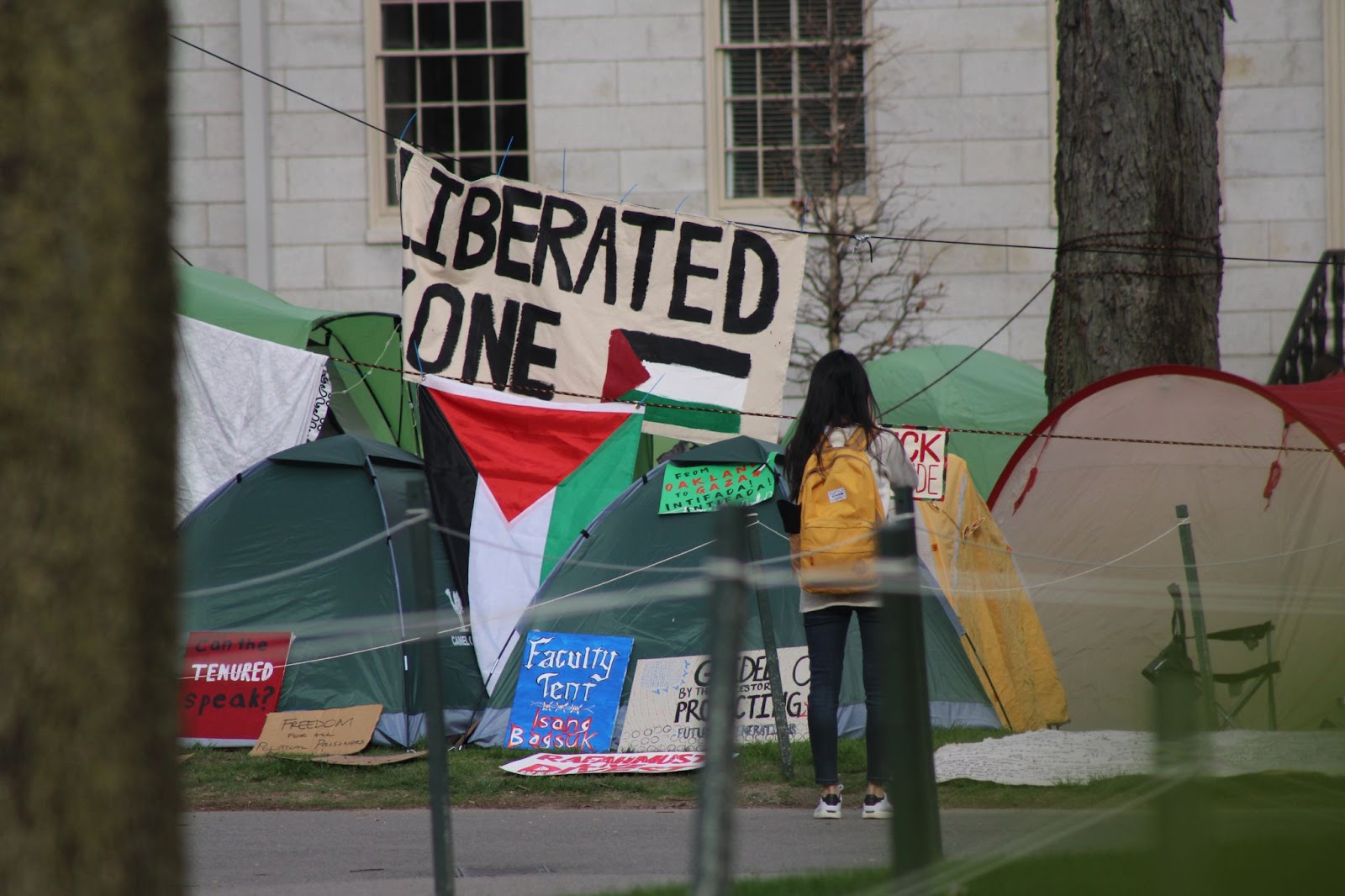
Image Courtesy of Owen Whaley ‘24
At Harvard, tents could be seen sprawled across Harvard Yard on Saturday, which administrators had closed to the public in anticipation of protests. Crowds comprising both students and faculty beat drums and chanted pro-Palestinian slogans. A mobile billboard displaying pro-Palestinian messages circled Cambridge’s streets.
But elsewhere on campus, life continued. Tourists filed into used bookstores, tobacco shops, and cafes. A comedian performed to scattered applause outside the campus center and students distributed pamphlets advertising the arts on campus. Whereas tent encampments at other schools, including nearby Emerson College, had faced crackdowns, Harvard’s police chief expressed to The Crimson that students “are protesting peacefully and it’s their right and we are going to support that.”

Photo courtesy of Owen Whaley ‘24
Other institutions have experienced more significant disruptions. Professors and students have been violently arrested at Emory University. Columbia shifted to hybrid learning amid clashes between pro-Palestinian and pro-Israeli demonstrators. The University of Southern California canceled commencement after tense protests resulted in nearly a hundred students’ arrests. Days earlier, the university had barred its valedictorian from speaking at the ceremony, citing security concerns related to her pro-Palestinian advocacy.
Holy Cross, meanwhile, has remained characteristically calm. The campus has seen virtually no protests, barring a handful of small gatherings hosted by a newly formed pro-Palestinian group called the Social Justice Collective. Students have not erected tent encampments on the Hoval or staged die-ins in Fenwick. Still, not even a small Catholic college perched atop a hill is immune from the intense divisions surrounding the War in Gaza — a fact demonstrated by the shouting match that erupted between audience members during a faculty panel held in the Performing Arts Center shortly after Oct. 7.
Amid the turmoil, college presidents are reconsidering long standing assumptions about the role their institutions ought to play within political discourse. Some, including Holy Cross’ Vincent D. Rougeau, have adopted policies of institutional neutrality — a radical shift after years of ubiquitous statements on everything from policing to the Trump presidency to the War in Ukraine. By February, Harvard’s interim president — whose predecessor had resigned after statements she made during a congressional hearing on the war ignited controversy — had been weighing neutrality, according to reports.
Rougeau has described institutional neutrality as essential to ensuring an atmosphere of “intellectual freedom and academic inquiry” at Holy Cross, one in which no community member is inhibited from “fully expressing their views or engaging in scholarship.”
But others have renounced such policies as antithetical to values of social justice and equity. “There is no such thing as neutral — you support the current state of things or you want to change them,” a Harvard Medical School instructor told the Boston Globe in March, rejecting institutional neutrality as a “smoke screen for a very clear position” of complicity in injustice.
The B.J.F. Society hosted a debate on whether Holy Cross should remain neutral on all political issues, without exception, in Dinand Library last month. Although a pre-debate poll found 53% of the audience opposed institutional neutrality, in the end, the pro-neutrality side won with 83% support.
In the short term, college administrators face another question: how to respond to the protests. “If they decide to go down the Columbia path,” Harvard Professor Steven S. Levitsky told The Crimson last Thursday, referring to the police crackdowns on the New York campus, “then I will join the protests, and many faculty will.”
Leave a Reply