Viveca Stucke ’26
Opinions Editor
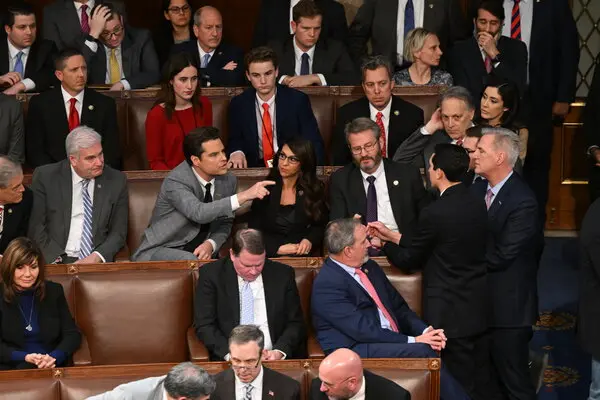
On October 5th, 2023, Kevin McCarthy, California Republican, was ousted from his role as the Speaker of the United States House of Representatives. His election as Speaker in January had been marked by the challenge of securing Republican support, where he ultimately ended up winning on the 15th ballot. Notably, this marked the first time since 1923 that a speaker election did not produce a speaker on the first ballot, demonstrating his limited popularity, which persisted throughout his time as speaker.
The vote to remove McCarthy, with a tally of 216-210, was orchestrated by Republican Representative Matt Gaetz of Florida. Gaetz, a long term rival of McCarthy, had opposed his leadership from the very beginning. This event further emphasized the existing divisions within the Republican Party, thereby shaping the political landscape in preparation for the upcoming 2024 election cycle. As the current race for the Presidency unfolds, conservatives have grappled with the challenge of uniting under one candidate, revealing a wide spectrum of Republican interests. The existing divisions were further highlighted by this, thereby shaping the political landscape in preparation for the upcoming 2024 election cycle. Following McCarthy’s removal from office, Republicans found themselves at an impasse, unable to rally behind a consensus candidate.
From an outside perspective, the fight for speakership was truly embarrassing. The inability for the Republican Party to rally behind a single candidate was a stark reflection of their present political landscape, underscoring the division within their party. Leading into the 2024 election, this is concerning for the GOP. If Republicans cannot reach a consensus on any of their 222 House members as a suitable leader, how can they hope to produce support for a singular Presidential candidate? This behavior is more than concerning, indicating a severe depletion of Republican strength, and further crumbling of their party principles.
Congressman Mike Johnson of Louisiana finally garnered the backing of the Republican Party and assumed the role of Speaker of the House on October 25, 2023. Prior to his eventual acquisition of the role, the speakership election was a three week process that involved the consideration of 4 various nominees before Republicans were able to even show a semblance of unity within their party.
Speaker Johnson’s new rise to power holds a duality of effects, characterized by his polarizing opinions but yet simultaneous capacity to strengthen the Republican body. Johnson’s values have been perceived as “far right,” generating resistance to his power because of his inability to represent the morals and needs of the party. On the other hand, there exists a potential for Speaker Johnson to act as a bridge within the party, working on reinstating more universal Republican ideals and serving the entire populace.
One of the key characteristics of Mike Johnson that has been brought to light is his religiosity, which deviates from the conventional norm of separating church and state, suggesting a possible integration of Christian ideals into his decision making processes. The Republican Party has long been associated with religious conservatism, an area of debate which has sparked controversy over the influence of religious principles on government operations. This connection was brought into sharper focus with the recent overturning of Roe v. Wade, an issue inherently linked to moral and religious considerations.
In a time where Republicans need to unite behind a singular vision and representative, Speaker Mike Johnson’s elevation to a higher level of leadership signals a potential shift in the party’s direction. Johnson’s capacity to rally support among white evangelical Christians holds significant promise, augmenting their influence on the political stage of the United States government.
However, as mentioned before, this development has the potential to trigger a backlash within the Republican Party. Centrist members, particularly those who represent swing districts may resist this new unity, particularly if they aim to maintain the support of their constituents.
Frankly, from an outside perspective, I do not believe that this new direction of the GOP is one that will be successful for them. Over the past five years, the Republican Party has been defined by events like Trump’s Presidency, the January 6th insurrection, anti-COVID policies, and far-right behavior. These developments, as well as the current public perception of the party, appear to deviate from the core values and beliefs of the base of many contemporary conservatives, which distorts their convictions and interests. By adding Mike Johnson into the mix, the negative public image of the GOP will be exacerbated, generating perspectives that the Republican Party is veering further to the right, rather than actively working to bridge the divides in our nation.
Featured image courtesy of The New York Times
Leave a Reply