Julianna Mariani ‘24
Nathan Howard ‘25
Editors-in-Chief
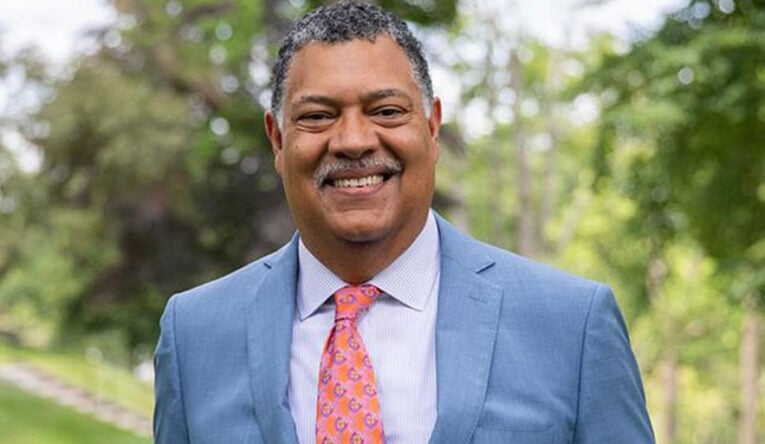
On Friday, November 3rd, The Spire spoke with President Rougeau for our monthly interview. Now that the semester is well under way, we decided to ask him about some current events on and near The Hill.
During the afternoon on Saturday, October 28th, the Holy Cross community got an email stating that there was a shooting on Worcester State’s campus on the night of Friday, October 27th. It was stressed that there was no threat to Holy Cross, but with the recent shootings in Maine being at the forefront of the conversation on gun violence, as well as the fact that it was an especially active “Halloweekend” for students on The Hill, the news was jarring. We asked President Rougeau to speak further on these events, wondering if there was anything he could say to ease fears of the campus community as we navigate a difficult period of uncertainty concerning firearms in the United States.
President Rougeau began by stating “We live in a country that has a serious problem with gun violence, and none of us can be truly safe in the face of a situation in our country where there are guns everywhere and mass shootings have just become a regular part of a very sad cycle of violence in our country. Now that being said, I think we can feel some confidence that here in Massachusetts, we’re in one of the safest places in the country when it comes to gun violence and I think we can also say that our campus here at Holy Cross is remarkably safe. We take a really serious and multi-pronged approach to keeping the campus safe. We have a great Department of Public Safety that is a state certified police department. So they have the ability to really monitor what’s happening in terms of criminal activity, safety activity around the city, around the state, and around the country. They’re very responsive to incidents and issues that occur on the campus and on the periphery so that they can do their very best to keep us all safe.”
With those reassuring comments in mind, President Rougeau also went on to emphasize the importance of safety further. “I think we all have to remember that safety is everyone’s job here. We all have to be alert…I think it’s also important to remind the students too, we do live in an urban space. And even though we feel very protected up on our hill there are just a lot of people around us and a lot of things happening around us…We certainly want to recognize in particular the tragedy that happened in Maine so close to us. But my call out to the students is we all need to think of how we, as citizens and as concerned individuals, work together to really see change in our country around guns and around gun violence.”
On a more positive note that involves being part of Worcester, in our last meeting with President Rougeau, he discussed the ways in which Holy Cross encouraged connections with the greater community during Family Weekend, such as providing guided tours of the Worcester Art Museum. We asked him to elaborate further on our connections with the city. He began by discussing our academic relationships with other institutions within Worcester, “We have our new 4+1 engineering program with Worcester Polytech; through the Physics and Math Department and Computer Science Department, a student can be on a five year track to get a master’s in engineering. You would spend your senior year taking courses at Holy Cross and at WPI and then your fifth year at WPI, and then you graduate with a master’s.
We’re also doing a 4+1 one master’s in teaching with Clark University. So again, you can take your Elementary Education Minor at Holy Cross and through this five year program actually get a master’s in teaching in one year post graduation. That’s incredibly exciting to me, because one of the things I want to make sure we remember is we want to be a top-notch, excellent liberal arts college, and we are focused on undergraduate education, but that does not prevent us from creating these great partnerships with our neighbors who specialize in other things and working together. We can make sure that our students have these amazing pathways that allow them to take the full advantage of being at an undergraduate college, but then also take advantage of great institutions in our community that can provide them with graduate level training. We also have a new partnership with UMass Chan Medical; summer clinical and research opportunities for students that allow them to have introductions to medical and medically related careers. And it’s particularly geared to students who come from communities that are traditionally underrepresented in medicine.”
Aside from the world of academia, President Rougeau also mentioned, in regards to Worcester, “I had a great meeting with the city manager again to talk a little bit about how we can be great partners around this Worcester pillar in our Aspire plan. And to really hear from him about what the city hopes to see from our relationship. It’s not just about us telling Worcester what we are going to offer Worcester, or here’s how we plan to help, but also hearing from Worcester’s leaders about how they would like to work with us.
And just a couple of days ago we had the celebration of faculty scholarship, where we focused on our scholarship in action in the city of Worcester. And had presentations from a number of faculty members who were doing collaborative scholarship in the city. And we also had a panel with Worcester leaders who talked about the things they’d like to see us work on going further. So those are just a few examples of, I think, already really interesting and rich work that’s happening.”
Moving away from the greater Worcester area, our next question focused specifically on Holy Cross. This past Monday, November 6th, marked the beginning of the enrollment process for next semester. This can be a stressful time for students as they strategize and plan their college careers, for the class of 2024, their last enrollment period is a bittersweet event. STAR was recently updated to become more user friendly, although it has presented an experimentation process as students navigate the new system. We asked President Rougeau to give some advice to students as they enter this period and to talk a bit about the new STAR updates. President Rougeau began humbly with, “Well, I know STAR is still a work in progress, but we’ve made some important improvements, and we’re going to continue to work on those. I would encourage students to engage with Patricia Ring and the Registrar’s Office to get more detailed information about what’s working, what they need, and what kinds of issues they’re having trouble with, so that we can continue to make improvements. From my perspective, just know that we get the fact that more needs to be done to make STAR better, or to make registration easier. So we’re going to continue to evaluate as we monitor how these improvements have gone. We’ll see if we can make more changes and keep getting better, I hope!”
We then discussed the College’s continued focus on art education. While the new Prior Performing Arts Center provides many exciting opportunities for performing arts, as well as exhibits in the Cantor Gallery, we asked President Rougeau if there is anything else in the works specifically catered towards visual or historical arts studies that we may not have heard about yet.
President Rougeau responded by saying that “I think the big news there is that we appointed a new director of the Cantor Art Gallery, Lauren Szumita, who is still settling in. And, hopefully, she’ll have an opportunity to assess what kinds of programming in the visual arts we might add. Additionally, we do have an exhibit right now that’s being curated by one of our faculty members, Rachelle Beaudoin who is showcasing the artist, Corita Kent. Also, I know that the director of the PAC, Professor Frisina, is working with the Visual Arts department directly in regards to mounting exhibitions of student work.”
President Rougeau added that “We have this new performing arts space, but we’re also showcasing a new commitment to the arts in general. So I think student voices are going to be really important in terms of giving us a sense of what people are interested in, for instance, where we should have more programming and maybe where we might need less programming. My hope is that we’re going to see a lot more students who have strong interests in the arts coming here because of this new commitment.”
The conversation then moved to the October 25th “Violence in Israel and Palestine” faculty panel discussion that was organized and co-sponsored by the Middle East Studies and Peace & Conflict Studies programs. Throughout the event, there were obvious tensions between students and faculty members who expressed differing viewpoints regarding this conflict. Despite this, many students still found the event to be enriching, especially since the panel created a space in which critically examining the conflict was encouraged, regardless of differing opinions. We asked President Rougeau about the importance of these difficult discussions and why they are essential for our campus community.
President Rougeau responded by saying “First, I want to point students to the statement I put out that I think just highlights, at a high level, my values and the college’s values. And for more detail, Provost Visconsi’s statement about academic freedom, which is a little bit more into the finer detail and the more academic detail. But I think it’s an important piece for the students to read because I think it’s framing who we are and what we believe as an academic institution. And academic freedom is central to that, so we want to make sure that everyone understands what those values are and what our commitment is to freedom of expression in the context of being an academic institution. Now that means that, as you mentioned, there are going to be some really hard conversations. And so how do we think about those conversations in the context of who we are as both a college, and additionally, as a Jesuit Catholic college? So I think what’s important to remember is that the academic enterprise is designed to surface ideas that sometimes are really unpopular or really challenging because they counter the prevailing wisdom. That’s what we want scholars to do. That can also produce conflict. But in the context of conflict, we want to remember who we are as a Jesuit Catholic college.”
President Rougeau added that “Our respect for one another, the dignity of one another, and our commitment to non-violence are all central to our values. So we don’t tolerate threats and violence. We have to learn how to speak to one another in a way that perhaps may get emotional, sometimes we can’t help that, but it’s never designed to produce a threat or a feeling that a person cannot speak freely. And we will hear things that we may not like. But we should not be thinking about shutting down ideas that make us uncomfortable. We should be thinking about: How do I respond to ideas that make me uncomfortable? How do I triumph in the battle of ideas? How do I sometimes need to change? Because ideas can also reshape the way we think. I really want to invite all the students into a really deep and meaningful participation in that work. I’m proud of how our students have responded to the panel because it was difficult. I think students have been really open to hearing more and to thinking deeply and that’s what we hope for. So, I hope we can continue to engage in meaningful conversation around these topics and I want to just end by saying it is really, really hard. There are a lot of people for whom this is not theoretical. These are issues, be it Palestine, Israel, be it Maine with gun violence, that are affecting their lives deeply. And, we have to be sensitive to that when we take on these questions, but we also have to remember why we’re here. So we’re going to all work together to make sure that we do our absolute best in that regard.”
We closed on a more lighthearted note, asking President Rougeau about any November or Thanksgiving-related traditions that he is currently looking forward to. With a smile, he said that “I always look forward to Thanksgiving because it begins this great season of eating. For our family, it’s really a time when we enjoy pulling out these old family recipes and remembering people that we loved, who are maybe no longer with us, but living still with us through food.” He concluded by saying that “We are very blessed in so many ways, and it’s a great time to remember that and to be with people that you love and to just feel thankful for the many, many things that we have to celebrate even in difficult times.”
Featured Image Courtesy of Catholic Charities Boston
Leave a Reply