Will Donahue ‘24
Chief Copy Editor
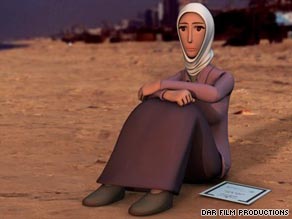
For some reason, I recently had an urge to seek out Palestinian art. A quick Google search and a YouTube link brought me to “Fatenah” (2009), the first ever 3D animated film made in Palestine. Written and directed by Ahmad Habash, the 30-minute film tells the story of a young woman living in Gaza who wants nothing more than to live a regular life with her loved ones. But after being diagnosed with breast cancer, she must confront the obstacles of her environment – from financial troubles, to undersupplied hospitals, to Israeli border patrols – in order to receive life-saving medical treatment.
I was honestly not expecting much from “Fatenah” before watching. A quick look at the animation style is enough to know Habash was working with tight resources here. Combine that fact with a low-resolution YouTube upload, and I knew I would not be in for a dazzling animated spectacle. To an extent, I was right; “Fatenah” is not visually spectacular. But frankly, I do not care. This movie could have been the ugliest piece of garbage to ever curse my eyes and I would have watched it front to back. Because Palestinian movies – good movies, bad movies, and everything in between – deserve to exist. And they deserve to be watched.
But more than that, I want to do my best to support international, adult-oriented animation. The phrase “animation is cinema” gets thrown around somewhat carelessly for my liking, but it is objectively true; animation is just as capable of depicting reality as live-action. It is not one genre, but a medium encompassing countless genres of film. “Fatenah” is a testament to this statement; its depictions of love, loss, and life under occupation are a far cry from the family-oriented fare of mainstream American animation. That’s not to say those movies are somehow “worse” – I don’t think anyone could say that when Spider-Man: Across the Spider-Verse exists. But they are not all that animation is.
While I enjoyed “Fatenah,” I almost chose not to write about it at all. I had initially searched for something more upbeat – something that would shine a light on Palestinian joy and leave all the violence behind. I wanted a movie that would show it is possible to talk about Palestine without also talking about the horrors of current events. But that search did not go well; most of the movies I found dealt with violence, war, and tragedy in one way or another. To be honest, I should not have expected anything else. Violence is inescapable in Palestinian cinema because violence is inescapable in Palestine. And until Palestine is free, that violence will remain inescapable.
The featured image is courtesy of CNN.
Leave a Reply