Martha Wyatt-Luth ’25
Staff Writer
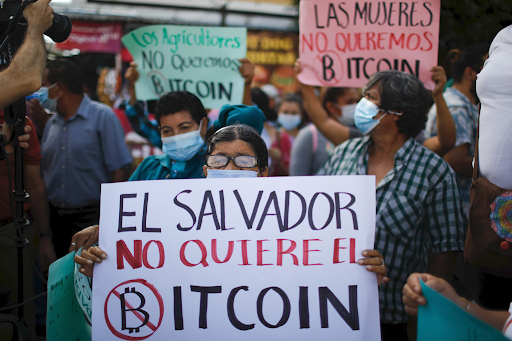
On Sept. 7, 2021, El Salvador made one of the biggest economic gambles in history. The young and audacious El Salvador President, Nayib Bukele, adopted Bitcoin as legal tender, requiring all businesses to accept bitcoin as payment. With, according to the World Bank, only 33 percent of the world population being financially literate, why would adopting such a cutting-edge currency be a wise decision?
The adoption of bitcoin provides several advantageous opportunities for El Salvador. The primary benefit of adopting a nonbanking currency is that El Salvador will no longer have to deal with the hassles of transporting physical cash or using middle-men—banks or non-banking providers—such as Western Union. No longer having a middle-man with currency transactions has also decreased the ability for fraud and corruption to occur. This can be a tremendous benefit for the economy. Since the 1930s, immigration to the U.S. has been rising, with now, over 1.5 million Salvadorans migrated over. Many of these individuals send money back to the rest of their families still living in their native country. The new President, Nayib Bukele, hopes that Bitcoin will make this vital process smoother for people to transfer money internationally.
However, the chances of bitcoin becoming the primary source of currency in a country still seems unlikely due to its volatility. The currency has reached an all-time high of nearly 65,000 U.S. dollars in April, but as of Sept. 20, it has fallen to 44,050.70 U.S. dollars. Public panic, often caused by political or environmental crises, makes the value of bitcoin drop dramatically, which works quite similarly to the U.S. stock market. If bitcoin’s value suddenly drops, Americans would be furious. But whose fault would it really be?
A unique characteristic of Bitcoin, which makes it less attractive to politicians, is that it’s a decentralized network. Thus, it is harder to control than a country’s current legal tender. Countries often settle their either inflated or deflated currency by controlling the amount of money printed. If too much money is printed, hyperinflation could occur. Cutting back on that print production, or gradually pulling money out of circulation through banks, alleviates this issue. In addition, countries with strong economies often use a floating exchange rate which allows the market to dictate the exchange rate with foreign, often less stable, currencies. These processes are far more challenging when dealing with bitcoin. In fact, they could potentially be impossible for governments to control. So the drop in value of bitcoin would really be the consequence of our own actions.
Considering how divisive our country has become in the last decade, I doubt we have the unity needed to withstand the untame powers of Bitcoin. But that doesn’t necessarily mean Bitcoin doesn’t have a role in the global economy. Bitcoin could be incredibly useful as a secondary legal tender in economies. It’s an asset many countries know will only become increasingly valuable as our world dives further into technology.
Due to simplifying global transactions, Bitcoin could increase economic activities. This has already shown to be a benefit for a country like El Salvador that was in a parallel situation twenty years ago. As of January 2001, El Salvador has been officially using the U.S. dollar as legal tender, rather than their colón, in hopes of joining the global market with a front-row seat. The aim was for dollarization to incentivize individuals to invest in El Salvador’s various economic ventures and settle the country’s volatile currency. The colón had been experiencing an extreme devaluation known as hyperinflation. Adopting the more stable U.S. dollar as national currency dramatically improved El Salvador’s economy. Soon enough, Salvadorans adjusted to their new way of life with the U.S. dollar. Who’s to say the same can’t be done with cryptocurrency?
Bitcoin is also, for better or for worse, driving a new age of individualism in the economy. As of 2021, over a third of the world’s population is unable to access banks, and therefore cannot pursue opportunities such as loans, savings, checking accounts, wiring transactions, and more. Having a cryptocurrency allows individuals to access their money and these previously inaccessible banking services completely online. And with the ever-increasing existence of technology, individuals all across the world have access to information at the touch of their fingertips. The adoption of Bitcoin as legal tender could empower individuals to become autonomous financial decision-makers
Many successful entrepreneurs know these grand benefits that Bitcoin has to offer. With the help of these powerful investors, such as Barry Silbert and Elon Musk, there is no doubt that bitcoin is here to stay. So however brazen this El Salvador President Nayib Bukele may seem, he may be the most business-savvy trendsetter of the year.


Leave a Reply