Brigid O’Malley ’29
Guest Writer
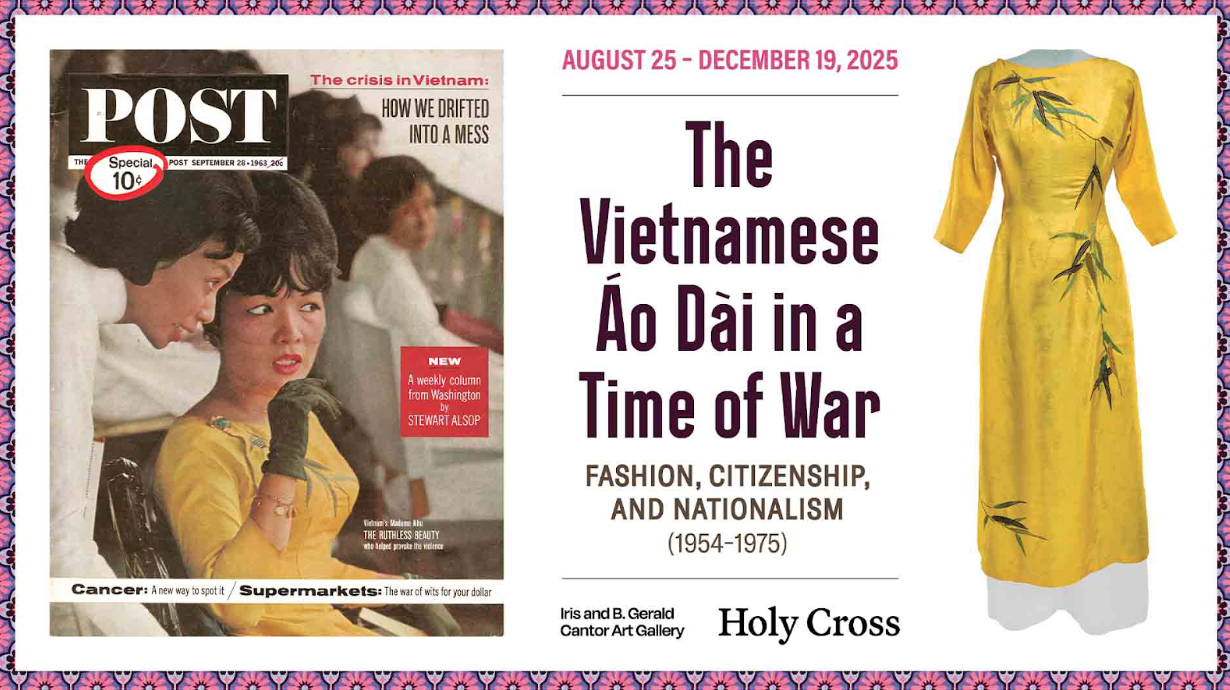
The Prior Performing Arts Center is now home to The Vietnamese Áo Dài in a Time of War: Fashion, Citizenship, and Nationalism. Several áo dài (pronounced “ow yai” or “ow zai”) are on display at the Cantor Art Gallery, including pieces once worn by prominent political figures and actresses of the last century. Leading up to the opening, Holy Cross professor and co-curator Ann Marie Leskowich welcomed co-curators Professors Martina Nguyen (Baruch College) and Tuong Vu (University of Oregon), designers Si Huang and Thai Nguyen, and legendary actress Kieu Chinh to the Hill for discussions on fashion, culture, history, and the áo dài.
The áo dài, a long tunic with high slits worn over trousers, is Vietnam’s national dress, but its story stretches far beyond the country’s borders. At the exhibit’s opening panel, designer Thai Nguyen spoke about its meaning for the diaspora: “For a very long time, I had to shun my identity so I could fit into the American culture, into the fashion industry’s standard.” Told not to use his Vietnamese name and to leave the áo dài out of his collections because it was “too ethnic,” Nguyen went on to design gowns for celebrities like Jennifer Lopez and Katy Perry. “I would never be able to make American fashion history,” he said. “But this exhibition today gave me an opportunity to be a part of that history as a Vietnamese diaspora.” His designs honor “the silhouette, the culture, the history,” while making the aó dài accessible for Vietnamese Americans.
The second day of the opening featured a conversation between Nguyen and Kieu Chinh, a trailblazing Vietnamese American actress. After fleeing North Vietnam in 1954, Chinh began her film career at just 18 and went on to star in over 100 films and TV shows, breaking barriers at a time when Asian actors were often sidelined or stereotyped. Even after seventy years in the U.S., she continues to honor her heritage through her foundation, the Vietnam Children’s Fund, and through her style. Chinh has worn an áo dài to every red carpet for the last 20 years, each one painted to reflect her latest film. One of her áo dài, designed by Thai Nguyen, is currently on display in the exhibition.
On the significance of the exhibition, Professor Leskowich emphasized the garments’ role as living storytelling. “The garments, the fibers, contain memories and evoke the memories of other people who can engage with them,” she said. Beyond memory, the áo dài carries political weight: “as the exhibition’s title reminds us, it has functioned as ‘fashion in a time of war,’ a tool of resistance, identity, and power.” By seeing these pieces up close, visitors hear these stories and are welcomed into the history, present, and future of the áo dài in global culture.
Several áo dài, including those worn by Madame Nhu and Kieu Chinh, as well as those designed by Thai Nguyen and Si Hoang, are currently on display at the Prior Performing Arts Center in the Cantor Art Gallery. The exhibition is free and will be open until December 19, 2025.
Featured image courtesy of College of the Holy Cross
Copy Edited by Gail Durkin ’26
Leave a Reply